
Six U12 Drills That Progress From Passing to Game Pressure
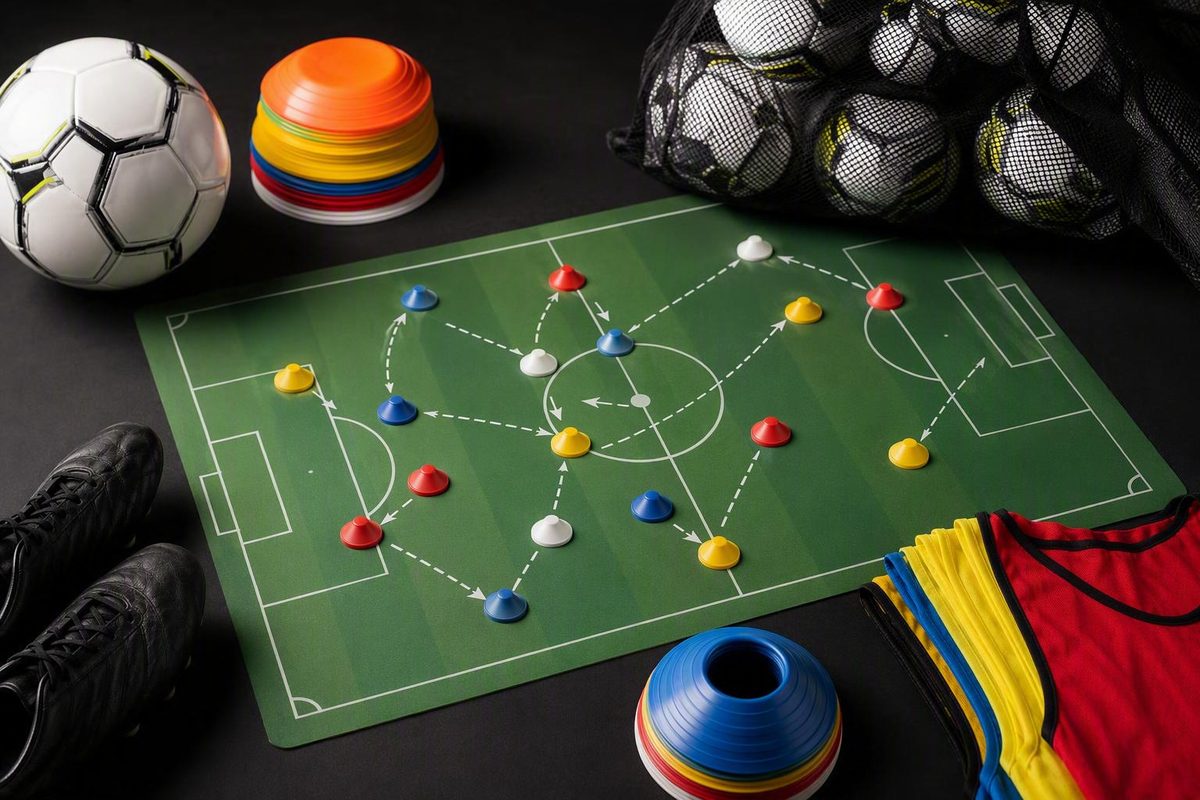
Six U12 drills with timings, layouts, easier and harder versions, a planner for any squad size, and what the research on 12-year-olds actually shows.
Soccer drills for 12-year-olds work best as a progression: rehearse receiving and passing for a few minutes, then add defenders, direction and scoring until players have to apply the skill in a game. The 60-minute session below does that in six activities — a ball warm-up, two-touch passing, passing through defenders, 2v1 attacks, 5v5 gate possession and a directional game — and each one has an easier and a harder version. The timings and dimensions are a coaching template to adjust for attendance, space and readiness, not a research-validated training dose; the evidence on U12 practice design is thin, and it is covered at the end.
The 60-Minute U12 Session at a Glance
| Time | Activity | Purpose |
|---|---|---|
| 0–8 min | Progressive movement with a ball | Raise intensity gradually while changing direction and handling the ball |
| 8–16 min | Two-touch passing in pairs | Prepare the ball with the first touch, pass accurately with the second |
| 16–26 min | Passing through defenders | Scan, move and find a route through pressure |
| 26–36 min | 2v1 attacks | Decide whether to dribble, pass or shoot |
| 36–48 min | 5v5 gate possession | Keep the ball and recognize an open scoring gate |
| 48–58 min | Directional small-sided game | Apply the theme while attacking, defending and transitioning |
| 58–60 min | Water and player review | Ask what players noticed; reinforce one idea |
Equipment: balls, bibs and enough cones to mark several small gates. Full-size goals and goalkeepers are optional.
The eight-minute opening is not the complete FIFA 11+ or a proven injury-prevention dose, and the block lengths are editorial defaults rather than research-established prescriptions for 12-year-olds. Shorten explanations to protect playing time.
Enter your player count and session length; the schedule and group formats update below.
U12 session planner
| Start | Drill | Min | Format for 10 |
|---|---|---|---|
| 0 | 1. Ball warm-up | 8 | Every player with a ball; pairs share if balls are short |
| 8 | 2. Two-touch passing | 8 | 5 pairs |
| 16 | 3. Pass through defenders | 10 | 1 area of 2+2v2; 4 extra in end groups of three or four |
| 26 | 4. 2v1 attacks | 10 | 3 lanes of 2v1; 1 rotating in |
| 36 | 5. Gate possession | 12 | 5v5 gate game |
| 48 | 6. Directional game | 10 | 5v5 |
| 58 | 7. Water and review | 2 | Whole group |
Space defaults and how to adapt them
- Drill 2: partners ~8–10 yd apart.
- Drill 3: ~24 × 15 yd in three equal bands (editorial default).
- Drill 4: ~20 × 15 m per lane, shot within four passes (FIFA session).
- Drill 5: ~30 × 25 yd with six gates ~2 yd wide for ten players (editorial default).
- Drill 6: ~30 × 25 yd for 5v5; shrink field and teams together if space is short.
- Enlarge any area if players cannot look up and connect passes. Cut players per area before adding touch limits. Change one variable at a time.
Minutes are the article's 60-minute defaults scaled to your session length; formats follow the adaptation table. Planning defaults, not research-validated U12 doses. Area sizes: FIFA Training Centre sessions and editorial defaults.
The sequence follows one logic: prepare physically at rising intensity, rehearse receiving and passing without heavy pressure, introduce defenders and passing decisions, create an attacking overload, retain possession under pressure, then finish with direction, scoring and transitions.
Use one coaching rule throughout: stop briefly for one useful cue, then restart and let the players solve the task.
Drills 1 and 2: Warm Up, Receive and Pass
Drill 1: progressive ball warm-up. Give every player a ball; if equipment is short, work in pairs and switch the active player often. Start with easy dribbling, jogging and direction changes. Add controlled lunges, skips or lateral steps, then increase the speed of turns, touches and short accelerations.
Intensity should rise across the eight minutes rather than starting with maximal sprints. The final actions can be quick, but movement quality stays controlled. A simple split is two minutes each of easy movement and free dribbling; direction changes and dynamic mobility; turns, sole rolls and changes of pace; and quicker ball actions with short accelerations. If players need longer to settle, simplify the sequence rather than rushing it.
Drill 2: two-touch passing. Place partners roughly 8–10 yards apart as an adjustable start. The receiver uses the first touch to prepare the ball and the second to return it. After passing, both players move: adjust to a new angle, step around a cone or check away before returning.
Coach five cues: scan before the ball arrives; receive side-on when the situation allows; direct the first touch into the space the next action needs; match pass weight to distance and teammate; use both feet.
For beginners, shorten the distance, drop the speed demand and allow extra touches. For experienced players, require movement to a new cone, add passive pressure or place a small gate the first touch must exit through. Do not impose one-touch passing because two-touch looks comfortable; add difficulty only while players can still read the situation and make useful decisions.
Keep this activity heading-free. Players can receive with feet, thighs or chest while the coach confirms the heading rules that apply to the team.
To monitor the drill, count how many first touches prepare the next action without a recovery touch. That is a coaching observation, not a validated test of learning. Use it to decide whether to change distance or pressure, not to rank players publicly.
Drill 3: Pass Through the Defended Middle
Mark two end zones separated by a middle zone. Start with two players in each end and two defenders in the middle, a 2+2v2. The end-zone players pass and move until an opening appears, then try to play through the defended band to the far end.
An adjustable first layout of roughly 24 by 15 yards, divided into three equal bands, gives a workable reference point. It is an editorial default, not a FIFA specification or an evidence-based U12 standard. Enlarge it if players cannot look up and connect passes.
If the defenders block or intercept, rotate them with the end team that lost possession. With more players, expand the end groups to threes or fours instead of building a queue. FIFA’s age-targeted version lets coaches begin by rolling or throwing the ball, then restore foot passes once players see how passing inside an end zone moves defenders and opens a route through the middle (FIFA Training Centre).
Make the zones generous at first and reduce space only when players complete the task too easily. Leave a safe gap between parallel areas. A first-time pass through the middle is an advanced progression, not a rule; if it produces repeated turnovers without useful scanning or movement, return to two or more touches.
Ask rather than prescribe: How can passing within the end zone open space in the middle? Which type of pass fits the opening? What clues can defenders use to predict the pass? Take a few answers, restart promptly and watch whether players apply their ideas.
Drill 4: Attack a 2v1
Where space permits, create parallel lanes of approximately 20 by 15 metres. Two attackers enter against one defender and try to reach a shot within four passes. Use a full goal, cone goal or end zone depending on equipment and goalkeeper availability. The area and the four-pass condition come from a FIFA coaching session; they are constraints to adapt, not evidence that this format is optimal for every 12-year-old (FIFA Training Centre).
Rotate roles after every attack so everyone attacks and defends. Run two or more lanes when numbers allow. A new attack starts when the previous shot is taken, the ball leaves the area or the defender wins possession.
Coach the decision, not a set passing pattern. The ball carrier attacks the available space, commits the defender when possible, passes when the teammate becomes free and continues into a supporting or finishing position. The second attacker creates a visible passing angle rather than hiding behind the defender. The defender delays, protects the most dangerous route and recognizes when a poor touch invites a press.
Easier: widen the area, start with passive defending or allow more than four passes. Harder: narrow the area gradually, add a transition gate for the defender after a regain or remove the pass limit so attackers must judge the moment themselves.
Drills 5 and 6: Gate Possession and a Directional Game
Drill 5: 5v5 gate possession. Scatter several small cone gates around the area. Two teams keep possession and score when a pass travels through a gate to a teammate. Kicking through an empty gate does not count.
For ten players, an adjustable start is about 30 by 25 yards with six gates, each about two yards wide, spread through the area rather than pushed to the edges. These are practical defaults, not dimensions validated for U12 training.
Restart with a pass from the sideline when the ball goes out. After a point, let the scoring team keep the ball and attack another gate so play continues without a long reset.
Look for movement after passing, support on different lines, an open receiving shape, early recognition of an unguarded gate and a change of direction when one route becomes crowded. Do not stop play because a player found a different solution from the one you expected.
Easier: widen the gates, enlarge the area or give the possession team an extra player. Harder: narrow the gates, shrink the area or reward a purposeful weaker-foot pass. FIFA also lists a second ball as a progression; use it only when players scan safely and the activity stays controlled.
Drill 6: directional small-sided game. Finish with 3v3, 4v4 or 5v5 using two end zones, two pairs of cone goals or appropriately sized goals. A field around 30 by 25 yards is an adjustable start for 5v5; reduce both field and team size if space is limited.
Keep restarts simple: pass or dribble in from the sideline, restart quickly from the defending end after a goal and keep spare balls nearby. Play rounds of roughly two to three minutes with a brief interval for rotation or one cue. Those round lengths organize the session; they are not research-established work-to-rest ratios.
Tie one scoring condition to the session theme: a normal goal scores one with a bonus for a line-breaking pass; a team scores by receiving under control in an end zone; or a goal earns a bonus if the attack included a pass through a gate. Avoid stacking touch limits, fixed zones and several bonuses at once.
Rotate waiting teams promptly. Goalkeepers can support the team in possession or defend suitable goals rather than spending the session isolated from the passing theme.
Adapting the Session for Six, Eight, Ten or More Players
| Situation | Adjustment | Why |
|---|---|---|
| Six players | Three pairs, two parallel 2v1 lanes, then 3v3 | Everyone active, no neutral players needed |
| Eight players | Two groups of four, 2v2 or 3v1 possession, then 4v4 | Frequent involvement |
| Ten players | Run the 5v5 gate game | Balanced opposition, no waiting group |
| Larger squad | Parallel fields | No long lines |
| Limited space | Cut players per area before adding touch limits | Smaller groups keep room to perceive and act |
| No goals or keeper | Gates, end zones or dribble-through goals | Keeps direction and scoring |
| Beginners | More space, less opposition, more touches, simpler scoring | More time to scan and execute |
| Experienced players | Reduce space gradually, balance numbers, add transition goals | More pressure with realistic choices |
| Mixed ability | Adjust pressure, space or task per player | Confidence, maturation and injury history differ |
For mixed-ability teams, avoid publicly sorting players against a single age-based standard. One player may need a passive defender; another may need less space or a transition target. Both can work on the same theme.
A constraint has stopped helping when you see repeated failure, players watching only the ball, deteriorating movement quality, confusion about several rules at once or long periods without involvement. Soften or remove the restriction instead of demanding more speed.
Change one variable at a time — space, numbers, pressure, gate width or scoring. If several conditions change together, you cannot tell which adjustment helped.
What the Research Supports for 12-Year-Olds
The most directly age-relevant intervention is a six-week exploratory trial of experienced male sub-elite U13 players with a reported mean age of 12.16 years. The dynamic–ecological group used variable tasks, guided exploration, decision games and 2v2 through 5v5 play; the traditional group emphasized analytical technique and fixed repetitions. The dynamic–ecological group improved more on several short-term physical tests, including the standing long jump, left-leg hop, 10-metre sprint and shuttle run (read the U13 trial).
That does not prove game-like practice produces better players. The trial was small and short, used experienced male outfield players from two sub-elite schools and bundled many differences into each program. It did not establish superior match performance, technical retention, enjoyment, injury prevention or long-term development, and its findings should not be assumed to transfer to girls, goalkeepers, beginners or injured players.
A separate eight-week study in male players around age 15 compared maximum-intensity skill stations with 3v3 games. Both groups improved on several physical measures, and the skill-based group improved more on most reported measures. That small, older sample does not settle what is best or safe for 12-year-olds, and better physical test scores are not proof of better match play (review the study).
So the practical conclusion is not a winner between drills and games. Treat them as complementary: rehearse a useful action briefly, then test it against opposition, direction and scoring. Keep the evidence types separate. FIFA supplies credible age-targeted organization, questions and progressions, but that does not show a particular drill improves performance. Commercial drill pages offer ideas, but a “U12” label validates nothing. Intervention studies measure narrow outcomes in narrow populations.
Heading Limits, Injury Risk and Safeguarding
Use a no-heading default for this session. Under the cited U.S. Soccer policy, players aged 11–13 may spend no more than 30 minutes per week practising heading. U.S. Soccer also reports a 25.6% decline in pediatric soccer-related concussion emergency-department visits between selected pre-policy and post-policy periods. That is an observed association; it does not show the heading policy caused the whole reduction (U.S. Soccer Learning Center).
The 30-minute limit is a U.S. policy, not an international rule or a medical safety threshold. Before introducing heading, check the current requirements of your club, competition and national association.
Leave safe separation between adjacent areas. In the United States, U.S. Soccer’s framework limits certain one-to-one interactions between adults and minors and places policy or screening obligations on covered participants and member organizations; consult the full U.S. Soccer Safeguarding Hub rather than treating a session plan as compliance guidance. Elsewhere, follow the safeguarding and reporting rules of your own organization.
Training carries injury risk, and general content does not replace a qualified coach or physiotherapist who can observe and assess a player directly, as stated in Soccer Science’s training disclaimer.
How Often 12-Year-Olds Should Run This Session
There is no research-established weekly frequency for this session. The relevant studies used different populations, schedules and programs, so neither protocol is a universal U12 prescription.
Fit the activities within the team’s existing training and match load. Revisit the theme often enough that players meet it again, but vary the pressure, space and game context rather than reproducing every minute. A coach who sees the players directly should modify the plan when readiness or movement quality does not suit the intended challenge. The aim is not a magic set of drills; it is repeated chances to scan, decide and execute at the right level of challenge.