
A Practical Passing Session From Technique to Game Pressure
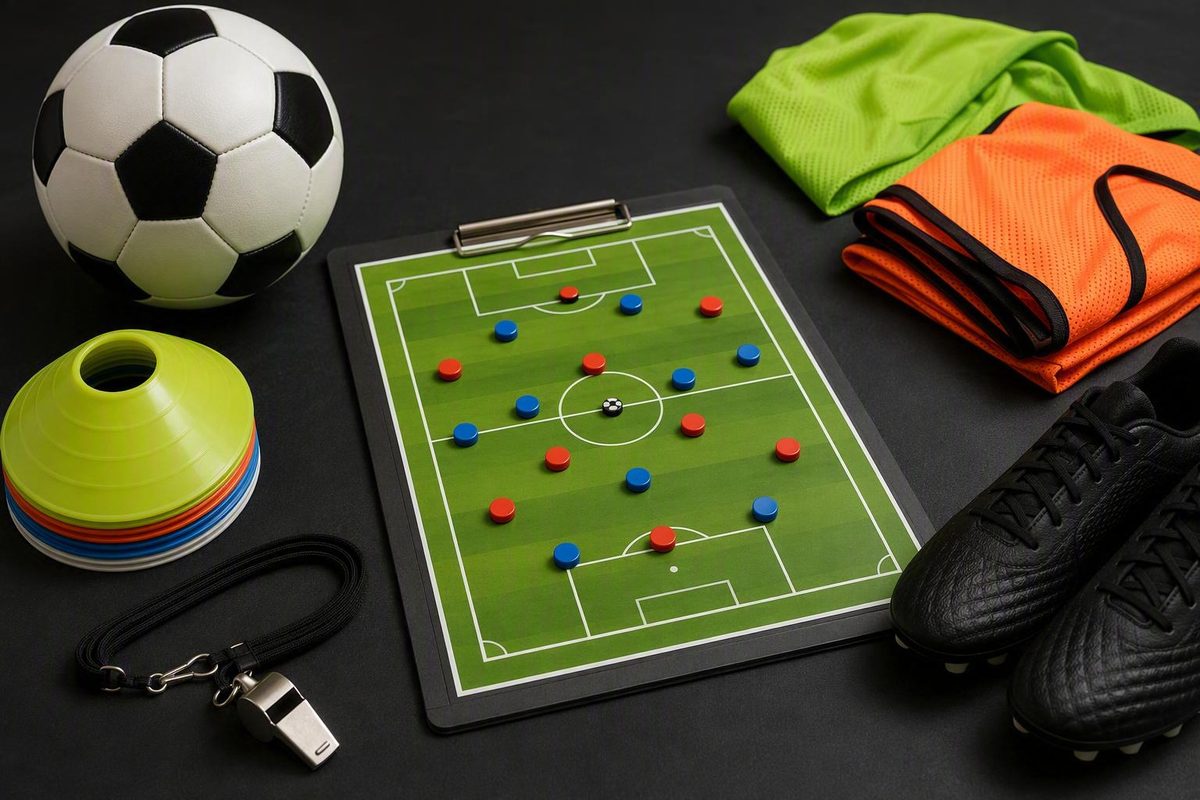
Move from controlled pair work to a conditioned game, with practical setups, coaching cues, adaptations, and observation measures.
Choose the activity that matches the problem your team needs to solve, establish accurate passing and receiving, and then add movement, pressure, direction, and choice. These six passing activities for soccer progress from controlled pair work to a conditioned game, with practical setups, coaching cues, adaptations, and observation measures. All dimensions, timings, scoring rules, and progressions are adjustable, coach-created starting points—not proven or optimal training protocols.
Start here: choose an activity by goal and group size
Passing practice should develop more than the mechanics of completing a pass. Players need to recognize when, why, and how to pass: retaining possession when forward play is unavailable, progressing into useful space, bypassing defenders, or creating a chance. Technical feedback should therefore be combined with scanning, body position, movement, timing, decision-making, and communication.
| Activity | Players and equipment | Pressure and time | Primary objective |
|---|---|---|---|
| Pair scan-and-pass | 2; ball and four cones | None; about 6 minutes | Receive and pass accurately while using visual information |
| Triangle pass-and-follow | 3; ball and three cones | None; about 6 minutes | Improve receiving shape, movement, and continuous support |
| Moving gate passing | 4 in two pairs; two balls and cones | Low traffic pressure; about 6 minutes | Weight and time passes for moving teammates |
| 4v1 keep-away | 5; ball, four cones, and bibs | Active defender; 6–7 minutes | Retain possession and play around pressure |
| Directional possession | 4v4 plus targets; ball, cones, and bibs | Active and directional; about 10 minutes | Progress from one end to the other |
| Conditioned small-sided game | 4v4; ball, bibs, cones, and goals or end zones | Match-like; 5–15 minutes | Break lines, combine, switch play, and create chances |
Use the table as a menu rather than a compulsory sequence. Choose one of the first three activities for a technical introduction, 4v1 for retaining possession, or directional possession for ball progression. Use the conditioned game to connect line-breaking passes, combinations, and switches with chance creation.
Three low-pressure activities for passing and receiving
The distances and work periods below are suggestions. Adjust them for the players’ control, physical capacity, available space, and session objective.
Activity 1 — Pair scan-and-pass
Setup: Place four cones in an 8–12-metre channel, with two cones available to each player. Use two players and one ball. Position two colored or numbered markers behind each receiver, or have a coach stand behind them and display a signal.
Rules and duration: Before receiving, the player checks over a shoulder and identifies the external cue. That cue determines the nominated foot, first-touch direction, or next cone. The player controls the ball, passes accurately, and moves to the other cone. Continue for three 90-second rounds with brief resets.
Coaching cues: “Find the information before the ball arrives.” Adopt a body position that preserves more than one option. Choose a suitable part of the foot, guide the first touch, and use enough weight to reach the target without forcing the receiver to retreat.
Easier: Shorten the channel and use the cue only to nominate the receiving foot.
Harder: Display the cue later, or make it determine both the first-touch direction and the player’s next cone.
Observe: Record whether the player identifies the cue and uses it correctly, rather than counting any head turn as a successful scan. This is a practical observation, not a validated assessment of scanning.
Activity 2 — Triangle pass-and-follow
Setup: Arrange three cones in a triangle with sides of approximately 8–12 metres. Put one player at each cone and begin with one ball.
Rules and duration: A player passes to the next point and follows the ball to that cone. The receiver moves into the ball’s path, receives across the body when that helps the next action, and continues the sequence. Run three two-minute rounds, changing direction between rounds.
Coaching cues: Look before the ball arrives, open a useful passing lane, communicate early, and select an appropriate contact surface. The first touch should prepare the next pass, and movement after passing should be immediate.
Easier: Reduce the triangle’s size and allow players to stop the ball before passing.
Harder: Add a second ball once spacing and awareness are reliable, or change direction on a coach’s signal.
Observe: Count sequences in which all three receivers prepare the next pass without stopping or chasing the ball. Also note whether each passer follows promptly.
Activity 3 — Moving gate passing
Setup: Mark several cone gates in roughly a 12-by-15-metre area. Organize four players into two pairs, ideally with one ball per pair.
Rules and duration: Both players move around the area. Score one point when a weighted ground pass travels through a gate and reaches the moving partner under control. A pair must use a different gate for its next point. Play three two-minute rounds.
Coaching cues: The receiver moves into a visible passing lane and communicates. The passer scans for traffic, judges the partner’s speed, and plays into the receiver’s path rather than toward the player’s previous position.
Easier: Widen the gates, use only one moving pair, or allow the receiver to wait beyond a gate.
Harder: Narrow the gates, require a change of direction after each score, or add a passive interceptor who screens routes without tackling.
Observe: Track successful gate passes, but distinguish a well-timed, well-weighted pass from a poor ball rescued by the receiver.
Three activities that add defenders and direction
The following coach-created formats introduce opposition and game direction. Their practical purpose is to make players choose among passing, supporting, protecting the ball, progressing, and changing the point of attack.
Activity 4 — 4v1 keep-away
Equipment and setup: Use one ball, four cones, and bibs in a suggested 10-by-10-metre area. Four possession players begin around the outside or spread across the space; one defender starts centrally.
Rules and restarts: The four attackers retain the ball while the defender applies active pressure. When the ball leaves the area, the coach serves a replacement or the nearest player immediately passes it back in.
Work period: Play four rounds of 60–90 seconds.
Scoring and rotation: If a target helps concentration, award one point for a chosen number of consecutive passes. Rotate the defender after each round, or after a turnover if that keeps workloads balanced.
Observe and coach: Look for early support angles, scanning before reception, passes away from pressure, and movement while the ball travels. Connect the activity to maintaining possession and playing around a defender rather than merely accumulating passes.
Activity 5 — Directional possession
Equipment and setup: Mark an adjustable area with cones and divide players into two teams of four. Place one target player or target zone at each end. Each team begins facing the end it must attack.
Rules and restarts: A team progresses by receiving from one end and connecting with the target at the opposite end. After scoring, it reverses direction. Restart from an end when the ball leaves the area; following a turnover, the new team attacks immediately.
Work period: Use two four-minute blocks with a short coaching interval, or one continuous 8–10-minute game.
Scoring and rotation: Award one point for connecting from end to end under control. Rotate target players every two minutes or after each block.
Observe and coach: Watch whether players create width and depth, recognize opportunities to play forward, and circulate the ball when the direct route is blocked. The match purpose is to progress through or around pressure, not to force every pass forward.
Activity 6 — Conditioned small-sided game
Equipment and setup: Play 4v4 with bibs, one ball, and either small goals or end zones. Begin in normal game positions rather than fixed passing stations.
Rules and restarts: Use kick-ins, dribble-ins, or spare-ball restarts to keep play moving. Normal goals count. Optionally award a bonus when a goal follows a line-breaking pass, combination, or switch of play.
Work period: Play for 5–15 minutes according to the wider session.
Scoring and rotation: Retain ordinary game scoring and add no more than one bonus condition at a time. Rotate goalkeepers or end-zone targets regularly if those roles are used.
Observe and coach: Look for purposeful choices: retaining the ball when needed, breaking a line when an opportunity appears, switching away from congestion, and supporting a teammate who receives beyond pressure. Touch limits are optional rather than mandatory.
Coach the action before, during, and after the pass
Organize feedback around the whole action rather than only the moment of contact.
- Before receiving: Scan for teammates, defenders, space, and the next option. Communicate and adopt a body position that keeps useful routes available.
- During the pass: Judge whether the selected part of the foot, direction, accuracy, weight, and timing suit the situation.
- After the pass: Move promptly to provide support, create a useful angle, and continue communicating.
| Observable problem | Likely issue | Practical correction |
|---|---|---|
| Pass arrives behind the receiver | Passer targets the player’s previous position | Release earlier and aim into the receiver’s path |
| Pass is too hard or too soft | Weight does not match distance or pressure | Adjust the swing and contact for the intended route |
| Receiver faces only the passer | Receiving position closes other options | Scan and receive side-on when appropriate |
| No useful scan before reception | Attention remains fixed on the ball | Add a color, number, or signal that changes the next action |
| Player stands still after passing | The pass is treated as the end of the action | Require an immediate support run to a new angle |
These are practical coaching suggestions, not validated interventions. Introduce short ground passes from stable positions, then ask both players to move. Once players can scan, receive, and deliver reliably, add optional driven, chipped, or lofted passes to reach more distant teammates or bypass defenders.
Soccer Coach Weekly defines a reverse pass as a disguised pass played in an unexpected direction (Soccer Coach Weekly). Use it when a defender has committed or a new lane has opened, not simply because a practice rewards novelty.
Progress from repetition to realistic choices
Use this coach-created pressure ladder to increase difficulty while preserving the original purpose:
- Unopposed execution: Establish contact, accuracy, receiving shape, and movement.
- Passive defender: Add a player who screens passing lanes without tackling.
- Active defender: Require the passer and receiver to adapt to genuine pressure.
- Directional possession: Introduce an attacking destination and meaningful forward options.
- Free or lightly conditioned play: Let players decide when to retain, progress, combine, or switch.
Move upward only while the activity’s objective remains visible. Extra difficulty is not useful if players stop scanning, cannot support the ball, or surrender possession repeatedly without recognizing alternatives.
If play continually breaks down, enlarge the area, reduce defensive pressure, permit more touches, simplify the scoring rule, or return temporarily to shorter ground passes. If possession becomes effortless and players no longer need to scan, reduce the space, add direction, introduce another defender, or reward purposeful progression.
Adjust difficulty through observation rather than using a supposedly universal completion-rate threshold.
A coach-created 45-minute passing session
This template moves from clean execution to movement, pressure, direction, and game decisions. It is a practical schedule, not evidence-based training dosage.
| Time | Activity | Primary coaching focus |
|---|---|---|
| 0–5 minutes | Ball preparation and pair work | Appropriate contact and controlled receiving |
| 5–11 minutes | Pair scan-and-pass | Find and use information before reception |
| 11–17 minutes | Triangle pass-and-follow | Move immediately after passing |
| 17–23 minutes | Moving gate passing | Match pass weight to a moving receiver |
| 23–30 minutes | 4v1 keep-away | Create support angles away from pressure |
| 30–40 minutes | Directional possession | Recognize when to progress or retain |
| 40–45 minutes | Conditioned play or review | Select a purposeful pass in game context |
Avoid coaching every detail in every block. Select the listed primary focus, observe it, and make brief interventions. Save unrelated errors for a later activity or individual conversation.
To shorten the session, combine one foundation activity with one opposed activity—for example, pair scan-and-pass followed by directional possession. With only one ball and a small set of cones, run technical activities in turns, reuse the cones for gates and boundaries, and make waiting players servers, targets, or rotating defenders.
Adapt the practice and track what players actually do
For beginners, use larger gates, shorter passing distances, lighter pressure, and more permitted touches. Prioritize accurate ground passes, receiving shape, and movement into clear supporting positions.
For experienced players, add active defenders, directional objectives, and multiple passing options. Longer or varied trajectories can be introduced when appropriate, including driven, chipped, lofted, or disguised passes.
With odd numbers, use a neutral player who supports the team in possession or rotate one player through an end-target role. In limited space, reduce the number of players in each activity rather than automatically crowding the full group into one area.
A simple observation sheet can cover:
- Accurate completions
- Turnovers
- Forward or line-breaking passes
- Relevant scans before receiving
- Useful communication
- Movement to support after passing
Interpret each observation in relation to the session goal. A high completion rate may show effective retention, but it may also reward safe sideways passing when progression is the objective. A failed forward pass may still show that the player recognized the right opportunity but executed it poorly.
Training carries risk, and written guidance cannot account for an individual player’s condition. Soccer Science states that its content does not replace a qualified coach or physiotherapist who can assess the player directly.
Can a passing activity be included in a soccer warm-up?
Yes. Begin with controlled passing and gradually increase movement speed, pass distance, scanning demands, and intensity. Keep the activity simple enough that players can prepare physically without lengthy explanations or repeated stoppages.
For example, start with moving ground passes, add movement to a new cone after each pass, and finish with a short gate-passing game. Soccer Science’s proposed 20-minute warm-up concludes with five minutes of accelerating ball work, although it does not prescribe a specific passing activity (Soccer Science). Passing can fit that phase when its pace increases progressively and it prepares players for the session that follows.
The central coaching priority is simple: select an activity for the match problem, establish accurate execution, and add only enough pressure and direction to make players scan, communicate, move, and choose a purposeful pass. These six setups are adaptable coaching templates, not proven prescriptions.