
Three soccer agility exercises: brake, react and beat a defender
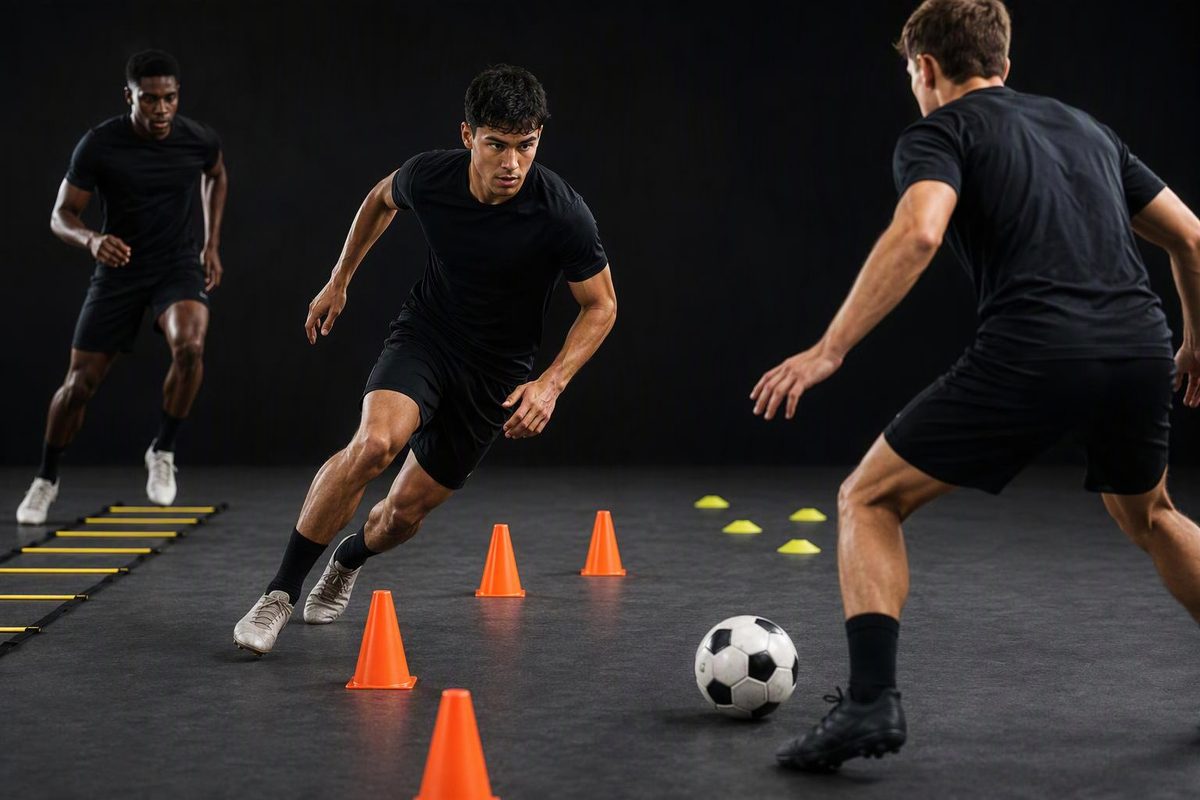
Run a 15-minute soccer agility block with planned cuts, partner reactions and live 1v1s, plus what research says about cone drills and ladders.
Use a short progression: practise a controlled turn, react to a moving partner, then solve a live 1v1 with the ball. Cones organise the space; another player supplies the uncertainty.
The distinction matters. A known route trains change-of-direction speed. Agility adds a response to a stimulus—such as an opponent’s movement—so the player must read the situation as well as move quickly. Both are useful, but they are not interchangeable. Soccer training research explicitly separates these qualities.
The 15-minute training block
Allow five minutes for each exercise, including demonstrations and recovery. Use cones, balls and pairs; duplicate the layouts rather than creating one long squad queue.
This is a coaching template for healthy adolescent and adult players accustomed to running and cutting, not a research-validated package. For younger children, simplify the games and reduce the repetitions rather than copying the full dose.
Use it after a progressive warm-up and before demanding conditioning. Start with controlled practice attempts, check the surface and footwear, and leave clear run-off space. The recovery periods are starting points: extend rest or do fewer repetitions if movement control deteriorates. Stop for pain; players returning from injury need guidance from a qualified coach or physiotherapist who can assess them directly.
1. Approach, brake and cut — 5 minutes
Purpose: Rehearse the movement before adding a decision.
Layout: Mark a start and a turning cone 5 metres ahead. Place two exit gates a further 5 metres away, diagonally forward-left and forward-right, creating roughly 45-degree turns from the approach line.
Action: Tell the player which exit to use before starting. They accelerate towards the turning cone, reduce speed enough to control the turn, then accelerate through the chosen gate. The cone is a landmark, not something they must touch.
Dose: After a controlled rehearsal, complete four fast, controlled repetitions per player: two each way. Allow 45–60 seconds between their efforts. Several players can share a layout if the previous runner clears it before the next starts.
Coach these points:
- Begin braking before the turn rather than arriving too fast and scrambling.
- Lower the body slightly and keep the turn balanced.
- Push out towards the exit rather than making extra sideways steps.
Adjust: If the player repeatedly loses balance, reduce approach speed first. Progress speed before making the turn sharper; do not increase both at once.
This is deliberately a planned exercise. For a separate cone-based turning block, see planned and reactive speed drills.
2. Partner mirror — 5 minutes
Purpose: Respond to movement that is not known in advance.
Layout: Give each pair a 5 × 5-metre square. Players face each other about 2 metres apart.
Action: For five seconds, the leader changes position within the square using lateral and diagonal movements. The follower tries to maintain the gap and stay facing the leader. No touching, crossing paths or running outside the square.
Dose: Perform eight five-second bouts, starting one every 30 seconds. Swap leader and follower after each bout, giving each player four attempts in each role. Use the remaining time for demonstration and feedback. For beginners, start with four bouts.
Coach these points:
- Watch the opponent’s body movement, not the cones.
- Stay ready to move again rather than committing to an oversized first step.
- Let leaders vary the sequence; a memorised left-right pattern removes the decision.
Adjust: Begin with lateral movement only if players struggle to maintain the gap. Add diagonal movement once they can follow without collisions or uncontrolled turns.
The coaching rationale is to connect perception and movement. A systematic review of team-sport agility found that human or video stimuli appeared useful for distinguishing playing levels in agility tests. That supports the choice of cue, but does not validate this mirror drill as a training intervention.
3. Two-gate escape with a defender — 5 minutes
Purpose: Change speed and direction while reading an opponent and controlling the ball.
Layout: Use an 8 × 10-metre area with two 2-metre gates on the far end line, separated by at least 3 metres. The attacker starts with a ball near the opposite end; the defender starts centrally, about 3 metres ahead.
Action: The attacker can score by dribbling through either gate under control. The defender tries to block the route or win possession. End the attempt after a score, the ball leaves the area, possession changes, or eight seconds.
Dose: After a brief demonstration, complete six bouts per pair, starting one every 50 seconds. Alternate roles so each player attacks three times and defends three times. Walk back and reset between efforts.
Coach these points:
- Attack the available space rather than performing a preselected trick.
- Change pace when the defender commits.
- Keep the ball close enough to make another decision.
Adjust: If the defender wins almost every attempt, increase the starting gap by moving them towards the gates. If the attacker succeeds without reacting, move the defender closer to the attacker. Change the starting gap before adding rules or extra repetitions.
For a longer ball-focused progression, use the dribbling drills session.
What the research changes
In a six-week study, 32 male elite youth soccer players, averaging 14.5 years old, were assigned to planned change-of-direction training, reactive agility training or a control group. The two intervention groups added two sessions per week, with similar running distances and training volume.
The reactive group reduced reactive-test time without the ball by 9.4%, versus 4.6% in the planned group. Conversely, the planned group improved the preplanned 5-0-5 turn test more: 3.4%, versus 2.2%. These were test improvements in a small youth sample, not proof of better match performance or a promised gain from this routine. The useful decision is to train—and assess—both planned movement and responses to a stimulus. Read the original study.
Do you need an agility ladder?
No. A ladder can provide a brief stepping-pattern activity, but it should not displace the opponent-based work in this block. In a trial of 18 male U13 players, six weeks of ladder training produced no statistically significant additional benefit over the control group in the tested sprint, planned change-of-direction or dribbling outcomes. Youth soccer trial.
A 2020 systematic review also judged broad performance claims premature because evidence was scarce and protocols poorly described. That is not proof that every ladder exercise is useless; it is a reason not to make one the centrepiece.
Progress decisions, not just workload
Start with one block in the weekly plan, replacing existing drill time rather than automatically adding more load. Repeat it before increasing volume.
Record three simple observations: balanced exits on each turning side, how often the mirror follower loses the gap, and successful controlled escapes out of three attacking attempts. Keep the layouts and starting gaps consistent when comparing sessions. These are coaching observations, not validated agility tests.
If players turn well but repeatedly choose the blocked gate, keep the reactive work. A faster cone time alone will not answer that coaching problem.