
Build Ball Control Into Better Live Dribbling Decisions
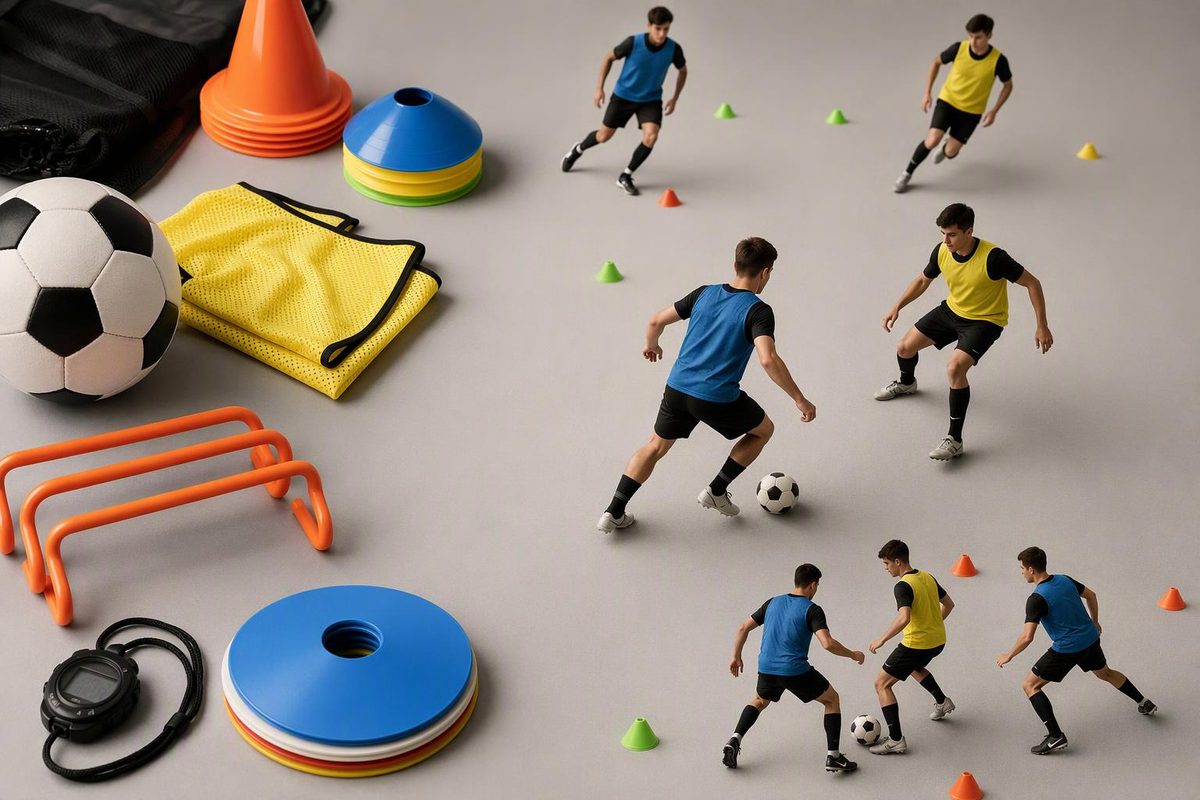
Five progressive soccer exercises move players from scanning and speed changes to defender pressure, live take-ons and contextual 3v3 play.
A useful 35-minute dribbling session moves from individual ball control to live decisions: five minutes of traffic dribbling, six minutes of gates, seven minutes escaping pressure, eight minutes of two-goal 1v1 and nine minutes of 3v3. The dimensions and timings below are starting points, not a research-tested prescription; adjust them to age, ability and player numbers.
Choose the block you want to run; the session plan and setup update below.
35-Minute Dribbling Session Planner
The full progression is selected by default.
Five drills move from individual control to live 3v3 decisions.
1. Traffic Dribbling
Time: 5 min
Setup: 15 × 15 yd; 8–12 players
Problem: Control while scanning
2. Gates At Changing Speed
Time: 6 min
Setup: Eight 1 yd gates
Problem: Move the ball into space
3. Escape The Defender
Time: 7 min
Setup: Channels ~8 × 6 yd
Problem: Protect, turn and accelerate
4. Two-Goal 1v1
Time: 8 min
Setup: Fields 12 × 10 yd
Problem: Read and unbalance a defender
5. 3v3 Line-Break Game
Time: 9 min
Setup: 24 × 18 yd; 4 yd end zones
Problem: Choose dribbling in context
Source: timings, dimensions and player ranges from the session plan in this article; they are starting points, not a research-tested prescription.
Use all five drills as one session or select the block that matches your objective. The progression preserves repetitions while gradually introducing what a slalom cannot: deciding whether, when and where to dribble.
| Drill | Time | Main Problem |
|---|---|---|
| Traffic dribbling | 5 min | Control while scanning |
| Gates at changing speed | 6 min | Move the ball into space |
| Escape the defender | 7 min | Protect, turn and accelerate |
| Two-goal 1v1 | 8 min | Read and unbalance a defender |
| 3v3 line-break game | 9 min | Choose dribbling in context |
Traffic Dribbling Builds Control While Scanning
Setup: Mark a 15 x 15-yard area for 8–12 players. Every player has a ball. Place four differently colored cones around the outside.
How to play: Players dribble freely. Call a color every 15–20 seconds; each player moves toward that side, turns away before crossing the line and returns to the area. Change the movement problem rather than prescribing a long sequence: accelerate for three touches, stop and restart, use only the weaker foot, or turn into a new space.
Coach players to maintain enough space between ball and feet to move, but not so much that another player could take it. Look for glances away from the ball before changes of direction and a visible change of speed after each turn.
Make the area smaller if players never need to look up. Enlarge it if collisions prevent purposeful movement. For more isolated ball-mastery options, use this soccer footwork progression, but keep the isolated portion short when match dribbling is the objective.
Gates Add Direction And Changes Of Speed
Setup: Keep the same area and make eight one-yard gates with cones. Use one ball per player.
How to play: A player scores by carrying the ball through a gate under control. The same gate cannot be used twice in succession. Play three 75-second rounds with 30 seconds between rounds:
- Any gate, any method.
- Exit each gate faster than the entry.
- Before entering, look over one shoulder and call the color or number held up by the coach.
Do not reward raw gate totals alone. A player taking tiny touches throughout can collect gates without learning to attack open grass. Count a point only when the ball remains playable after the exit.
A useful cue is: “Push the ball through the gate and arrive with it.” This directs attention toward the ball’s path and the task outcome rather than prescribing every joint movement.
Evidence for external-focus feedback is not specific to dribbling. A study of 10- to 12-year-olds learning a soccer throw-in found better transfer of movement form with frequent movement-effect feedback than with body-focused feedback (Chiviacowsky et al., 2010). That supports concise, outcome-led cues, but it does not prove this phrase—or any other—is uniquely effective for dribbling.
Escape The Defender Makes Turns Functional
Setup: Create channels approximately 8 x 6 yards. Put one attacker and one defender in each, with a ball for the attacker. Mark an end line at both ends.
How to play: The defender begins about one yard away. On the whistle, the attacker has five seconds to dribble over either end line. The defender tries to win the ball or force it out. Swap roles after every attempt and target six to eight repetitions each.
Begin with controlled defensive pressure if attackers cannot turn. Move toward realistic pressure once they can protect the ball and escape.
Look for the attacker to place the body between defender and ball when protecting it, notice when the defender’s weight shifts, take the first exit touch away from pressure and accelerate immediately after creating separation.
This is where turns become functional. Players can use any solution rather than waiting for permission to perform a named move.
Two-Goal 1v1 Develops Defender Reading
Setup: Make several 12 x 10-yard fields. Put a two-yard cone goal in each attacking corner. One attacker starts with the ball opposite one defender.
How to play: The attacker scores by dribbling under control through either goal. The defender scores by winning the ball and carrying it over the starting line. Use 20–25-second bouts, rotate quickly and aim for at least six attacks per player.
Two goals make the defender protect more than one route. The attacker must read the defender rather than execute a predetermined trick. If the attacker rarely succeeds, widen the field or start the defender a yard farther back. If almost every attack succeeds, narrow the field or reduce the starting separation.
Ask one question between rounds: “What told you which goal was open?” Avoid stopping every repetition; players need uninterrupted attempts in which to compare solutions.
FIFA’s 1v1 finishing practice likewise combines receiving on the move, beating a live defender and completing the action rather than treating dribbling as a cone-only technique (FIFA Training Centre). Add goals and goalkeepers for older or more experienced squads when finishing after the take-on is the actual match problem.
A 3v3 Line-Break Game Tests The Decision To Dribble
Setup: Play 3v3 in a 24 x 18-yard area with a four-yard end zone at each end. Prepare several fields to limit waiting.
How to play: A team scores when a player dribbles into the attacking end zone under control. Passing is unrestricted. Play three two-minute rounds with one minute between rounds.
The scoring rule creates a reason to carry the ball forward, but teammates and defenders still make passing possible. Do not require every player to beat an opponent before a goal; that can produce forced dribbles and reward the wrong decision.
A 2021 meta-analysis of six youth team-sport studies found a beneficial effect of small-sided-game programs on technical execution compared with controls (effect size 0.59, 95% CI 0.29–0.89), but none of the eligible studies reported tactical-behavior outcomes (Clemente et al., 2021).
A soccer-specific systematic review found support for self-exploration in representative practice while also finding improvements from repetition-based approaches. Its authors cautioned that the evidence was heterogeneous and not strong enough to declare one approach universally superior (Bergmann et al., 2021). The practical choice is not simply “cones or games.” Use controlled work to create repetitions, then let players apply the skill against live information.
Five Cues Cover The Main Dribbling Problems
Use one cue at a time rather than delivering several instructions during each attempt.
- Into open space: Push the ball farther when space is available.
- Near pressure: Keep it close enough to change direction or shield.
- Commit the defender: Approach close enough to make the defender choose.
- Change something: Alter direction, speed or both.
- Exit: Accelerate past the defender’s reach.
Technique matters, but there is no single touch distance for every situation. Surface, speed, opponent position and the player’s capabilities alter the solution.
Measure Take-Ons And The Next Action
During the final game, record three numbers for each team:
- Purposeful take-ons attempted: a deliberate effort to carry the ball past the immediate defender.
- Successful take-ons: attempts that beat that defender while retaining possession.
- Successful next actions: a pass, shot or continued controlled carry immediately afterward.
The basic take-on success rate is successful take-ons divided by attempted take-ons, multiplied by 100. The next-action rate is successful next actions divided by successful take-ons, multiplied by 100. Leave the rate unreported when its denominator is zero rather than treating an unknown outcome as 0%.
A cone-course time measures cone-course speed. It does not show whether a player recognizes a useful moment to dribble. That distinction matters: in one 14-session intervention involving 19 U12 players, modified games with attacking overloads improved passing decisions and execution but did not produce statistically significant improvements in the measured dribbling outcomes (Práxedes et al., 2018). One small study cannot establish the best dribbling method, but it supports targeting the action directly rather than assuming dribbling will improve through generic possession games.
Repeat the session over several weeks and change only one constraint at a time: field width, defender starting position or scoring method. If attackers succeed almost every time, increase the challenge. If they rarely succeed, provide more space or a more favorable start. Stop or adapt contact and intensity for pain or injury, following guidance from a qualified coach or physiotherapist.