
Build Better Touches, Turns, and Decisions—Not Just Faster Feet
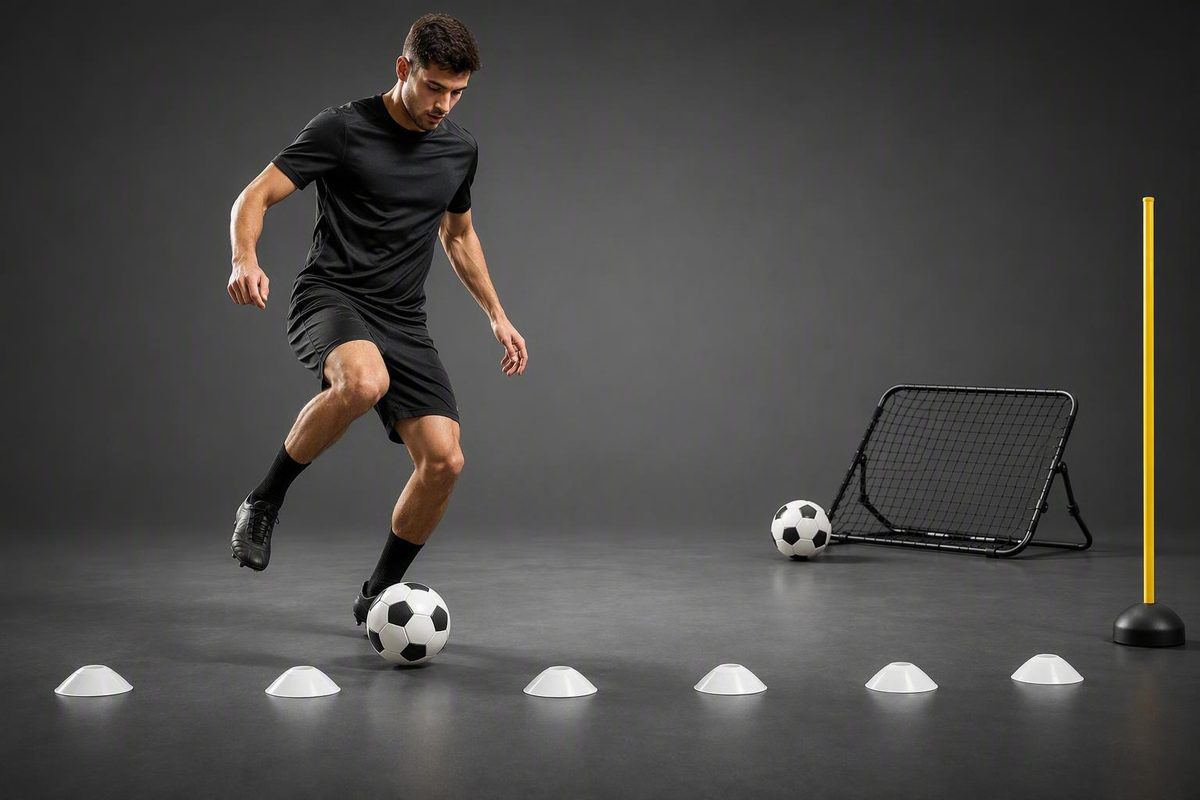
Five ball-mastery moves lead into turns, wall passing or 1v1 pressure, with easier and harder options plus simple ways to track control.
The most useful soccer footwork drills do more than make your feet move quickly. Start with controlled ball repetitions to learn a touch or turn, then add movement, scanning, random cues, and opponents. A ball, a few markers, a wall, and about 20 minutes are enough for a practical session—but isolated patterns should prepare players for pressured play, not replace it.
Choose the drill by the skill you actually want to train
Soccer footwork includes the movements used to control and move the ball, turn, stop, start, shield, evade opponents, and maintain balance. That broad definition covers several related but distinct training targets:
- Ball-specific technique: How the foot contacts and moves the ball.
- Off-ball coordination: Foot placement and body control without the ball.
- Change-of-direction speed: A rapid directional change through a known, preplanned route.
- Reactive agility: A directional change made in response to a stimulus such as an opponent, pass, color, or verbal cue.
- Pressure-based skill: Technique selected and executed while perceiving teammates, opponents, space, and time.
Choose the activity by its main outcome:
| Intended outcome | Representative drills | Players, space, equipment | Primary demand |
|---|---|---|---|
| Close control | Inside-outside touches, toe taps, push-pulls, sole rolls | 1 player; about 2 × 2 m; 1 ball | Technical |
| Turns and directional exits | Six-marker weave, V-pulls, small-box cuts | 1+; about 3 × 6 m; ball and markers | Technical and physical |
| First touch and passing | Directional wall passes, target passing | 1; clear wall area; ball and target marker | Technical |
| Off-ball coordination | Ladder or taped-line patterns | 1+; narrow lane; ladder, tape, or chalk | Coordination and preplanned movement |
| Pressure-based decisions | 1v1 to endlines, Shield-Steal, rondos, keep-away | 2+; size adapted to level; balls and markers | Decision-rich |
A memorized cone route can train control and preplanned directional changes. It becomes reactive only when the player must respond to information they do not know in advance. Reactive agility requires a stimulus; change-of-direction speed can be tested with a fixed route.
“Targets” is also an important word. A drill intended to train close control is not automatically proven to improve ball retention in competition. Moving quickly through a ladder does not establish better dribbling or reactive agility. The setup must match the quality being practised, while transfer into opposed or competitive play should be evaluated separately.
A complete 20-minute footwork session
This plan moves from progressive preparation to controlled technique, directional exits, and either receiving or opponent pressure. The timings are adaptable coaching starting points, not a scientifically established optimum.
| Time | Activity | Format |
|---|---|---|
| 0:00–4:00 | Progressive movement and dynamic mobility | Easy movement, lateral steps, skips, lunges, gradual accelerations |
| 4:00–10:00 | Controlled ball mastery | Five drills at 40 seconds work and 20 seconds reset, then 1 minute of freestyle combinations |
| 10:00–14:00 | Turns and directional exits | Two 90-second work blocks with a 30-second reset after each |
| 14:00–18:00 | Solo wall work or pressure game | Directional receiving or short 1v1 rounds |
| 18:00–20:00 | Low-intensity cooldown and notes | Easy movement, then record results |
Minutes 0–4: progressive movement
- 0:00–1:00: Walk, jog easily, or move lightly around the area.
- 1:00–2:00: Add lateral steps, gentle backward movement, and controlled changes of direction.
- 2:00–3:00: Use dynamic movements such as walking lunges, leg swings, or skips.
- 3:00–4:00: Add the ball and progress from easy dribbling to two or three short, submaximal accelerations.
Enter the technical work progressively warm rather than beginning with maximal cuts, sprints, or frantic touches. This follows the publication’s approved progressive warm-up guidance.
Minutes 4–10: controlled ball mastery
Complete each drill for 40 seconds, followed by 20 seconds to rest, reset the ball, or change the setup:
- Inside-outside touches
- Toe taps
- Push-pulls
- Lateral sole rolls
- Forward-backward rolls
Those five rounds take five minutes. Use the final minute for a freestyle combination joining at least two movements.
Minutes 10–14: turns and exits
- 90 seconds: Six-marker cone weave.
- 30 seconds: Reset, adjust the spacing, and rehearse the next movement slowly.
- 90 seconds: V-pull turns with a controlled acceleration away.
- 30 seconds: Reset and prepare for wall or pressure work.
Minutes 14–18: choose one
Solo option—directional wall control: Pass toward a visible target, receive across your body or into a designated side, and pass again. Alternate feet and starting angles.
Group option—1v1 to endlines: Play short rounds in which the attacker scores by dribbling under control across either endline. Rotate attacker and defender frequently. Begin with enough room for the attacker to succeed before tightening the area.
Minutes 18–20: cooldown and notes
Move at low intensity, let breathing settle, and record one or two useful measures: clean touches, losses of control, weak-foot successes, target passes, or successful actions under pressure.
Reduce speed, space demands, or total volume when technique repeatedly deteriorates. Quality is the constraint; the clock is adjustable.
Ball-mastery drills for close control
These soccer footwork drills require one ball and little space. The doses are adjustable practice guidance, not validated universal prescriptions. Isolated repetitions provide repeatable technique work, but they have not been established as a direct route to better match performance.
Inside-outside touches
- Place the ball beside one foot.
- Nudge it inward with the inside of that foot.
- Redirect it outward with the outside of the same foot.
- Continue with small side-to-side contacts.
- Repeat on the other foot, then alternate feet if control permits.
- Equipment: One ball
- Space: About 2 × 2 m
- Starting dose: 2 × 30–40 seconds
- Difficulty: Beginner to intermediate
- Easier: Use one foot slowly and pause between contacts
- Harder: Alternate feet while moving forward or scanning
- Common error: Chasing large touches
- Correction: Soften the contact and keep the ball within one controllable step
Stay balanced with slightly flexed knees. Establish small, reliable touches before increasing speed.
Toe taps
- Stand behind the ball in a balanced position.
- Touch the top of it lightly with the front of one sole.
- Replace that foot and alternate sides.
- Begin stationary, then progress to slight lateral or forward movement.
- Equipment: One ball
- Space: About 2 × 2 m
- Starting dose: 2 × 20–40 seconds
- Difficulty: Beginner
- Easier: Pause after each tap or use nearby support
- Harder: Travel sideways, forward, and backward while retaining the rhythm
- Common error: Stamping down and moving the ball excessively
- Correction: Use light contacts and keep your weight controlled over the supporting foot
Push-pulls
- Place the sole on the ball.
- Push or roll it a short distance away.
- Pull it back toward the body with the sole.
- Repeat before changing feet.
- Add diagonal and lateral directions after controlling the straight movement.
- Equipment: One ball
- Space: About 2 × 3 m
- Starting dose: 30 seconds per foot
- Difficulty: Beginner to intermediate
- Easier: Work forward and backward only
- Harder: Alternate feet and exit in a new direction
- Common error: Moving the ball beyond playing distance
- Correction: Shorten the push so the pull can begin without a recovery step
Lateral sole rolls
- Place one sole on the outside half of the ball.
- Roll it across the body.
- Catch or continue it with the opposite foot.
- Shift the hips with the ball while maintaining balance.
- Equipment: One ball
- Space: About 2 × 3 m
- Starting dose: 2 × 30 seconds
- Difficulty: Beginner to intermediate
- Easier: Roll and stop the ball before changing feet
- Harder: Travel laterally or combine the roll with an inside cut
- Common error: Crossing the legs and losing balance
- Correction: Move the supporting foot early and keep the torso controlled
Forward-backward rolls
- Place the sole lightly on the ball.
- Roll it forward without allowing it to escape.
- Pull it backward with the same foot.
- Change feet after several controlled cycles.
- Progress to alternating feet or moving through a narrow lane.
- Equipment: One ball
- Space: About 2 × 3 m
- Starting dose: 30 seconds per foot
- Difficulty: Beginner
- Easier: Use a smaller range and slower rhythm
- Harder: Alternate feet while changing body orientation
- Common error: Leaning backward as the ball moves forward
- Correction: Keep your body centered over a stable base
Freestyle combinations
Join two or more learned movements—for example, inside-outside touches into a sole roll, or a push-pull into an outside-foot exit. Change direction and pace rather than repeating one rhythm indefinitely. Use the eyes, shoulders, arms, hips, and changes of speed to suggest one direction before leaving in another.
- Equipment: One ball; optional markers
- Space: About 3 × 3 m
- Starting dose: 2 × 30–60 seconds
- Difficulty: Intermediate
- Easier: Predetermine a two-move sequence
- Harder: React to a partner’s color or number cue
- Common error: Adding moves faster than they can be controlled
- Correction: Remove one element, stabilize the combination, and then rebuild it
Turning and directional-control drills
Changing direction successfully requires more than touching the ball around a marker. The player must control the body, position the ball for the next action, and use an exit touch suited to the available space.
Six-marker cone weave
Set six markers in a straight or gently staggered line. Begin with generous spacing so the player can use both feet without lunging.
- Dribble through the route with soft, frequent touches.
- Use inside and outside surfaces rather than relying on one foot.
- Turn beyond the final marker and return.
- Keep the ball close enough to alter the next touch.
- Increase speed only while retaining control.
Progress by narrowing the spacing, offsetting the markers, or adding a chosen turn at each end. Change one variable at a time.
V-pull
- Approach the marker under control.
- Place the sole on the ball and pull it backward.
- Open the hip and push the ball diagonally with the inside or outside of the same foot.
- Leave with a controlled exit touch.
- Accelerate only after positioning the ball safely.
If the ball escapes, reduce speed. In a tight area, shorten the exit touch. Keep the center of mass controlled rather than throwing the upper body beyond the ball, and practise exits to both sides with both feet.
Small-box drill
Mark a square approximately 2–3 m wide. Stay inside it while combining inside cuts, outside cuts, sole rolls, and stepovers. Begin with one named movement. Next, alternate movements at each boundary. Finally, have a partner call the next action or direction.
Completing the same pattern faster trains a preplanned task. It does not test reactive agility until an external cue determines what happens next.
Use this progression:
- Known route: The movement and exit direction are fixed.
- Random cue: A partner calls a color, number, or direction.
- Passive defender: A partner closes space without tackling.
- Active defender: The attacker protects the ball and selects an exit.
The final stages connect the rehearsed movement to perception and choice.
Wall drills for first touch and passing footwork
Use a solid wall in a clear area where rebounds will not endanger people or damage property. Mark a visible target and begin far enough away to receive the ball comfortably.
- Pass with the inside of one foot toward the target.
- Move into line with the return.
- Control the ball into useful space rather than stopping it directly beneath you.
- Pass again with the other foot.
- Begin with two touches: one to control and one to pass.
Progress by directing the first touch left or right, shrinking the target, moving before each pass, or changing the passing angle. Try one-touch passing only when the rebound and technique are consistent.
Measure execution rather than contacts alone. Over 20 attempts, record:
- Successful target passes
- Clean directional controls into the intended side
- Successful weak-foot passes
- Misses or rebounds requiring an extra recovery touch
Structured repetition can be useful when the target is narrow and specific. Structured passing practice produced better post-intervention results than three-a-side games on three tests of 10 m side-foot accuracy. The passing-practice study was small and did not establish long-term retention or transfer to match performance.
Wall passing is a practical instructional variation for solo work, but that study did not test wall practice specifically. Neither form replaces the pressure, movement, scanning, and choices found in opposed play.
Add pressure with 1v1s, rondos, and small-sided games
Opponents and teammates create information that fixed solo drills cannot: where space is opening, when pressure is arriving, which side is protected, and whether to dribble, shield, support, or pass.
Use one of these applications after controlled technical work:
- 1v1 to endlines: The attacker scores by dribbling across either endline under control. This applies turns, feints, changes of pace, and directional exits.
- Knockout or Shield-Steal: Each player protects a ball, or partners compete to retain one. Emphasize body position, sole control, and shielding.
- 4v2 or 5v2 keep-away: Outside players receive, support, and pass while defenders pressure space and passing lanes.
- Small-sided bonus game: Award a bonus point for a successful weak-foot exit, practised turn, or directional first touch—but only when the action suits the situation.
Pair each isolated movement with a likely application:
| Isolated practice | Pressure application |
|---|---|
| Cone turns and V-pulls | 1v1 to endlines |
| Sole rolls and push-pulls | Shield-Steal or Knockout |
| Wall receiving and passing | Rondo or keep-away |
Research supports a qualified case for game-based work, not the claim that games improve every footwork skill. A meta-analysis of six youth team-sport studies reported a small beneficial pooled effect on technical execution. It was not soccer-only, and none of the included studies reported tactical-behavior outcomes.
For preplanned change-of-direction speed, small-sided games are not clearly superior to other conditioning methods. A review of 14 youth soccer studies found similar outcomes for small-sided games and running-based training. Choose games because they add opponents, decisions, and soccer context—not because they guarantee improvement in every isolated technique.
Progress drills without sacrificing technique
Use this progression ladder:
- Stationary control
- Movement
- Alternating feet
- Weaker-foot emphasis
- Tighter space
- Head-up scanning
- Random cues
- Passive pressure
- Active pressure
- Competitive play
Change one constraint at a time. If you simultaneously narrow the area, add a defender, demand the weaker foot, and increase speed, it becomes difficult to identify what caused the errors.
A player may be ready to progress when they can:
- Complete several rounds with few losses of control
- Perform the intended movement on both sides
- Keep the ball playable after the exit touch
- Look away from the ball periodically without immediately losing it
- Retain technique late in the work period
These are practical coaching thresholds, not validated universal standards.
For beginners, provide more room, move slowly, and teach one movement at a time. For more capable players, add variable cues, deceptive body movement, non-dominant-foot exits, and opponents. Avoid universal prescriptions based only on age: the available research is youth-heavy and does not establish drill-specific standards for every maturity level, sex, playing level, or injury history.
What the research says about ladders and extra repetitions
Agility ladders can demand quick, accurate foot placement through a fixed pattern. That does not mean they automatically improve soccer-specific agility, speed, or dribbling.
A randomized trial assigned 18 male under-13 players either to six weeks of added ladder training or to normal soccer training. The added program produced no between-group advantage in the measured sprint, agility, dribbling, slalom-dribbling, or skill-index outcomes. The agility-ladder trial was small and tested one specific program, so it does not prove that every ladder activity is useless. It does challenge the claim that ladder work automatically transfers to soccer agility or dribbling.
Treat ladders as optional coordination or warm-up tools when fixed foot-placement practice is the intended purpose. They should not displace ball work, reactive cues, or opponent-based tasks when those are the actual objectives.
More sessions are not automatically better. In a randomized study of 90 players aged 9–12, an intervention group completed 11 additional sessions involving ball mastery, 1v1s, and small-sided games. Both that group and the control group improved on a passing-and-dribbling course, but the difference in improvement was not significant. The youth skill-course study noted that familiarity with the test and ordinary soccer participation or recreational play could have contributed.
Pre-to-post improvement within one group is therefore not enough to show that an intervention caused the gain. Select training for a defined task and evaluate more than a faster time on one familiar route.
Track useful progress and train safely
Use a simple log:
| Drill | Work time | Clean touches | Control losses |
|---|---|---|---|
| Inside-outside | 40 sec | ||
| Cone weave | 90 sec | ||
| Wall target | 4 min | ||
| 1v1 | 4 min |
Add separate fields or notes for:
- Weak-foot successes
- Target accuracy
- Completion time
- Perceived effort
- Success against passive pressure
- Success against active pressure
Do not treat the fastest attempt as automatically best. Report time and errors side by side—for example, “18.4 seconds, two control losses”—rather than combining them into an undefined score. If a coach chooses to add time penalties, the value of each penalty should be defined in advance and treated as a local, nonvalidated tracking convention.
Look for observable practice outcomes such as:
- Retaining possession in a constrained 1v1
- Controlling a wall rebound into the intended space
- Executing a turn against passive and then active pressure
- Using the weaker foot successfully when the situation calls for it
These are practical indicators, not validated proof of better match performance.
Before training, clear adequate space and check that the surface and footwear are appropriate for the setting. Begin with progressive preparation. Stop or simplify the task when fatigue repeatedly disrupts balance or ball control. Training carries injury risk, and this article does not replace a qualified coach or physiotherapist who can assess the player directly, in line with Soccer Science’s editorial safety guidance.
The rule is simple: earn speed through control, then add scanning, uncertainty, and opponents. Useful soccer footwork drills do not require elaborate equipment, but they should progress beyond rehearsing fast feet. Build repeatable touches and turns first; then test whether the player can use them while perceiving pressure and making decisions.