
Five Soccer Goalkeeping Drills From Handling to Live Decisions
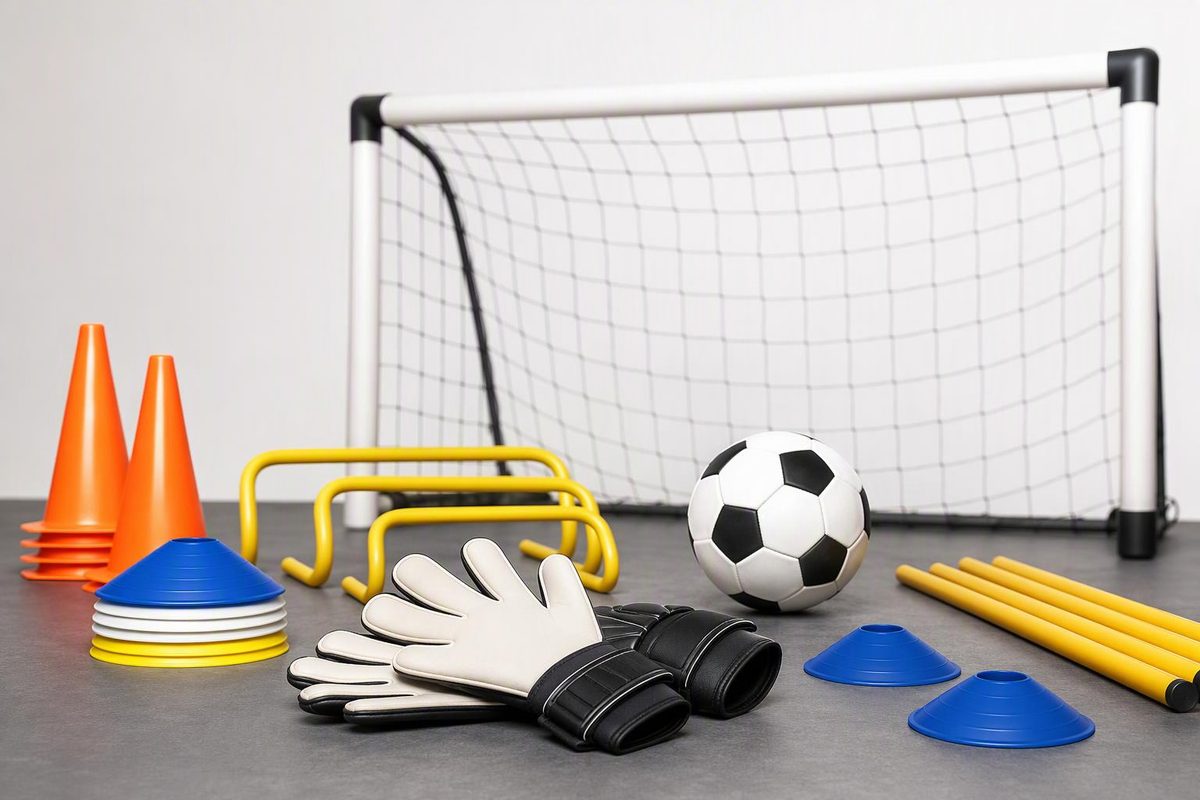
Run a 25-minute goalkeeper block with handling, low saves, angle changes, pressured passing and live attacks, plus what research says about transfer.
Start with controlled handling, then add movement, an uncertain shot and an opponent. Finish with a save-to-distribution task—not another predictable volley into the goalkeeper’s hands.
The five soccer goalkeeping drills below form a 25-minute block after the warm-up. They focus on handling, low saves, positioning and playing out under pressure. They are a coaching proposal, not a scientifically validated training dose, and do not replace separate work on crosses or defending space behind the back line.
Set up the block
You need: one goalkeeper, four outfield players, a coach, several balls, cones and an age-appropriate goal. Secure portable goals with suitable anchors or counterweights and check connecting hardware before use, as advised in AYSO’s goal-safety guidance. With two goalkeepers, alternate short sets within the same time allowance; each will receive fewer repetitions.
Use a level, clear surface with suitable grip. Warm up with progressive movement, passing and easy catches before increasing shot speed. Low diving work is for players who have already learned controlled landing technique with a qualified coach; beginners can move to collect rolls without diving. Stop for pain or deteriorating landing control. This routine is not a rehabilitation plan.
| Drill | Time, including recovery | Main task |
|---|---|---|
| Move, set and catch | 4 minutes | Arrive balanced and secure the ball |
| Low save and reset | 4 minutes | Save to either side with control |
| Pass across, adjust, save | 5 minutes | Reposition as the shooting angle changes |
| Back-pass under pressure | 5 minutes | Read pressure and select an outlet |
| Live attack to distribution | 7 minutes | Connect positioning, saving and the next pass |
Distances below are starting points for older youth and amateur players. For younger or less experienced keepers, shorten passing distances, reduce service speed and use smaller goals. Increase difficulty one variable at a time. Treat repetition counts as targets: do fewer if setup or recovery takes longer, rather than rushing the next ball.
1. Move, set and catch
Setup: Place two cones about 2 metres apart in front of the goal. A server stands 5–7 metres away.
Run it: The goalkeeper moves between the cones. As the server prepares to deliver, the keeper settles into a balanced ready position and catches a gentle underarm service. Return the ball and repeat. Start with central catches, then vary between waist and chest height.
Use four sets of six deliveries, with approximately 20–30 seconds between sets. Reset fully between balls; this is not a rapid-fire drill.
Cue: “Move early; be balanced before the delivery.” Keep the knees comfortably flexed and hands available rather than hiding them behind the body.
Adjust: Remove the lateral movement if handling breaks down. Progress by letting the server choose when to deliver, rather than serving on a fixed count.
Handling, footwork, positioning, saving techniques and distribution are also the stated objectives of England Football Learning’s basic goalkeeping session. The layout and repetitions here are our practical starting points.
2. Low save and reset
Setup: Keep the server 5–7 metres away. Clear cones and spare balls from the landing area.
Run it: Roll the ball within comfortable reach to one side. The goalkeeper uses their previously coached low-save technique, secures the ball and stands before the next delivery. Start with the side announced; later let the server choose left or right.
Use three sets of four saves—two each side—with 30 seconds between sets. Allow roughly 10 seconds to return the ball and reset between saves, or longer if needed. Use the remaining time for explanation and feedback.
Cue: “Secure the ball before resetting.” Do not make a second ball arrive while the player is still getting up.
Adjust: For beginners, roll close enough to collect without a dive. For competent keepers, vary the direction before increasing speed or reach. Avoid turning this into repeated maximum-extension dives.
3. Pass across, adjust, save
Setup: Two attackers stand 10–14 metres from goal, one central and one slightly wide. Only one ball is active.
Run it: The first attacker passes across to the second, who controls and shoots at manageable speed. The goalkeeper tracks the pass, adjusts their position relative to the ball and goal, then prepares for the strike. Alternate the direction of the pass.
Run two sets of five attacks with 45 seconds between sets and a full reset between attacks.
Cue: “Follow the ball, not a memorised cone route.” Discuss whether the keeper was positioned for the new angle and balanced at the strike.
Progress: Either attacker may shoot or pass. The keeper must now respond to the attacker’s action rather than knowing the sequence. England Football Learning’s Borussia Dortmund session similarly identifies cues, decisions and positioning adjustments as coaching objectives—not just shot-stopping technique.
4. Back-pass under pressure
Setup: Mark a roughly 15-by-12-metre area in front of goal. Put two supporting teammates to either side of the goalkeeper and one opponent centrally.
Run it: A teammate passes back along the ground. The opponent presses once the pass travels. The goalkeeper receives with the feet and chooses an available teammate; the supporting players can move to create passing lanes. Reset after a completed outlet pass or turnover.
Use two 90-second bouts with 45 seconds of recovery; use the remaining time for setup and brief feedback. Begin with a walking press, then allow realistic pressure.
Cue: “Look before the pass arrives; take the first touch away from pressure.” Do not impose a one-touch rule before the player can receive reliably.
Measure: Count passes that reach a teammate in usable space, not merely balls struck through a gate. For additional receiving work, use the first-touch practice progression.
5. Live attack to distribution
Setup: Use an approximately 20-by-18-metre area with two attackers, one defender and the goalkeeper. A fourth outfield player waits as an outlet beyond the far boundary. Keep the pitch’s penalty-area marking visible, or mark an age-appropriate penalty area for the practice; the keeper uses their hands only inside it.
Run it: The coach serves to either attacker. Play a live 2v1 towards goal. If the goalkeeper gains secure possession, they distribute to the outlet. If the defender wins the ball, they can use the goalkeeper—receiving with the feet after a deliberate back-pass—to help reach that outlet. Reset after a goal, an outlet pass or the ball leaving the area.
Run three 90-second bouts with 45 seconds between bouts. Use the remaining minute for explanation and feedback. Rotate outfield roles during breaks.
Cue: “Position for the attack; scan again when possession changes.” Let the defender and attackers create the problem instead of directing every goalkeeper movement.
Keep shots at controlled intensity initially. Do not allow attackers to challenge a goalkeeper holding the ball. If attacks repeatedly become unopposed close-range finishes, move the outlet player into defence and distribute through a cone gate instead.
Connecting possession changes with positioning and distribution is consistent with the objectives of the FA’s goalkeeping transition session.
Why finish with a live decision?
A 2010 penalty-kick experiment compared goalkeepers responding verbally or with simplified movements against goalkeepers actually attempting saves. Their gaze behaviour changed with the task: during real interceptions, attention was shared more evenly between the kicker’s movements and the ball than during limited-movement judgments. The original research abstract argues for representative testing conditions.
That is not proof that these five drills improve match save percentage. It supports a narrower coaching inference: reading an attacker while preparing to save is not the same task as identifying a direction without making the save. Keep controlled repetitions for technique, but include real ball flight, player choices and goalkeeper action when practising decisions.
At the next session, repeat a comparable live task before giving reminders. Record three things: positioning at the strike, whether the save left a playable rebound, and whether the next pass found an available teammate. Those observations are more useful than treating every conceded goal as a handling error.