
Train the first touch to solve the next problem—not simply stop the ball
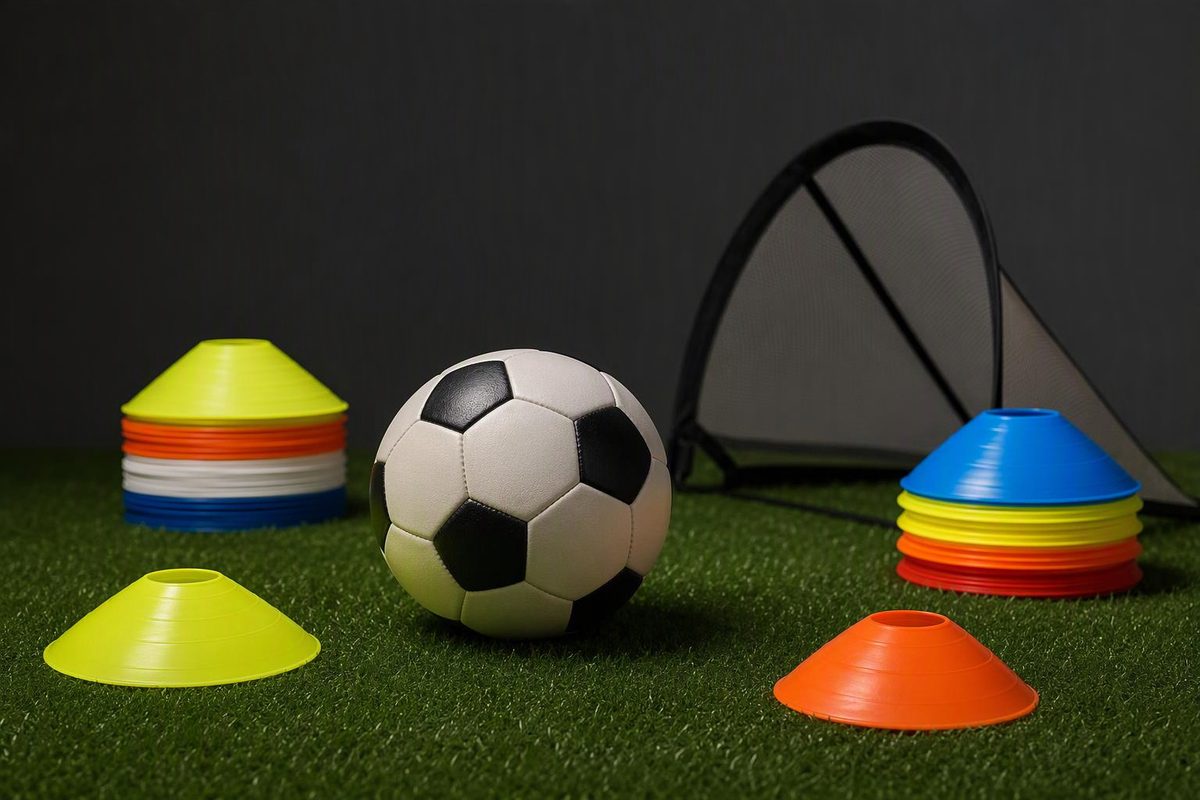
Improve first touch in soccer with scanning and directional-control cues, a 25-minute practice progression, and simple game-based measures.
A good first touch does not always stop the ball close to the player. It puts the ball where the next action can happen before pressure arrives.
That may mean cushioning the ball to protect it, directing it across the body to pass forward, pushing it farther ahead to accelerate, or setting it beside the standing foot for a shot. Judge the touch by whether it helps the player retain possession and execute the intended next action—not by one fixed idea of “perfect” technique.
The first-touch sequence
Teach four linked decisions rather than contact with the ball in isolation.
1. Scan before the pass arrives
The player should look away from the ball long enough to locate relevant opponents, teammates and space, then return their eyes to the incoming ball. Scanning helps the player decide whether to turn, protect, combine or play first time.
An analysis of 9,574 possessions by 27 players from one English Premier League club covered 21 competitive matches. After accounting for individual differences and pass difficulty, its model found a small positive association between more frequent scanning and pass completion. Scanning also varied with position, pressure and field location, so it should not become a compulsory head turn at an arbitrary moment (Jordet et al., 2020).
In a 4v4 study of 25 elite female youth players, short verbal prompts increased scans before reception by 27%. Performing at least one scan was also associated with a greater likelihood of a successful subsequent action. This was an immediate response measured over two sessions, however, not evidence of lasting learning (Hintermann et al., 2025).
Useful prompt: “Find the defender and the exit before the ball arrives.” It tells the player what information to collect rather than merely shouting “scan.”
2. Arrive in a position that preserves options
Move early enough to adjust to the pass. When the situation allows, receive side-on or on the half-turn so the player can see the passer and more of the field. An open stance is not an absolute rule: a player marked closely from behind may need to receive square, protect the ball and set it back.
FIFA Training Centre receiving practices emphasize scanning, an open posture and a first touch away from an approaching opponent. They also make the passer part of the solution: poor weight or timing can cause a difficult reception that is then blamed entirely on the receiver (FIFA Training Centre).
3. Choose the contact for the intended exit
The inside of the foot offers a broad surface for cushioning or redirecting a ground pass. The outside can move the ball away from pressure without another step. The sole can be useful when receiving with the back to goal or in tight spaces. Aerial balls may call for the instep, thigh or chest.
Do not turn “always receive with the back foot” into a universal rule. Back-foot reception is often efficient when the player can let the ball run across the body and play forward. The front foot may be safer when pressure blocks the far side or the player needs to protect and return the pass.
A standardized test involving 45 elite Brazilian U12 and U13 players found that scanning and foot sequence affected control-and-pass performance. In its most demanding 360-degree condition, scanning was associated with greater turn accuracy, fewer control errors and faster completion. Because this was a rebound-board task rather than match play, it supports varying direction and information demands in practice—not prescribing one technique for every reception (Hunter et al., 2025).
4. Match touch distance to the next action
Use an outcome rule:
- Protect or set: keep the ball within immediate playing distance.
- Pass quickly: place it far enough from the feet for a clean swing, but not within an opponent’s reach.
- Turn away from pressure: direct it across or behind the defender’s line of approach.
- Accelerate into space: take a firmer touch that permits running speed.
- Shoot: set the ball into the strike path without an unnecessary adjustment step.
“Soft touch” is incomplete advice. The required force changes with pass speed, surface, pressure, available space and the next action.
A 25-minute first-touch practice
This session begins with repeated contacts but quickly adds information, choices and opposition. That balance is supported by a systematic review of soccer skill-acquisition studies: representative activities encouraging exploration improved technical and tactical outcomes, while repetition-based practice also improved technical tests but had less evidence of transfer to match play. The included studies were of moderate and uneven quality, so this is a useful design principle rather than a settled formula (Otte et al., 2021).
1. Directional receiving in pairs — 5 minutes
Set-up: Pairs stand 8–12 metres apart. Put a gate two metres to each side of both players.
The passer serves along the ground and, just before the pass, calls the left or right gate. The receiver takes the first touch through that gate and passes back. Switch the direction regularly and vary pass speed.
Coach only two points:
- Identify the exit before contact.
- Make the return pass without first recovering the ball from under the body.
Increase difficulty by narrowing the gates or changing the passing angle. Do not require mechanical alternation between feet if it removes the decision about which foot best serves the exit.
2. Receive, turn or set — 6 minutes
Set-up: Use groups of four: a passer, a receiver, a target player beyond the receiver and a defender starting behind or beside the receiver. Work over roughly 10–12 metres.
As the pass travels, the defender applies controlled pressure from one side or stays tight behind. The receiver scans and chooses to:
- turn away from side pressure and pass to the target;
- take the ball across the body when the forward route is open; or
- protect it and set it back when the defender closes the turn.
Begin with the defender moving at walking speed, then allow a live challenge once receivers are consistently looking before contact. Rotate roles every 60–90 seconds.
This preserves repetition without allowing the receiver to preselect the touch.
3. Directional rondo — 6 minutes
Play 4v2 in a 12 × 12-metre area. Place one two-metre gate just inside each of two opposite sides.
After three passes, the possession team scores when a player receives through either gate and keeps the ball in the area. Defenders intercept and press normally. Award the point only if the first touch crosses the gate under control.
This rewards directional control without forcing every player to take two touches. Adjust the ratio, space and pressure using the principles in this rondo setup guide.
Useful cue: “Can your first touch escape the defender?”
4. 4v4 game with end zones — 8 minutes
Use a 25 × 20-metre pitch with a three-metre end zone at each end. Teams score by passing to a teammate who receives under control in the attacking end zone. Play two three-minute bouts with one minute for feedback between them.
Start with unrestricted touches. If players repeatedly take unnecessary contacts, try a three-touch maximum in the second bout—but remove it if they rush or stop scanning.
A study of 12 male junior players found that two-touch and three-touch limits produced more first-time passes than unrestricted 4v4 play, while pass-success percentages were similar across those three conditions. The paper also summarized earlier studies in which a one-touch maximum produced lower pass-success rates than two-touch or unrestricted formats. A universal one-touch rule can therefore remove the reception you are trying to train (Skalski et al., 2025).
For a broader sequence linking reception to passing decisions, use these passing activities.
Measure the outcome, not the appearance
During the final game, record 10–20 receptions for one player or position group. Classify each as:
- Useful: the touch enables the intended next action while retaining possession.
- Recoverable: possession remains, but an extra adjustment delays the action.
- Lost: the touch directly produces a turnover or sends the ball out of play.
Also note whether the player scanned before reception and where pressure came from. The percentage of useful touches under live pressure is more informative than the number of tidy repetitions completed in an unopposed line drill.
Retest in a later session rather than assuming that good practice performance means learning has transferred. Change the pass angle, pressure and available exit. The objective is not one permanent receiving shape; it is a first touch that repeatedly solves the situation in front of the player.