
How to Build a Rondo That Fits the Training Goal
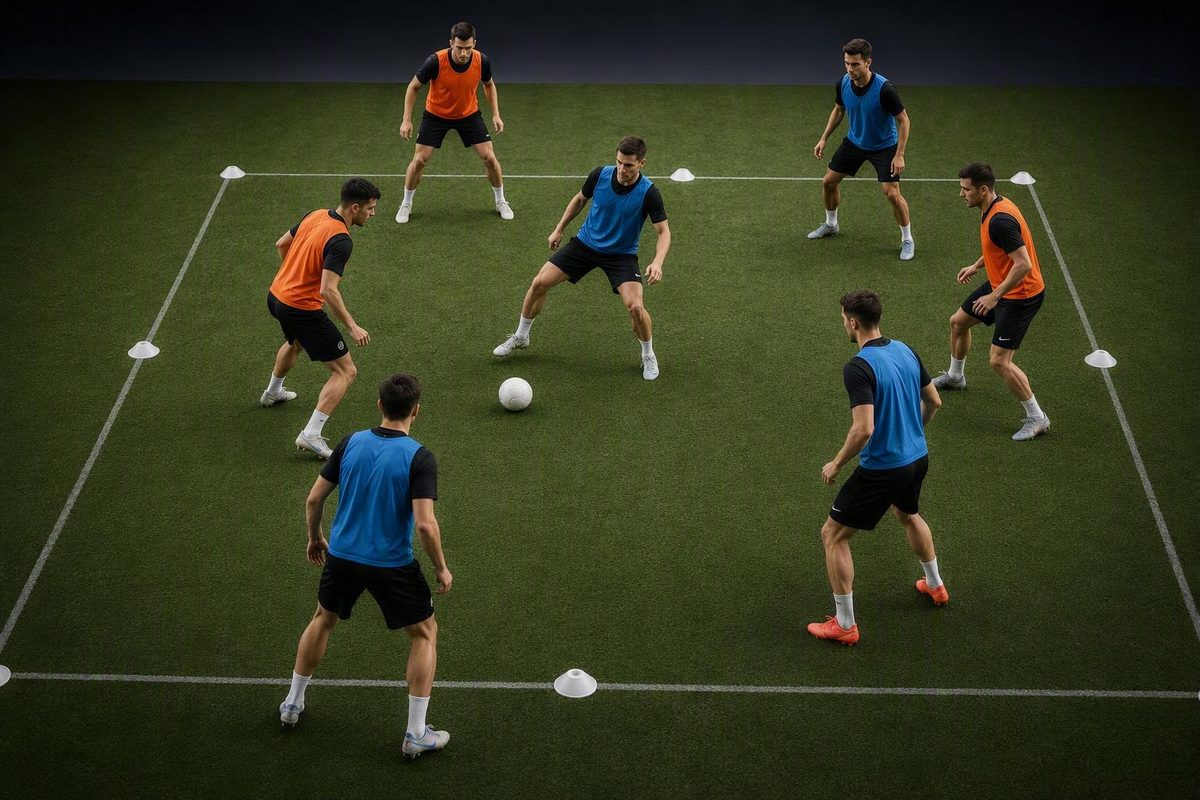
Adjust player ratio, space, touch limits, direction, duration and recovery to target retention, progression or a specific physical load.
A soccer rondo is a constrained possession activity in which one group—usually with a numerical advantage—keeps the ball from fewer defenders in a limited area. There is no universally best rondo: player ratio, space, touch rules, direction, duration, and recovery all change the task. Define the behavior or physical demand first, then use the fewest constraints needed to create it.
What a rondo is—and a 3v1 setup you can run immediately
A conventional rondo emphasizes retaining possession rather than progressing toward a goal. Attackers circulate the ball while one or more defenders press, intercept, or force an error. Adding goals, zones, directional targets, or transition rules makes the exercise more specific.
For an accessible starting format, use this 3v1:
- Mark an equilateral triangle measuring 10 meters on each side.
- Place three possession players and one defender inside it.
- Ask the attackers to retain possession.
- When the defender wins the ball, immediately exchange roles with the player who lost possession.
- As a practical regression—not a FIFA prescription—allow free touches if players cannot yet circulate the ball with control.
The organization comes from the FIFA Training Centre’s 3v1 rondo, which presents positional readjustment and the preservation of triangular passing lanes as its main coaching focus.
Use three primary cues:
- Scan before receiving. Check the defender, teammates, and likely next passing lane before the ball arrives.
- Move after passing. Adjust immediately to reopen a lane rather than admiring the pass.
- Prepare the body for the next action. Receive in a position that permits an efficient next pass instead of becoming trapped square to the ball.
These are legitimate behaviors to coach and observe. FIFA’s page is a coaching-methodology resource, however, not a controlled study proving that the activity improves scanning, positioning, or decision-making.
Choose the training goal before choosing the format
Do not choose 3v1, 5v2, or 6v2 because it looks advanced or because another team uses it. Choose the structure that makes the desired behavior or load likely to appear.
| Objective | Suggested setup and constraints | What to observe | Evidence status and limitations |
|---|---|---|---|
| Introductory retention and positional adjustment | 3v1 in a 10 m triangle; movement after every pass; free touches initially as a coaching regression | Support angles, controlled reception, body position, reopened lanes | FIFA coaching methodology. The organization and movement cue come from FIFA; free touches are an untested adaptation. See the 3v1 practice. |
| Compact pressure and acceleration-deceleration demand | 5v2 in 6 × 6 m; one touch; three 3-minute bouts with 1-minute recovery | Perceived exertion, repeated changes in velocity, technical quality under pressure | Measured in rondos. This exact format produced the highest perceived exertion and greater high-magnitude acceleration-deceleration demands in one male semi-professional team’s format comparison. |
| More running in the measured 12.1–21.0 km/h zones | 6v2 in 6 × 6 m under the same one-touch and work-rest protocol | Distance in the measured speed zones and whether possession quality survives | Measured in rondos. Protocol-specific finding from the same study, not proof of better overall conditioning. |
| Greater overall running load | 3v3+3 on 35 × 35 m rather than 25 × 25 m; three 4.5-minute bouts with 2-minute passive recovery | Total distance, higher-intensity running, peak speed, power metrics, exertion | Measured in rondos. The larger setup produced greater acute load in 34 elite male U19 players in a pitch-size comparison; it is not a universal grid-size rule. |
| Progression through pressure | Opposed teams with central and end neutrals; score by connecting through the central neutral | Forward passing, support beyond pressure, receiving orientation, transition after regain | FIFA coaching methodology. The tactical intention is described in FIFA’s two-zone transitional rondo, but outcomes were not tested. |
| Retention into immediate attack | Begin with overloaded possession; after a turnover, the defenders attack an end target or small goal | First action after the regain, reaction of former attackers, forward options | Untested coaching adaptation. It aligns the rule with a transition objective but is not proven superior. |
FIFA’s directional model uses opposing teams, end neutrals, a central neutral, and a scoring condition requiring the possession team to play through the middle. After regaining the ball, the defending team connects with the opposite end neutral and becomes the possession team. This shifts the problem from circulation for its own sake toward forward progression through pressure.
The seven constraints that change a rondo
A rondo’s name tells you less than its constraints. A 5v2 can create very different demands depending on whether it is one-touch in a tiny grid, free-touch in a larger area, directional, or played in long bouts.
1. Attacking-to-defending ratio
A larger possession overload generally provides more passing options, making formats such as 4v1 reasonable coaching regressions for inexperienced players. Adding another defender removes time and lanes, increasing immediate task pressure.
That does not mean smaller overloads produce better learning. If every sequence ends after one hurried pass, the activity may have become harder without becoming more useful.
2. Playing area
More space generally gives receivers more time and permits wider support positions. Less space compresses passing lanes and accelerates pressure.
Enlarge the grid when players cannot receive with balance or create viable passing angles. Reduce it when tighter control fits the objective and the group can still sustain purposeful sequences. These are coaching adjustments, not validated prescriptions; age, numbers, ability, surface, and session purpose all matter.
3. Touch limit
Free touches let players secure the ball and solve the problem at their current level. Two-touch or one-touch rules reduce the time available after reception and increase the importance of preparation before the ball arrives.
Use a touch limit to address a visible problem, not merely to create errors. One-touch play may help when players hold the ball despite having clear options. It is less useful when poor pass quality or inadequate support makes one-touch circulation unrealistic. The evidence here does not establish that one-touch rondos produce better learning than free-touch versions.
4. Neutral players
Neutrals create overloads and can stabilize possession. A central neutral can provide a reference between defenders, while end neutrals can make the activity directional.
Decide whether neutrals can move freely, must remain in zones, or have a touch restriction. Each choice changes the information and passing options available to the other players.
5. Scoring and directional targets
Scoring should reward the behavior the session is intended to develop:
- Count consecutive passes for retention.
- Reward a pass splitting defenders for penetration.
- Use end targets for progression.
- Require an immediate attack after a turnover for transition behavior.
A pass target can encourage patience, but it can also cause players to reject an available forward action until an arbitrary count is reached. Remove any rule that begins competing with the intended soccer behavior.
6. Work-bout duration
Short bouts can help preserve pressing speed and technical quality. Longer bouts may accumulate fatigue, but fatigue is not automatically evidence of a better exercise.
As a practical coaching judgment—not a validated stopping rule—consider resetting the activity when support disappears, pressing becomes token, or technical execution deteriorates so far that the intended problem is no longer being practiced.
7. Recovery
Recovery determines how much fatigue carries into the next repetition. Longer recovery may preserve execution and repeated high-intensity actions; shorter recovery may increase accumulated strain while reducing technical consistency.
Duration and recovery must be considered together. Three minutes of work with one minute of rest is not equivalent to a continuous nine-minute block, even when total playing time is identical.
Change one constraint at a time once players can repeatedly create useful support angles and retain possession without technique collapsing. If you reduce space, add a defender, impose one touch, and shorten recovery together, you cannot identify which change produced the response. Research does not establish universal thresholds for pass counts, errors, grid dimensions, or progression timing.
What rondo studies show about physical load
“Intensity” is too vague to guide rondo selection. Separate at least five outcomes:
- Perceived exertion: how hard the activity feels.
- Total distance: overall movement volume.
- Higher-speed distance: running accumulated within defined speed zones.
- Acceleration-deceleration demand: repeated rapid changes in velocity.
- Peak speed: the highest speed reached.
A drill can rank highly on one outcome and relatively low on another.
In one observational study, 21 male Spanish semi-professional players completed 5v2, 6v2, and 8v2 one-touch rondos across four weeks. Each format involved three 3-minute bouts with 1-minute recoveries. The 5v2 produced the highest perceived exertion and greater high-magnitude acceleration and deceleration demands than the other formats. The 6v2 produced more distance in the 12.1–18.0 and 18.1–21.0 km/h zones, despite producing fewer high-magnitude accelerations and decelerations (study details).
Player numbers were not the only difference: 5v2 and 6v2 used 6 × 6 m, while 8v2 used 8 × 8 m. The observational design therefore cannot establish that player numbers alone caused the differences. The findings apply to short, one-touch bouts performed by one men’s team, not every squad or setup.
Pitch size can also alter the response. In 34 elite male U19 players, 3v3+3 rondos on 35 × 35 m produced greater total distance, moderate- and high-intensity distance, peak speed, very-high metabolic power, maximum power, and perceived exertion than 25 × 25 m rondos. Both conditions used three 4.5-minute bouts separated by two minutes of passive recovery (pitch-size study).
Both studies measured acute session demand. They did not test long-term fitness, technical learning, match performance, or injury outcomes. The practical conclusion is not that one rondo is “most intense,” but that the format should match the specific load required.
Do rondos improve skill, creativity, or decisions?
The evidence fits a simple ladder:
- Controlled intervention findings: small studies have reported changes in general creativity tests or isolated technical tests.
- Observational load findings: GPS and perceived-exertion studies show that particular formats create different acute demands.
- Instructional coaching claims: scanning, support, communication, pressing, and body orientation are reasonable actions to target and observe.
- Outcomes not established: universal improvements in match intelligence, tactical decision-making, competitive performance, or injury risk.
A randomized study assigned 24 competitive male U13 players to a rondo group or an active-control group. The rondo group added one session per week for eight weeks, using changing player formats, geometries, dimensions, zones, goals, pass targets, touch limits, scoring rules, and work-rest structures. Researchers reported significant time-by-group effects across general creativity and problem-solving indices, with partial eta-squared values from 0.24 to 0.48 (U13 randomized study).
Those outcomes came from psychometric tests—not match decisions, scanning behavior, passing accuracy, possession retention, or competitive performance. The intervention also changed many constraints, so it cannot identify which format, geometry, or rule produced the result.
A separate six-week study of 30 male university players reported a 2.21-point adjusted advantage on a passing test and a 0.31-second advantage on a timed dribbling test compared with regular training. Confidence should remain limited: the page did not report session frequency, duration, rondo format, dimensions, touch rules, or training load, and unrelated basketball text appeared in its results section (reported findings). The outcomes were isolated tests rather than match performance.
Coaches can still use rondos to expose and assess scanning, communication, support, pressing coordination, lane blocking, and receiving orientation. The defensible claim is that the activity creates opportunities to coach those actions—not that every rondo reliably improves them.
Rondos, positional games, and small-sided games are not interchangeable
These activities overlap, but their structures and purposes differ.
| Activity | Structure and typical objective | Positional reference, direction, or goals | Evidence that transfers safely |
|---|---|---|---|
| Compact rondo | Usually overloaded possession in constrained space, emphasizing retention | Often non-directional and not tied to formation positions | Findings from the same or a closely matched rondo format; space and rules still matter |
| Positional game | Possession activity using formation-specific locations, distances, angles, or game-phase references | Usually directional, with unit-level or positional relationships | Coaching principles may transfer, but physical and learning outcomes require comparable setups |
| Conventional small-sided game | May use balanced teams, goals, goalkeepers, and more open play | Attacking and defending goals organize movement | Useful conditioning context, but not automatically rondo-specific evidence |
A rondo can become position-specific. FIFA’s two-zone transitional practice uses end and central neutrals to represent building through pressure. Its scoring and transition rules prioritize forward progression through a press rather than simple retention.
Likewise, a goal-based 4v4 game may involve passing, pressure, and transitions, but goals, goalkeepers, and balanced teams change player movement and tactical incentives. Broader small-sided-game research can inform conditioning decisions without proving what happens in a compact overloaded rondo.
Program and monitor rondos without asking them to do everything
Place a rondo early when technical quality, learning, and attentive execution are priorities. That is a practical programming choice, not a proven optimum. A coach may place it later to rehearse execution under accumulated fatigue, but that creates a different task.
Indirect evidence from 12 male junior players found that distance measures in goal-based 4v4 games were generally higher near the beginning of training than after 40 minutes of 11v11 work. Because the activity included balanced teams, goals, and goalkeepers, this shows that session order can affect game-based load—not specifically rondo load (timing study).
Use this checklist during and after the activity:
- Possession success: Are sequences long enough to expose the intended problem?
- Technical errors: Are mistakes caused by pressure, poor execution, or an unrealistic rule?
- Support angles: Does the ball carrier have more than one viable option?
- Pre-reception scanning: Are players checking before the pass travels?
- Turnover reactions: Do both teams respond immediately?
- Pressing coordination: Are defenders cooperating or chasing independently?
- Perceived exertion: Does the activity feel as demanding as intended?
- Sprint exposure: Did players receive meaningful high-speed or maximal-speed work elsewhere in the session or week?
More fatigue, running, or exertion does not automatically mean better learning. A technically poor rondo can be exhausting, while a well-executed rondo may still provide insufficient sprint exposure.
A meta-analysis of six studies involving 156 youth male players found that running-based high-intensity interval training produced a greater improvement in linear sprint time than small-sided-game training, with a between-group effect size of 0.42. It found no significant between-group differences for jumping or change of direction. The analysis did not isolate possession rondos (meta-analysis).
Rondos should therefore complement rather than automatically replace:
- Dedicated sprint exposure
- Analytical passing and receiving practice
- Tactical games with realistic direction and goals
- Strength and injury-reduction programming
- Position-specific or unit-specific training
Training carries injury risk. Generic programming cannot replace direct assessment by a qualified coach or physiotherapist who can evaluate the player, workload, and context.
How often should a soccer team perform rondos?
There is no evidence-based universal frequency. The available intervention studies used different populations and incompletely comparable programs, so they do not establish an optimum.
Frequency should follow the objective, total training load, player age, and interaction with technical, tactical, sprint, strength, and recovery work. Short rondos may appear regularly when they serve a narrow purpose, but repetition alone does not guarantee transfer. Monitor whether execution remains purposeful and whether the activity is displacing other required training.
Do rondos reduce soccer injury risk?
That has not been established. The rondo research reviewed here does not demonstrate reduced injury incidence, and acute GPS or perceived-exertion findings cannot establish injury prevention.
Rondos may contribute to a planned session, but they should not be presented as an injury-reduction intervention or a substitute for individualized workload decisions and dedicated injury-reduction programming.
Use a simple selection rule: define the desired behavior or load, choose the fewest constraints needed to create it, observe whether players can execute with useful quality, and change one variable at a time. Rondos are adaptable tools with several measured but narrow effects—not complete replacements for technical instruction, tactical games, sprint exposure, injury-reduction work, or qualified coaching judgment.