
Get Quicker for Soccer: Train Acceleration, Turns and Decisions
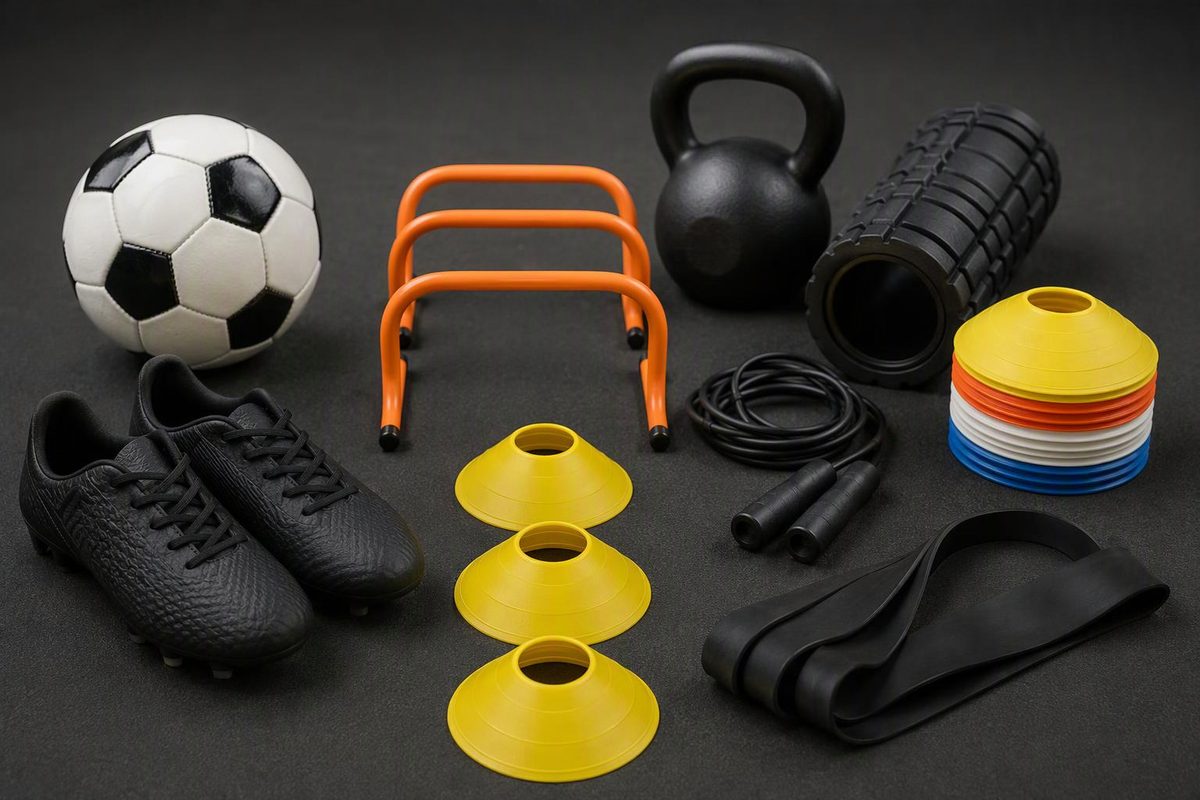
Build soccer quickness with short sprints, controlled turns, reactive drills and strength work. Includes a two-day starter plan and progress checks.
To get quicker for soccer, combine short sprints with plenty of recovery, braking and turning practice, reactive drills, and strength work. Fast-looking footwork is not the same as moving your body quickly—or choosing the right movement early.
Use up to two short quickness blocks per week, after warming up and before tiring conditioning. Coordinate them with your coach rather than adding them on top of an already demanding squad schedule. If the work is unfamiliar, start with one block.
Identify what is making you late
“Quicker” can describe several different problems. Choose the emphasis that fits yours:
| What happens in games? | Training priority |
|---|---|
| You lose ground in the first few steps | Acceleration over 5–20 metres, supported by strength and power training |
| You reach the opponent but struggle when they turn | Braking, planting and re-acceleration |
| You move well through cones but react late to opponents | Unpredictable movement cues and live 1v1 practice |
| You are quick without the ball but slow with it | First touch and dribbling under pressure |
| You start fast but cannot repeat efforts later | Conditioning alongside—not instead of—quickness work |
If you mainly lose longer footraces, you also need exposure to longer sprints. Our soccer sprint drills separate acceleration, top-speed work and repeated-sprint conditioning.
What the research changes
A systematic review covering 121 studies and 3,419 football-code athletes, predominantly male soccer players, found improvements in short-sprint performance from strength, power and plyometric training, resisted or assisted sprinting, and combined approaches. No single method was clearly best. Ordinary sport training and unresisted sprint/running-drill programmes alone did not produce significant pooled improvements. However, many sprint programmes used incomplete recovery, which limits the conclusion that sprinting itself is ineffective. The practical decision is to combine high-quality sprint practice with physical development—not simply run more tired sprints. Read the review.
Turning along a known route and reacting to an opponent also deserve separate practice. In a six-week trial of 32 elite male youth soccer players, planned direction-change training produced greater improvements in two planned turning tests without the ball, while reactive training produced greater improvements in reactive tests. Reactive-test time without the ball improved by about 9.4% with reactive training versus 4.6% with planned training. These were test improvements, not measured gains in match performance. Read the trial.
Much of this evidence comes from male players, including small youth samples. Use it to choose training components, not to promise every player the same improvement.
A two-day quickness starter plan
The following is a practical coaching template, not a replication of one study. It suits healthy adolescent and adult players already accustomed to sprinting and changing direction in soccer.
As a starting planning rule, leave 48–72 hours between demanding speed sessions, accounting for matches too. This spacing comes from athletics best-practice guidance, not a soccer-specific guarantee of recovery. Initially, keep unfamiliar extra work out of the final two days before a match. If the schedule does not leave room, use one block or omit extra work during congested weeks.
Before either block, spend roughly 10–15 minutes warming up: easy movement, dynamic mobility, controlled stops and turns, then three progressively faster accelerations. Extend the warm-up if you are not ready. Use a clear, even surface, suitable footwear and unobstructed space beyond every finish line to slow down safely.
Day A: acceleration
- Four 10-metre sprints, resting 2–3 minutes between repetitions.
- Two 20-metre sprints, resting 3–4 minutes between repetitions.
- Use a comfortable split stance. Push the ground away, drive the arms and rise gradually rather than forcing an exaggerated lean.
- Sprint through the finish, then decelerate in the clear run-out area.
These are fast efforts, not shuttle conditioning. Extend the rest if speed or movement quality has not returned; end the block if quality does not return. The sprint review highlights full recovery as important for maintaining maximal intensity. Recovery discussion.
Day B: braking, turning and reacting
1. Planned cut: four repetitions, two each way. Run five metres to a cone, turn approximately 45 degrees and accelerate another five metres. Begin at a controlled approach speed. Reduce that speed if you cannot plant and exit under control; do not treat the cone as a compulsory hard stop. Rest 60–90 seconds between repetitions.
2. Reactive exit: four repetitions. Place two exit gates five metres from a central cone, diagonally forward to its left and right. Approach the cone from five metres away. A partner indicates the exit as you approach, early enough to turn under control. Rest 60–90 seconds. Adjust the cue timing if players stumble or guess.
3. Live 1v1: four short attacks per player. In an approximately 8-by-10-metre area, put two scoring gates on the far end. The attacker has up to five seconds to dribble through either gate; the defender tries to prevent it. Rotate roles and allow at least 60 seconds before the same player’s next effort. No sliding tackles.
Extend recovery in any of these drills if quality falls. The live task is a coaching progression toward soccer-specific decisions, not proof that this exact layout improves match agility. Observe whether players respond to the defender and retain control—not merely whether their feet move rapidly.
Support the pitch work with strength and jumps
After the quickness block, or in an existing supervised strength session, use a manageable starting dose:
- Squat or split squat: two sets of six controlled repetitions; six per leg for split squats.
- Hip hinge: two sets of six.
- Calf raise: two sets of eight.
Choose resistance that leaves a few good repetitions available; do not train these sets to failure. Get coaching for unfamiliar exercises. This is an introductory dose, not a complete strength programme proven to improve sprint times.
If you already tolerate jumping comfortably, perform two sets of four controlled countermovement jumps after warming up and before Day A’s sprints. Rest 60–90 seconds between sets and reset after each landing. For a fuller progression, use our soccer plyometric starter plan rather than stacking both plans together.
Progress and check whether it works
If this work is new, begin with half the listed field repetitions. Build toward the full plan only if recovery and technique remain good. Then improve execution before adding volume; make reactive tasks less predictable rather than continually adding more sprints.
Before starting and after six weeks, check:
- 10-metre sprint: use the same start, surface, footwear and timing method; take two attempts with full recovery and consistently record the best time.
- Planned cut: check both directions with the same layout.
- Live play: record successful controlled exits across the same number of 1v1 attempts against comparable opposition.
Timing gates are preferable for sprint measurement. With a handheld stopwatch, do not treat tiny differences as certain improvement. Keep sprint and turning results separate from live-play observations: they answer different questions.
Do not make an agility ladder the centre of the plan. A small randomized trial in 18 U13 boys found no statistically significant additional sprint, agility or dribbling benefits over normal training after six weeks of ladder work. That does not establish that ladders are useless, but it is weak support for prioritizing them over these components. Ladder-training trial.
If ball control remains the limitation, redirect practice toward first touch under pressure. If sprinting, cutting or jumping causes pain, stop and seek assessment from a qualified physiotherapist or other appropriate healthcare professional. A return from injury needs an individually assessed progression, not this generic plan.