
Two soccer speed drills for turning and reacting
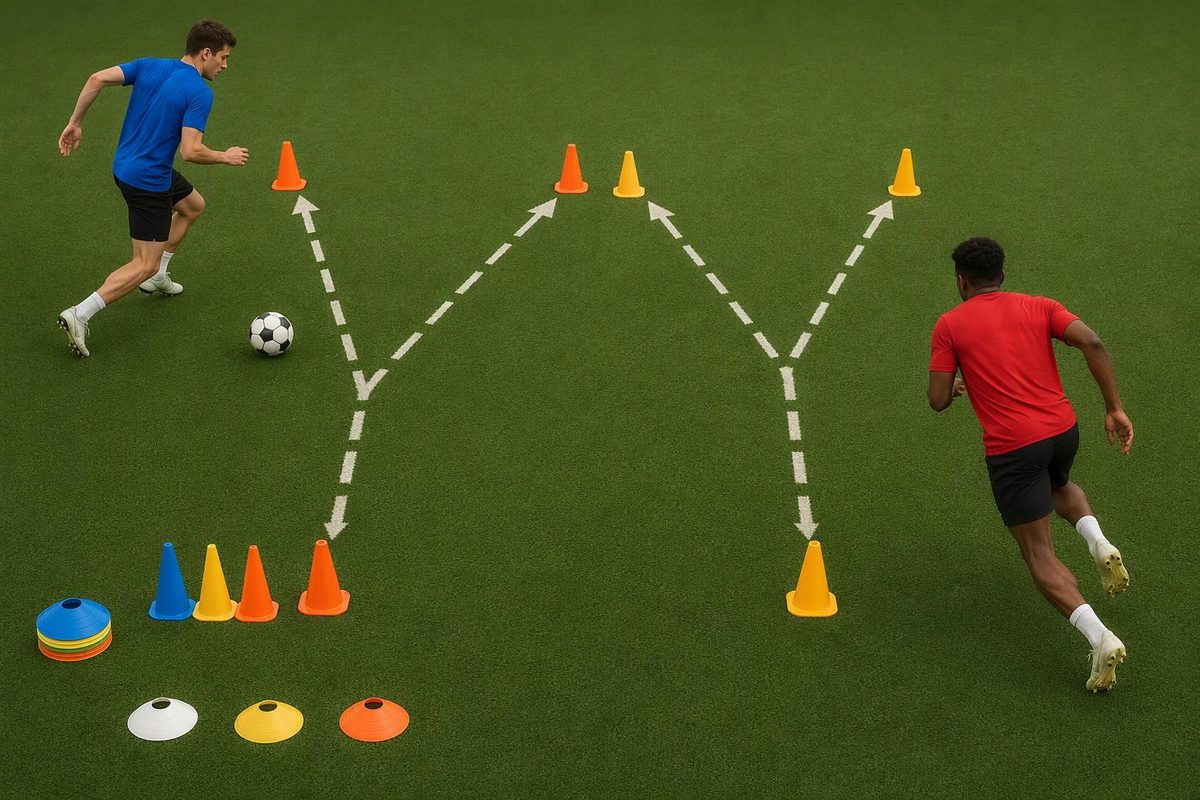
Use two Y-cut drills to practise planned turns and reactive agility, with clear layouts, recovery periods and a 15–20-minute training block.
To practise changing direction quickly, use a planned turn, then a reactive version of the same layout. Give players enough recovery to repeat fast, controlled efforts—not just finish the circuit.
This block targets turning and responding to a cue. For straight-line acceleration and high-speed running, use our separate soccer sprint drills guide.
Allow roughly 15–20 minutes after warming up. This is a coaching starting point for healthy adolescent and adult players already accustomed to sprinting and cutting, not a research-tested package. For younger children, use shorter, simpler chase games rather than copying the full dose.
The session at a glance
| Drill | Main target | Dose per player | Recovery between efforts |
|---|---|---|---|
| Planned Y-cut | Braking, turning and accelerating again | 4 repetitions: 2 each side | 2 minutes |
| Reactive Y-cut | Selecting a direction while moving | 4 repetitions | 2 minutes |
Treat recovery as a starting point, not a deadline. Extend it if players cannot reproduce their speed or movement control. A review integrating sprint research and elite coaching practice recommends full recovery for acceleration work, with 20 m efforts and two-minute recoveries as an example for young, relatively untrained athletes. The recovery above applies that principle; it is not an established optimum for soccer cutting drills. Haugen and colleagues, 2019
Before starting, use progressive running, dynamic mobility, controlled braking and turns, then several accelerations building towards session speed. Put this block before demanding games or conditioning. Use a clear, even surface, suitable footwear and generous run-off space. Stop for pain or altered running mechanics. Players returning from injury need an individually assessed progression.
1. Planned Y-cut
Setup: Place a turning marker 5 m from the start. From that marker, put two exit gates another 5 m away, approximately 45 degrees left and right of the original running line. Leave clear space beyond both gates for gradual slowing down.
Action: Tell the player which gate to use before starting. They accelerate towards the turning area, reduce speed as needed, change direction and accelerate through the chosen gate. Complete two efforts each side.
Coach one thing: “Prepare the turn before the final plant.” Encourage braking over the approach rather than trying to absorb everything in one last step. The marker indicates an area to turn; players do not need to touch it.
Make it easier: Rehearse at a controlled pace before fast efforts. Reduce approach speed if the player repeatedly slips, loses balance or cannot exit in the intended direction.
Keep the route unchanged while learning it. A faster time on a known cone course measures planned change-of-direction performance; it does not, by itself, show better decision-making.
2. Reactive Y-cut
Setup: Keep the same Y layout. Position the coach beyond the turning area, clear of both running routes.
Action: As the player approaches the junction, the coach points clearly towards one gate. The player selects that route, turns and accelerates through it. Give four efforts with an unpredictable sequence of left and right cues.
Initially, give the cue early enough for controlled braking. Move it later only when players can respond without scrambling into the turn. Do not withhold the cue until a safe turn is impossible.
Coach one thing: “See the cue, then commit.” Record wrong-gate choices as well as movement quality; speed alone can reward guessing.
Ball progression: Replace the pointing cue with a pass towards either exit. The player reacts to the pass direction, collects the ball and carries it through that gate. Begin with early, manageable passes and vary direction as control improves. This adds perception and ball control, so do not compare its times directly with the no-ball version.
What the research changes
Do not assume planned turning practice also trains reactive agility. In a study of 19 highly trained male U15 soccer players, six sessions of either pre-planned shuttle training or visually cued multidirectional training improved Illinois change-of-direction test performance. Only the visually cued group showed a significant improvement on the reactive test, with a reported within-group effect size of 1.03. Neither group significantly improved 20 m sprint performance. Born and colleagues, 2016
That suggests a reason to include reactive practice—not a promise that this Y-cut routine reproduces those results. The study used a computer-guided platform and repeated 15-second efforts, not the short, well-rested drills above. Its reactive test also does not establish better match decisions.
Fit it into squad training
Start with one block in the week, replacing some existing running rather than simply adding workload. Use parallel lanes and staggered starts, but check each player’s recovery: a queue is not a measured rest period. For unfamiliar players, begin with fewer repetitions.
End the block if efforts repeatedly slow or turning control deteriorates despite extra rest. If the aim is repeated efforts under fatigue, plan that separately using football conditioning drills.
Track planned-cut performance on each side and correct reactive choices. Use the same surface, distances, start procedure and timing method when comparing sessions. For reactive checks, give the cue at a consistent point on the approach while keeping direction unpredictable. Later cues belong in progression, not in a supposedly identical retest.