
Soccer Sprint Drills: Train Speed Without Turning Every Rep Into Conditioning
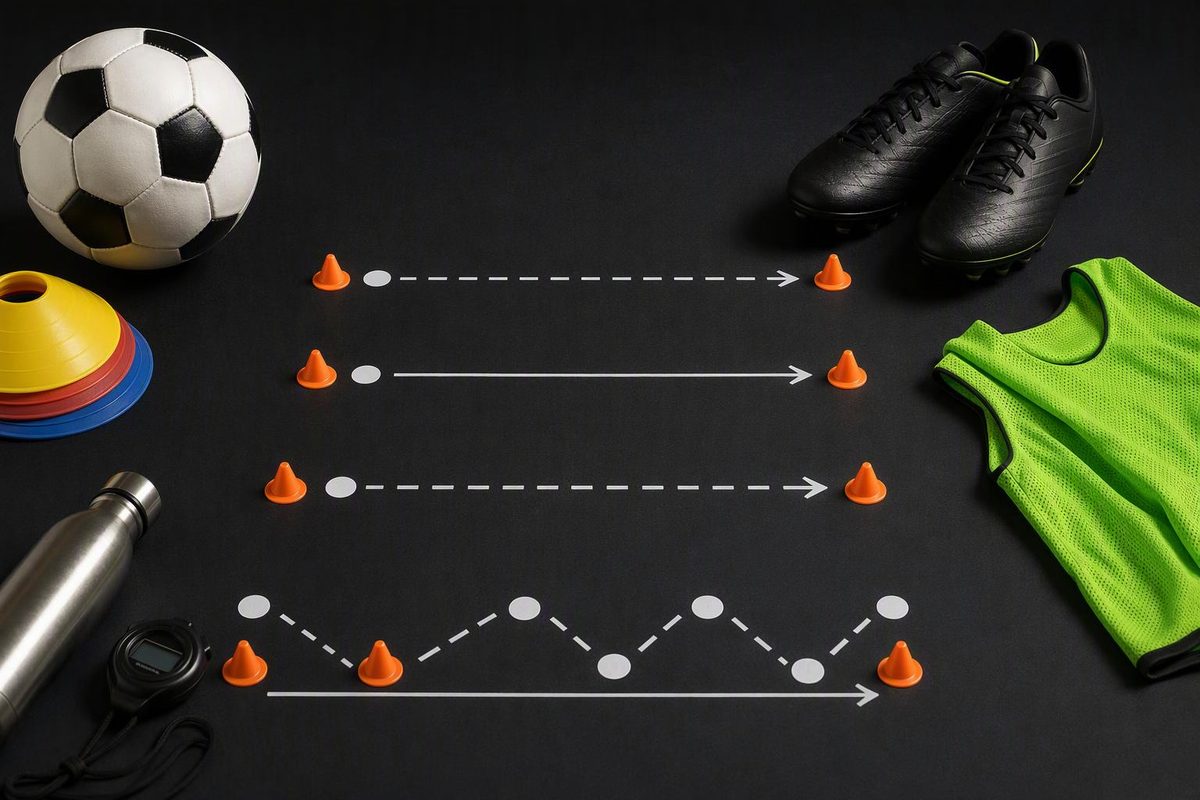
Four soccer sprint drills with distances, rest periods and a practical session plan. Separate acceleration and top-speed work from repeated-sprint conditioning.
For speed development, sprint while fresh and rest long enough to reproduce the effort. For repeated-sprint conditioning, deliberately shorten recovery. Those are different training decisions—not interchangeable versions of the same drill.
Start with straight-line acceleration and flying sprints. Use a reaction drill to practise responding to an opponent, or a separate repeated-sprint block when conditioning is the goal. You do not need all four in one session.
A practical speed session
For healthy older teenagers and adults already accustomed to sprinting, start with:
- 10–15 minutes of progressive warm-up: easy movement, dynamic mobility, controlled changes of direction, then three or four progressively faster runs. Extend it if players are not ready.
- 4 × 20 m accelerations, resting two minutes after each effort.
- 3 × flying 10 m sprints, using a 20–30 m build-up and four minutes of recovery between efforts.
Allow roughly 20–25 minutes for the sprint block after warming up, including recovery between drills. Put it before demanding games or conditioning. These doses are coaching starting points, not a protocol proven optimal for every squad.
Use a clear, even surface and suitable footwear. Mark enough unobstructed space beyond every finish for players to slow down gradually. Check that space during the progressive warm-up runs; do not make players stop on the finish line. Anyone returning from injury needs a progression assessed by a qualified coach or physiotherapist, not this generic session.
1. Straight-line acceleration
Goal: build speed from a standing or moving start.
Setup: mark a start and a finish 15–20 m apart, followed by the slowing-down area. Give each runner a separate lane.
Dose: 4–6 repetitions, with two minutes of recovery after each sprint. Extend recovery if the next effort is slower or visibly less coordinated.
Start in a comfortable split stance. Accelerate hard through the finish. Useful cues are “push the ground back” and “rise gradually”; avoid asking players to manufacture a long first stride.
Once the setup is familiar, occasionally start from a walk or sideways stance. Keep the distance and recovery unchanged so that the variation does not quietly become extra workload.
The recovery matters. A review integrating sprint research and coaching practice describes 20 m accelerations with two-minute recoveries as an example for young, relatively untrained athletes. It recommends full recovery and ending speed work when performance or technique deteriorates. That is athletics-derived guidance, not a soccer-specific optimal dose. Haugen and colleagues’ review
2. Flying 10 m sprint
Goal: practise high-speed running without making every repetition primarily a standing-start acceleration.
Setup: mark a 20–30 m build-up, a 10 m fast zone and a clear slowing-down area.
Dose: 2–3 repetitions, resting four minutes between efforts.
Build speed smoothly, enter the fast zone running fast, and continue through its end. Cue “tall and relaxed,” rather than reaching forward with the feet or tensing the shoulders.
The approach distance is adjustable: a player still accelerating strongly throughout the fast zone may need a longer build-up. A fixed 20 m approach does not guarantee that everyone reaches maximum speed.
Flying sprints with a 20 m build-up, a 10 m fast zone and approximately four-minute recovery appear in the same review’s developmental examples. The underlying decision is to allow more recovery for high-speed work, not squeeze it into a rapid-fire circuit. Flying-sprint guidance
3. Opponent-triggered acceleration
Goal: connect acceleration to a visible soccer cue.
Setup: place two players in adjacent lanes with a finish 10–15 m ahead. One is the leader; the other responds when the leader moves. No contact or crossing lanes.
Dose: four paired starts, giving each player four sprints. Swap the leader after each repetition and allow about two minutes of recovery between starts. Use this instead of, rather than automatically alongside, the straight-line drill.
The leader can vary when they start but must run forward once committed. The responder watches the opponent rather than waiting for a whistle. Keep the task simple enough that both players can accelerate decisively.
This is a coaching application for practising perception and movement together—not evidence that chase drills improve maximum speed more than straight sprints. If timing the drill from the leader’s first movement, the responder’s result includes their reaction delay. Keep that result separate from a sprint timed from the responder’s own start.
4. Repeated-sprint conditioning
Goal: practise producing repeated hard efforts with incomplete recovery.
Setup: mark a straight 20 m lane with slowing-down areas at both ends. Alternate running direction.
Starting dose: 1–2 sets of 4 × 20 m, with 30 seconds of recovery after each finish and three minutes between sets. Start with one set if this work is unfamiliar.
Sprint with maximal intent, slow down under control, then walk back to the finish line—which becomes the next start. That walk is part of the 30-second recovery. Do not add a shuttle turn unless braking and turning are part of the intended task.
A systematic review of 176 studies in team-sport athletes aged 16 and older found that shorter distances and longer rests reduced fatigue within repeated-sprint work. Longer distances and shorter rests increased physiological demands and sprint-performance decline. The proposed dose applies that finding; it is not a validated optimum. Repeated-sprint meta-analysis
For other conditioning goals, use the football conditioning drill guide rather than shortening every speed drill’s rest.
Progress the work, not the exhaustion
Start with one dedicated speed block weekly, fitted around matches and existing training. As a starting planning rule, leave 48–72 hours between demanding sprint sessions, accounting for match demands too. That spacing comes from athletics best-practice guidance; it is not a guarantee of recovery for a soccer player. Readiness and the squad schedule still determine the dose. Recovery guidance
Repeat the initial dose before adding work. Then change one variable: one extra acceleration or one extra flying sprint—not both plus shorter recovery.
Do not assume longer repetitions are automatically better. In a six-week study of 18 male U19 players, both 20 m and 40 m sprint-training groups improved, with no statistically significant difference between their changes. Total training distance was matched. The small sample and absence of a usual-training-only control limit what can be credited to sprint training itself. Short- versus long-distance trial
For monitoring, use the same start, distance, surface and timing method. Prefer dual-beam timing gates or suitable high-speed video over hand timing for short efforts; tiny stopwatch differences are not reliable evidence of progress. Sprint-monitoring review Extend rest when speed falls, and end pure-speed work if quality does not return. Stop immediately for pain or altered running mechanics.
Sprint drills are one component of speed development. A football-code systematic review supports strength, power and combined training approaches for medium- to long-distance sprint performance, without identifying one universally best method. It does not establish straight sprint practice alone as a reliably effective route to those improvements. Pair appropriate sprint exposure with planned physical preparation—not merely more repetitions. Training-method review