
Choose the Right Football Conditioning Drill
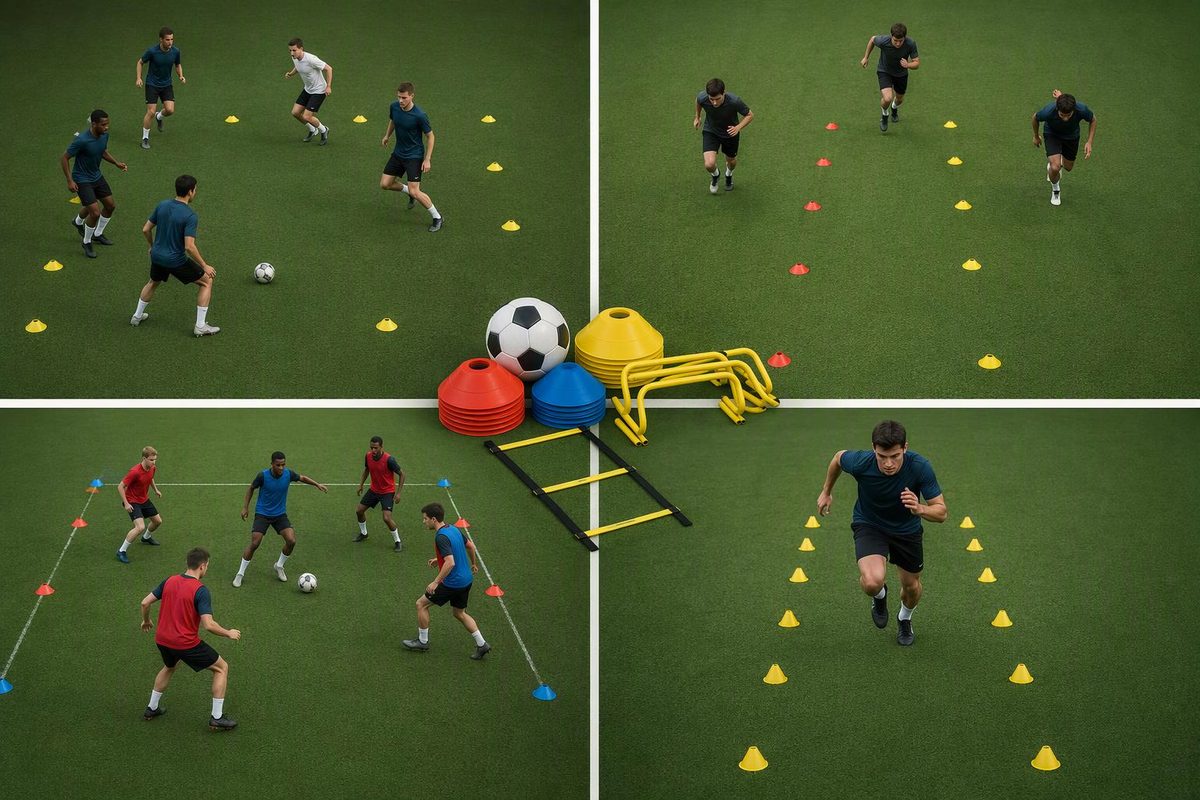
Match four football conditioning drills to aerobic fitness, repeated sprints, transitions or maximum speed, with practical doses and progressions.
Choose football conditioning drills by the adaptation you need: a 4v4 game for aerobic work with decisions, repeated 20 m sprints for repeated-sprint ability, 3v2 waves for transition conditioning, or build-and-fly runs for maximum-speed exposure. Do not choose a drill simply because it looks exhausting.
These qualities overlap, but they are not interchangeable. Small-sided games can develop endurance, yet they do not reliably supply enough high-speed running or maximal sprinting. Running work is easier to standardize; game-based work also trains perception, technique and tactics.
Choose the quality you need most; the selector identifies the matching drill and starting dose.
4v4 continuous game
Start with 4 × 4 minutes and 2 minutes of recovery.
| Goal | Drill | Starting Dose |
|---|---|---|
| Aerobic + decisions | 4v4 game | 4 × 4 min; 2 min recovery |
| Repeated sprints | 20 m sprints | 2 × 5; every 20 sec; 3 min between sets |
| Transitions | 3v2 waves | 2 × 4 min; 2 min recovery |
| Maximum speed | Build-and-fly | 4–6 reps; 3–4 min recovery |
Source: starting doses and constraints from the session templates in this guide; research context is cited in the accompanying sections.
Treat the doses as starting templates, not four stations in a circuit. Select one main option—or occasionally combine a small dose of fresh sprinting with a game—according to the session objective and the load players have already accumulated.
Use 4v4 for Aerobic Work With the Ball
Best for: aerobic conditioning when you also want pressing, support angles and ball actions.
Mark a 30 × 24 m area and play 4v4, using two small goals at each end or goalkeepers in larger goals. Complete 4 × 4-minute games with 2 minutes of recovery between games. Keep spare balls around the pitch for immediate restarts.
Play directionally and restart quickly. Avoid adding a touch limit merely to make the drill harder: it changes the game but does not guarantee the physical response you want.
If players can hide or the game becomes slow, use quicker restarts, reduce team size or slightly enlarge the area. If technique collapses and useful decisions disappear, shorten the bouts to three minutes or add recovery. Enlarging the pitch can create more room for high-speed running, but it also changes the tactical problem.
A meta-analysis of nine studies involving 232 male youth players found broadly similar improvements in endurance measures from high-intensity interval training and small-sided games. Neuromuscular measures were largely unchanged by both approaches (Sports Medicine Open). A small-sided game can therefore be a useful aerobic tool, but it is not a complete speed program.
The label “4v4” does not determine the load. Player numbers, pitch dimensions, goals, scoring rules, instructions and bout duration can all change the exercise. FIFA’s Training Centre recommends manipulating these variables deliberately to fit the intended technical, tactical and physical outcomes (FIFA Training Centre).
Use 20 m Repeats for Repeated-Sprint Ability
Best for: sustaining sprint performance when recovery between efforts is short.
Create parallel 20 m lanes with enough space beyond the finish for players to slow down. Run 2 sets of 5 × 20 m, starting one repetition every 20 seconds. Recover for 3 minutes between sets.
Demand maximal intent, but end the set if a player slows markedly or loses safe mechanics. Players can walk back or continue to a second starting line. Do not place an abrupt turn immediately beyond the finish, and use small lane groups so the exercise remains sprinting rather than a crowded race.
This is not the same as an aerobic interval. Repeated-sprint work uses maximal or near-maximal efforts with incomplete recovery. If players deliberately pace the opening repetitions, the session no longer targets the same quality. Extending recovery to several minutes shifts the emphasis toward high-quality speed.
A six-week trial in 27 male U15 players used maximal 15–30 m sprints with 20 seconds between repetitions and four minutes between sets. One or two weekly sessions produced similar changes when weekly sprint volume was matched. Both groups improved average, fastest and total repeated-sprint time, although the percentage performance decrement did not significantly improve (Biology of Sport).
A review of 21 soccer studies found mixed results across protocols, but improvement was more common in programs that included sprinting than in nonspecific programs (Applied Sciences). That supports specificity, not one universally optimal set-and-repetition scheme.
Start below the research volumes if players are new to maximal sprinting. Five clean repetitions are more useful than ten progressively slower ones.
Use 3v2 Waves for Transition Conditioning
Best for: repeated accelerations, recovery runs and decisions during attacking-to-defending transitions.
Mark a 30 × 25 m pitch with a goal and goalkeeper at each end. Start three attackers against two defenders. When the ball goes dead, the two defenders immediately attack toward the opposite goal and are joined by one player waiting at that end. The three original attackers recover and defend.
Rotate resting players into the next wave so work is shared. Play 2 × 4-minute bouts with 2 minutes of recovery.
Keep spare balls beside both goals and restart quickly. The coach’s job is to preserve continuity, not demand disorder. Pause and reset if players no longer understand their roles.
Begin with a consistent 3v2. Progress to 3v3 if attacking success is too easy, or lengthen the pitch slightly when players have no room to accelerate. If decision quality deteriorates, shorten the bouts before reducing recovery.
This drill is less standardized than straight running. Position, decisions and turnovers produce different individual loads. That variability is useful when the objective is transition play under fatigue, but it is a weakness when every player requires the same running dose.
Track participation rather than assuming equal work. If one player repeatedly misses waves because of the rotation, adjust the next bout or add an individualized running top-up. Do not claim a precise conditioning adaptation from the setup unless you also measure what players actually do.
Use Build-and-Fly Runs for Maximum Speed
Best for: maximum-speed exposure, not fatigue tolerance.
This is speed work rather than conventional conditioning, but it belongs in the plan because game-based conditioning alone may leave a sprinting gap.
Mark a 20 m progressive build-up, a 15–20 m fast zone and at least 20 m for gradual deceleration. Accelerate smoothly through the build-up, then run fast and relaxed through the fly zone.
Complete 4–6 repetitions with 3–4 minutes of recovery between runs. Place the drill after a progressive warm-up and before tiring games. The long recovery is intentional.
If a timed fly split clearly slows, posture deteriorates or a player reports pain, end the sprint work rather than turning it into accidental fatigue training.
A meta-analysis of six studies in male youth players found a small advantage for running-based HIIT over small-sided games for linear sprint improvement, with no clear between-method difference for jumping or change of direction (Frontiers in Physiology). It did not test this build-and-fly session specifically, but it supports the narrower conclusion that game conditioning should not be the only method used when sprint development is a priority.
Place the Main Conditioning Load Midweek
With one weekend match, a simple starting framework is:
- Early in the week: recovery or low-load technical work, depending on minutes played.
- Middle of the week: the main conditioning drill, after the warm-up and before lower-priority fatigue work.
- Later in the week: a small speed dose with full recovery, but only when players are recovered and enough time remains before the match.
- Day before the match: brief, sharp practice rather than a conditioning test.
This is not a fixed calendar. Match minutes, player age, training history, surface, heat and the rest of practice all change the appropriate dose. A demanding pressing game still counts as physical work even if the plan labels it “tactical.”
Use a structured soccer warm-up before maximal running. If the actual need is controlled aerobic work rather than a game-based drill, choose one of these soccer interval-training sessions.
Monitor Whether the Drill Hit Its Target
Record completed repetitions or bouts; attendance alone does not describe the dose. Time sprints where practical, or note clear slowing and technical breakdown. For game-based work, count successful transitions, shots or regains when those actions are part of the objective.
About 20–30 minutes after practice, ask each player for a 0–10 rating of the whole session. Multiplying that rating by session minutes provides a simple internal-load estimate (Journal of Human Kinetics). Use it to follow the player’s own pattern, not as a stand-alone injury predictor.
Check the next-day response as well. Unusual soreness, pain or fatigue should affect the next prescription.
Progress one variable at a time: add a repetition, extend a bout, reduce recovery or enlarge the pitch—not all four together. The aim is repeatable work that serves the football objective, not merely an exhausted squad.
Training carries injury risk. Players returning from injury, managing a medical condition or reporting pain need an individualized plan from a qualified coach, physiotherapist or clinician who can assess them directly.