
Four beginner dribbling drills, from ball control to a live defender
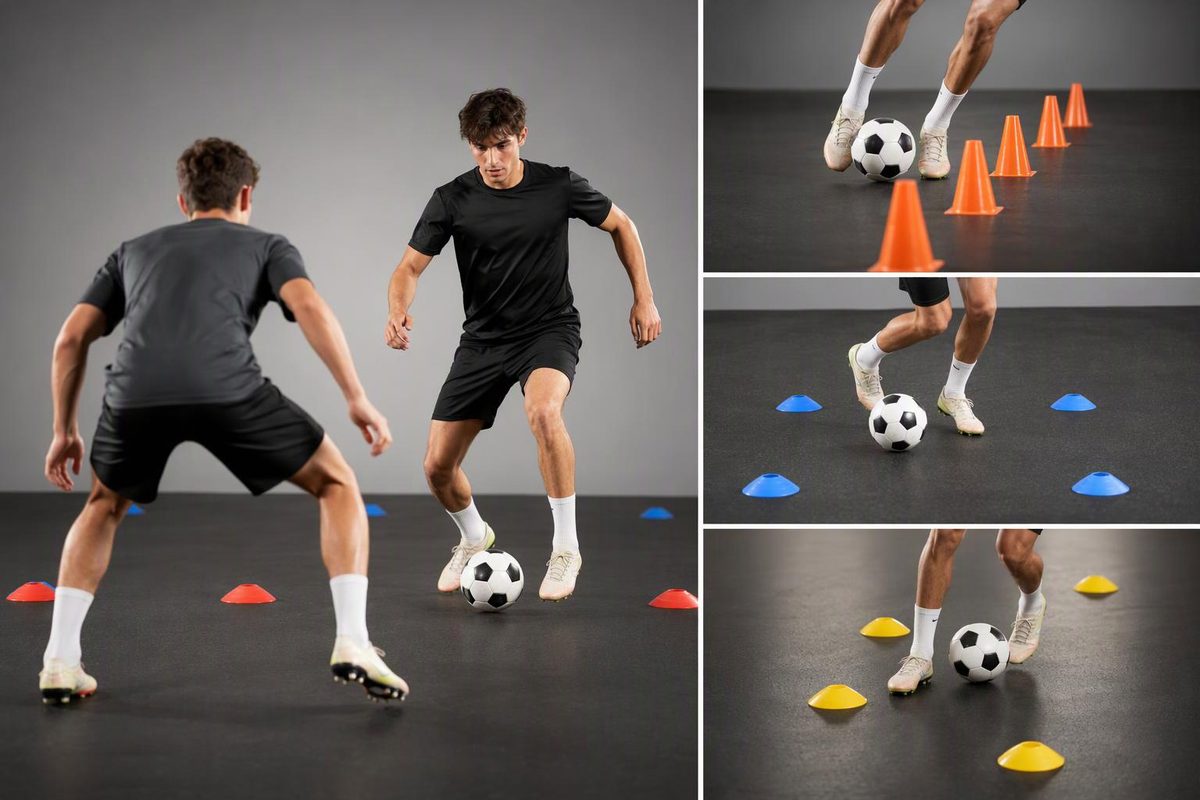
Try four football dribbling drills for beginners with simple setups, coaching cues and easier options, then check control against a defender.
If you are still learning to move with the ball, start with carrying it, stopping it and changing direction—not a long list of tricks. Then add a choice of targets and a defender. The aim is to keep the ball available for your next action, rather than complete a cone course as fast as possible.
These four football dribbling drills for beginners form a 20-minute skill block, including rest but excluding the warm-up and layout changes. You need a ball, eight flat markers and, for the final drill, a partner. Coaches can duplicate the layouts to keep players active rather than waiting in queues.
The dimensions and timings below are practical starting points, not a research-tested optimum. Begin with a few minutes of easy movement and gentle ball work on a clear, suitable surface. Stop if movement causes pain; persistent symptoms need assessment by a qualified professional.
1. Carry and stop — 5 minutes
Setup: Mark a square approximately 6 × 6 metres for one player. Give each player a separate space where possible.
Task: Dribble around the square at walking speed. Every few touches, stop the ball gently with the sole, choose a new direction and move again. Use the inside and outside of the feet to guide the ball; give both feet opportunities rather than forcing an alternating pattern.
Dose: Four rounds of 45 seconds, each followed by 30 seconds to rest and reset.
One cue: “Keep the ball close enough to stop without chasing it.”
- Easier: Take one touch, stop, then take another.
- Harder: Move at a light jog and vary the direction of each restart.
Allow players to look down to locate the ball. Start adding brief looks into the space ahead between touches, rather than demanding that they never look at it. FIFA’s grassroots guidance asks players to keep their heads up to avoid others while dribbling under control.
2. Turn and return — 5 minutes
Setup: Place two markers 5 metres apart, with clear space beyond each marker.
Task: Dribble towards the far marker, slow down before reaching it and turn back. Begin with an inside-foot turn: guide the ball across your path, turn your body and follow it in the new direction. Once comfortable, try stopping the ball with the sole and gently pulling it back before turning.
Practise turning in both directions. There is no need to learn several named moves in this block.
Dose: Four rounds of 45 seconds, each followed by 30 seconds to rest and reset.
One cue: “Slow down before the turn; leave with the ball.”
- Easier: Walk, stop completely and then turn.
- Harder: Make the turn while moving, then take two or three quicker steps away.
If the ball repeatedly escapes, reduce the approach speed. Do not make the turn tighter and faster at the same time.
3. Choose a gate — 5 minutes
Setup: Arrange four gates, each about 1.5–2 metres wide, around an 8 × 8-metre area. Use flat markers and leave room between gates.
Task: Dribble through one gate, look for a different gate and travel towards it. A gate counts only when the player carries the ball through and remains in control afterwards—not when they kick it through and chase.
Dose: Four rounds of 45 seconds, each followed by 30 seconds to rest and reset.
One cue: “Find your next gate before you arrive.”
- Easier: Use wider gates and walk between them.
- Harder: A partner closes one gate by standing safely outside it. The dribbler must choose another, and the partner can change which gate is closed between attempts.
This introduces a simple decision without immediate tackling pressure. When sharing an area, reduce crowding and ask players to avoid occupied gates. Once basic carrying and turning feel manageable, the separate cone-dribbling progression adds a slalom and changes of speed.
4. Two-gate 1v1 — 5 minutes
Setup: Mark an area roughly 8 metres long and 6 metres wide. Put two 2-metre gates on the far end line, one towards each side. The attacker starts at the opposite end with the ball; the defender starts nearer the gates.
Task: The attacker tries to dribble through either gate under control. Begin with a shadow defender who moves slowly to cover a route but cannot tackle or crowd the attacker. Once the attacker can manage this, allow the defender to win the ball with their feet. No sliding tackles.
Each attempt ends after a score, the ball leaving the area, the defender winning possession or 20 seconds. Alternate roles after every attempt, allowing time to walk back and reset. Continue for five minutes, taking extra rest if needed.
One cue: “Look for the open route, then take the ball into it.”
- Easier: Widen the gates or keep the defender in shadow mode.
- Harder: Allow live defending and narrow the gates slightly.
FIFA uses shadow defending without pressure as an easier version of an opposed possession exercise. The version here adapts that idea to dribbling; it is not evidence that this particular two-gate drill is superior.
Training alone? Repeat the gate drill with different routes. It remains ball practice, but it does not reproduce an opponent’s changing position.
Why include a defender so early?
A systematic review covering 35 soccer intervention studies found that repetition-based practice could improve technical outcomes. It also found support for practice that encouraged players to explore solutions in game-like situations; transfer from traditional drills to match performance remained largely unexplored.
The studies involved players with prior soccer experience rather than complete beginners, and the evidence was moderate in quality and varied substantially. The practical inference is to combine manageable ball repetitions with simple opposed practice—not to claim that beginners must master cone work before facing a defender.
What to record before making it harder
At the next session, repeat the same layout and note:
- Control: How often does the ball escape or leave the area?
- Turns: Can the player turn in both directions without a long recovery chase?
- Decisions: In 1v1, do they change route when the defender blocks their first choice?
Increase one demand at a time: speed, tighter space or defender pressure. A faster unopposed run shows progress on that task; keeping control while responding to an opponent is a separate check.