
Four Cone Dribbling Drills, From Control to Live 1v1
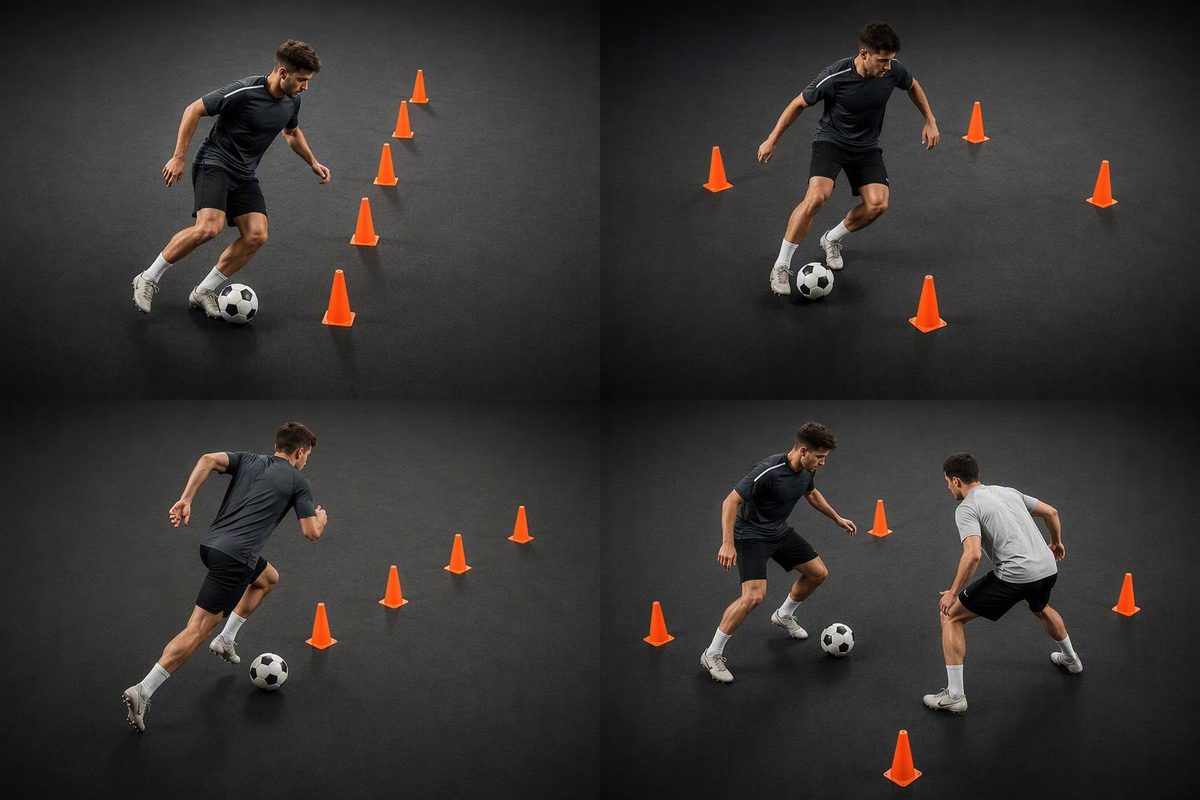
Use four football dribbling drills with cones to practise close control, turns, speed changes and live 1v1 decisions in a 20-minute block.
Use cones first to organise touches and turns, then to mark choices and scoring targets. Finish against a defender rather than making the same slalom increasingly complicated.
This four-drill block takes 20 minutes after a warm-up, including recovery and feedback, plus time to rearrange cones. You need eight flat cones per layout and a ball per player. Use an individual layout for each player in drills 1 and 2, then one layout per pair for drills 3 and 4. For squads, duplicate the layouts rather than building long queues.
The dimensions and timings below are coaching starting points—not a research-validated dose. Widen the spacing or slow the task when players repeatedly lose control; add pressure when they can complete it comfortably.
1. Slalom and accelerate — 4 minutes
Set up: Place six cones in a straight line, roughly 2 metres apart. Put a two-cone finish gate 5 metres beyond the last cone. Leave a clear return lane beside the course.
Do: Weave through the cones, then accelerate through the finish gate with the ball. Walk back outside the course. Use four rounds of 30 seconds’ practice and 30 seconds for recovery and feedback. Only one player enters each course at a time.
- Round 1: use both feet freely.
- Round 2: favour the right foot.
- Round 3: favour the left foot.
- Round 4: use both feet to weave around every cone as quickly as control allows.
Coach: Keep the ball within reach around the cones; take a longer touch into the clear exit space. Glance forward between touches rather than insisting that players never look at the ball.
Adjust: Widen the gaps for beginners. For a harder version, vary the gaps so the player must adjust touch size—not simply memorise a faster rhythm.
2. Square turns — 4 minutes
Set up: Mark a 6 × 6-metre square with a cone at each corner and one in the centre. Work individually.
Do: Start beside the centre cone, dribble towards a corner, turn before reaching its cone and return towards the centre. Choose a different corner next, passing beside the centre cone. Use four rounds of 30 seconds’ practice and 30 seconds’ recovery.
Practise an inside-foot cut, an outside-foot cut and a sole pull-back in the first three rounds. In the fourth, choose the turn that sends the ball towards the next corner. Try each action with either foot.
Coach: Approach under control, turn the ball into the intended exit path and follow it with your body. Avoid adding several decorative touches before leaving.
Adjust: Start at walking pace if the turn is unfamiliar. Progress by changing the approach speed and exit direction. A cone marks the turning point; it does not behave like a defender.
3. Choose an exit gate — 5 minutes
Set up: Make three gates, each about 1.5 metres wide, across the far side of a 10 × 10-metre area. Mark a starting point on the opposite side. A partner stands beyond the gates.
Do: Dribble forward. When the player is approximately halfway across, the partner points to one gate. The player identifies it, changes direction if necessary and carries the ball through. Reset outside the area and swap roles after each attempt. Use five rounds of 40 seconds’ practice and 20 seconds to recover.
Coach: Look up early enough to see the cue, then direct the next touch towards the exit. Count successful exits with the ball still under control rather than rewarding speed alone.
Adjust: Give the cue earlier to simplify the task. Give it slightly later to increase difficulty, without making the turn impossible. Practising alone? Choose a new gate on each run, but recognise that this removes the need to react to external information.
4. Two-gate 1v1 — 7 minutes
Set up: Mark a rectangle about 10 metres long and 8 metres wide. Put two 1.5-metre exit gates on its far end line, one towards each side. The attacker starts at the opposite end with a ball; the defender starts around halfway, facing them.
Do: The attacker scores by dribbling through either gate under control. The defender tries to win the ball or force it out. End each attempt after a score, turnover, ball out or about 10 seconds. Alternate attacking roles and take short recovery breaks throughout the seven-minute block.
Coach: Watch which gate the defender protects. Use a change of direction or feint when needed, then accelerate into the available space. Do not require a particular trick regardless of the defender’s position.
Adjust: Begin with a walking defender if necessary, then allow full pressure. Widen the area if every attempt ends immediately; narrow it if the attacker can bypass the defender without engaging them. Keep spare balls and neighbouring groups clear of the playing area. Stop or adapt the activity for pain or injury, with guidance from a qualified coach or physiotherapist.
What the evidence changes
FIFA’s ball-control session moves from unopposed work to interacting players, a competitive dribbling activity and a game. Its coaching points emphasise close control, looking forward and attacking available space. That is a practical model for using cones as an introduction, not the whole dribbling session.
Research also cautions against treating drill performance as complete evidence of learning. In a study of 40 boys averaging 10 years old, both passing-drill and game-based groups improved after five weeks, with better retention results reported for the game-based group five weeks later. This concerns passing, not cone dribbling, so it is indirect support for including dynamic practice—not proof that these four drills outperform alternatives.
A separate randomised study of players aged 9–12 found no significant between-group difference in skill-course improvement after 11 additional sessions focused on ball mastery and decisions. Both groups improved their course scores. Track cone control and live play separately: record clean slalom runs out of total runs, then successful gate attacks out of total attempts against a defender. Keep the layout and defensive pressure similar when comparing sessions. A faster rehearsed course alone does not establish better match dribbling.
For a longer session, continue into the live take-ons and small-sided play in the 35-minute dribbling progression.