
Solo football training: a 30-minute skills session, with optional conditioning
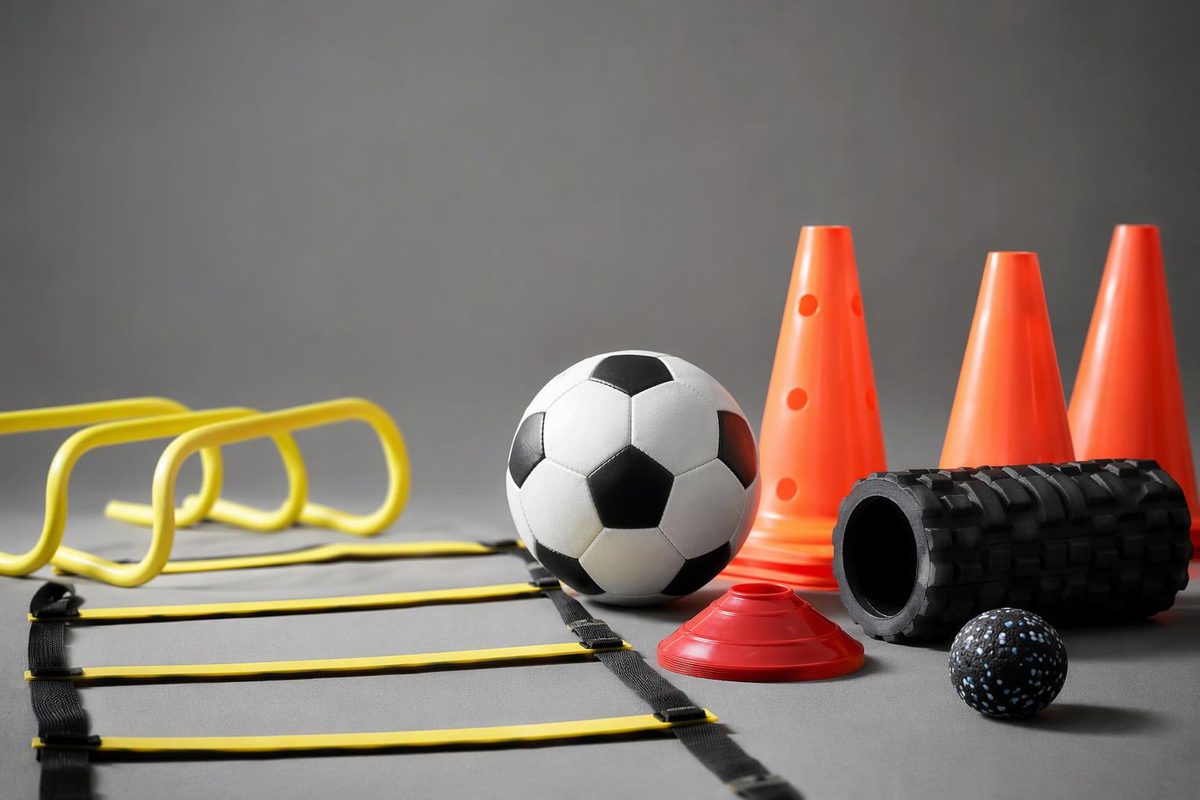
Structure solo football training around first touch, passing and dribbling, then choose conditioning that fits your goal and existing workload.
Build solo football training around one technical objective, a varied practice block and an optional physical block. You do not need to finish every session exhausted—or squeeze passing, shooting, sprinting and strength into the same workout.
Start with the 30-minute skills session below. Add conditioning only when it fills a gap in your existing training. This is a practical coaching template, not a routine that has been tested as a complete package. The physical options are intended for healthy adult recreational players; children and players returning from injury need an adapted plan.
A 30-minute solo skills session
You need a ball, four flat markers, water and a level, non-slip space. A safe wall or rebounder makes receiving practice possible. Check that rebounds and misplaced passes cannot reach traffic, windows or other people.
Choose a specific objective before starting: “Take my first touch into space, then make an accurate pass” is more useful than “improve everything.”
| Block | Time | What to do |
|---|---|---|
| Warm-up | 8 minutes | Easy movement, controlled mobility and progressively quicker ball actions |
| Receive and pass | 10 minutes | Wall passes, with the first touch directed through a side gate |
| Carry and release | 10 minutes | Dribble through a gate, turn, then pass towards a target |
| Record the session | 2 minutes | Note accuracy, the main error and overall effort |
1. Warm up progressively
Begin with easy jogging or walking with the ball. Add controlled squats, lunges, ankle movements and side steps, then increase the pace of your dribbling and passing. Include a few progressively quicker runs if you plan to run hard later.
The aim is to arrive at the first demanding action prepared, not already tired. Treat eight minutes as a guide, not a deadline; extend the warm-up if needed, especially before sprinting. If you add a physical block after a long technical section, briefly build the running pace up again before starting it.
2. Receive and pass
Stand roughly 3–5 metres from the wall. Make a one-metre gate on each side of your receiving position.
Pass against the wall, direct the rebound through one side gate with your first touch, then reposition and pass again. Practise both feet, adjusting your starting distance if the rebound is too fast to control.
Use three two-minute rounds, each followed by one minute to retrieve the ball, rest and adjust the setup. Finish with a one-minute accuracy check. That totals ten minutes. Count an attempt as successful only when the first touch clears the intended gate and the next pass reaches your wall target.
- Round 1: Repeat one receiving direction to understand the task.
- Round 2: Practise the other direction and foot.
- Round 3: Vary the passing angle and choose a gate according to where the rebound arrives.
3. Carry and release
Reuse the markers as two gates several metres apart. Dribble through one, turn towards the other, then finish the sequence with a pass towards a wall target or through the second gate. Reset after each attempt.
Use the same three-round structure and final accuracy check. Begin with a familiar turn, then vary your approach angle, turning direction and passing distance. Score the complete sequence: controlled carry, purposeful turn and accurate release—not simply touches per minute.
No wall? Use target gates for ground passes, retrieve the ball and reset. That still allows passing and dribbling practice, but it removes the incoming ball needed for receiving practice. With a safe goal available, you can replace this block with carry-and-finish attempts rather than adding another ten minutes.
The progression from repetition to variation is deliberate. Williams and Hodges’ review of soccer skill learning distinguishes looking better during practice from retaining and adapting a skill later. Much of the underlying evidence came from laboratory tasks and other sports, so it supports varying the challenge—not a claim that this exact gate drill improves match performance.
Choose the physical block separately
If technique is the priority, stop after the skills session. If fitness is the priority, shorten the technical work rather than treating every component as compulsory. Treat hard conditioning as a planned hard session, not a daily extra; if team training already covers that goal, omit it.
For aerobic conditioning
For players already accustomed to hard running, one researched option is:
- Four four-minute runs at 90–95% of measured maximum heart rate.
- Three minutes of easy jogging between runs.
- A clear route without repeated sharp turns.
That adds 25 minutes, bringing the session close to an hour once you allow for the transition and an easy finish. These are sustained hard efforts, not all-out sprints. Without a reliable maximum-heart-rate measurement, use a controlled hard pace you can repeat across all four bouts; that is an approximation, not confirmation that you matched the study intensity.
In a randomised trial of 19 elite junior male players, this interval format, performed twice weekly for eight weeks, improved aerobic fitness. The study detected no changes in measured speed, strength, kicking precision or passing quality. That distinction matters: running fitness does not replace technical practice.
A meta-analysis of 20 studies also suggested similar endurance improvements from running-based intervals and small-sided games, although evidence certainty was very low. Running is therefore a reasonable option when you have no partners—not proof that it is superior to playing.
If you are new to conditioning, do not start by copying an elite-junior dose. Keep the session easy and use an adapted progression with a coach; see the soccer interval-training options.
For speed or strength
Choose a dedicated quickness session or strength session instead of adding both after hard intervals. When speed is the main objective, place that work after the warm-up while fresh, then reduce the technical volume. This prioritises sprint quality: a review integrating sprint research and coaching practice recommends full recovery between acceleration repetitions and ending sprint work when performance or technique deteriorates.
Make the next session better—not just longer
Record three things: successful attempts out of total attempts, the most common error, and session duration plus overall effort from 0–10, where 0 is rest and 10 is maximal effort. Keep one short test unchanged between sessions so comparisons mean something. Increase only one challenge at a time: distance, target size, approach angle or pace.
Count solo work alongside team sessions, matches and gym training. The IOC load-management consensus recommends monitoring both work completed and the athlete’s response; no single marker of that response consistently predicts injury. If you are unusually fatigued, reduce or omit the physical block. Stop if pain changes how you move, and seek assessment for persistent symptoms.
Finally, check the skill against another player when possible. A wall provides rebounds, not an opponent’s pressure or a teammate’s movement. The FA’s individual-practice guidance for young players recommends combining individual skills and bringing them into game-like situations. Use solo practice to prepare the action; use live play to find out whether you can choose and execute it at the right moment.