
Strength Training Exercises for Soccer Players: A Practical Two-Day Plan
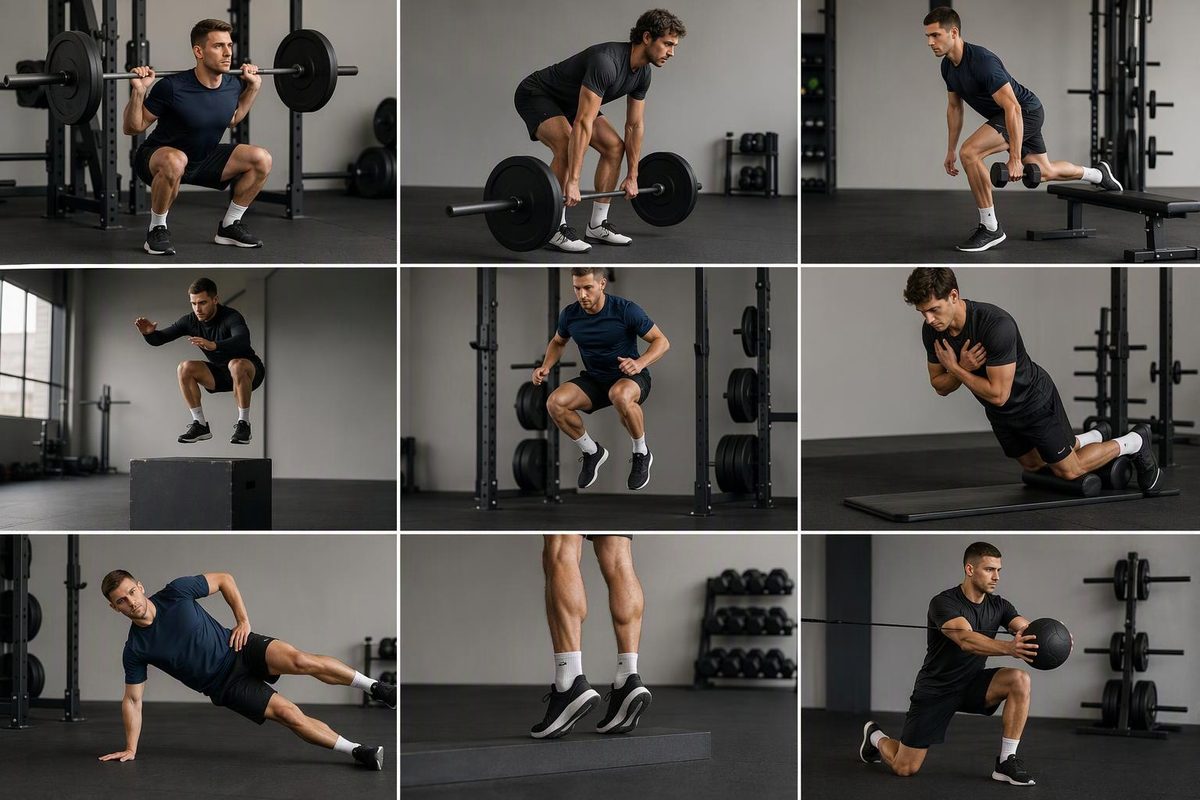
A two-day soccer strength plan with squats, hinges, single-leg work, jumps, Nordics, Copenhagen adduction, calves and trunk training.
Use two full-body strength sessions in pre-season or in weeks with enough recovery time. Build them around a squat, a hip hinge, single-leg work, hamstring and groin exercises, calf work, an upper-body push and pull, trunk control and a small dose of jumps.
During congested in-season weeks, one well-placed session may be the better decision. A review focused on highly trained players concluded that two weekly sessions can develop force and power in pre-season, while one can be enough to limit in-season detraining (Sports Medicine - Open, 2015).
The exact routine below has not been tested as a complete program. It is a practical template assembled from evidence on resistance, plyometric and injury-prevention training, and it should be adjusted around the player’s training history and soccer load.
The two-day strength plan
This is a starting plan for a healthy player with access to basic gym equipment. Perform jumps first, then the main lifts and finally the smaller exercises. Rest about two minutes after demanding sets and 60–90 seconds after accessories.
Session A: Squat and vertical-power emphasis
| Exercise | Sets × reps | Main coaching cue |
|---|---|---|
| Countermovement jump | 3 × 3 | Jump with maximal intent; take time to reset |
| Goblet squat or back squat | 3 × 5–8 | Keep the whole foot down and control the descent |
| Romanian deadlift | 3 × 6–8 | Push the hips back and keep the load close |
| Rear-foot-elevated split squat | 2 × 6–8 each leg | Lower under control; drive through the front foot |
| Standing calf raise | 2–3 × 8–12 | Use a comfortable full range and pause at the top |
| Row or pull-up | 2 × 6–10 | Move the shoulder blades, not only the arms |
| Side plank | 2 × 20–30 seconds each side | Keep ribs, pelvis and feet aligned |
Session B: Unilateral strength and horizontal power
| Exercise | Sets × reps | Main coaching cue |
|---|---|---|
| Standing broad jump | 3 × 3 | Project forward and land under control |
| Trap-bar deadlift or kettlebell deadlift | 3 × 4–6 | Push the floor away; finish tall without leaning back |
| Step-up or reverse lunge | 3 × 6–8 each leg | Keep the working knee tracking over the foot |
| Nordic hamstring exercise | 2–3 × 3–6 | Keep the hips extended and resist the fall |
| Short-lever Copenhagen adduction | 2 × 6–10 each side | Lift the lower hip and keep the trunk straight |
| Push-up or dumbbell bench press | 2 × 6–12 | Keep the trunk braced and shoulders controlled |
| Bent-knee calf raise | 2 × 10–15 | Move slowly through a comfortable range |
| Dead bug or Pallof press | 2 × 6–10 each side | Keep the pelvis still while the limbs move |
A player new to lifting can begin with two sets of each strength exercise and omit one accessory from each day. The listed lifts are options, not requirements: a goblet squat can replace a barbell squat, and a kettlebell deadlift can replace a trap bar. A movement the player can perform and progressively load is more useful than a fashionable variation.
Why these exercises make the cut
Squats, hinges and single-leg exercises build force
Squats and deadlift variations provide scalable ways to develop lower-body force. Split squats, lunges and step-ups add substantial work through one leg at a time. That is relevant to—but does not reproduce—accelerating, braking, cutting and kicking.
The evidence supports the training category more strongly than any one “best” lift. A systematic review of 34 studies involving 1,396 highly trained male youth players found that strength, plyometric and combined programs improved lower-body strength, jumping, horizontal power, acceleration and change-of-direction speed compared with normal soccer training. Effects on maximal running speed were smaller, while strength and combined training produced larger strength gains than plyometrics alone (Sports Medicine, 2024).
Getting stronger can therefore support soccer actions, but a squat does not replace sprinting. Players still need high-quality accelerations, faster running and change-of-direction practice on the field.
Jumps train fast force production
Place low-volume jumps near the start of a session, while the player is fresh. Use maximal intent, few repetitions and controlled landings rather than turning jumps into conditioning.
In the male-youth review, strength, plyometric and combined training all had positive effects, with the greatest confidence in improvements to vertical and horizontal power and acceleration. A separate review of 12 studies in female soccer players found better jump, sprint and change-of-direction outcomes from the plyometric interventions than from the strength interventions in that evidence base. Its authors also said the limited literature did not support a confident, exact prescription (International Journal of Environmental Research and Public Health, 2021).
The practical inference is to include force-oriented lifts and explosive work rather than treating them as rivals.
Nordics and Copenhagen adduction target the hamstrings and adductors
The Nordic hamstring exercise loads the hamstrings eccentrically as the player resists a forward fall. A soccer-specific meta-analysis found an injury-rate ratio of 0.49 for prevention programs containing Nordics versus no prevention measures—approximately a 51% lower hamstring injury rate (Sports Medicine, 2017). Only five studies met its criteria, and the result applies to programs containing the exercise, not necessarily to Nordics in isolation or to every player.
Start conservatively because unfamiliar eccentric work can cause substantial soreness. In one six-week trial involving male athletes, the researchers used 3 × 3–5 as their beginner Nordic dose before progressing to 3 × 6–8 (Orthopaedic Journal of Sports Medicine, 2021). A player unable to control the start of the fall can use band assistance or begin with sliding leg curls.
Copenhagen adduction directly challenges the hip adductors. Begin with the knee supported—the short-lever version—before progressing to support at the ankle. Do not introduce large doses of Nordics and Copenhagens together immediately before a match.
Strength exercises can complement an evidence-based soccer warm-up, but their repetitions still count toward the week’s total load.
Calf, upper-body and trunk work fill the gaps
Straight-knee and bent-knee calf raises challenge the lower leg in different joint positions. Rows, presses and trunk exercises round out the program without requiring elaborate “soccer-specific” variations. They are supporting work, not a reason to let the session expand indefinitely.
How hard should each set be?
For the main lifts, choose a load that allows stable technique and leaves roughly two good repetitions available at the end of each set. Increase it only when every prescribed set is controlled.
A simple progression is:
- Start with two sets and conservative loads in week one.
- Add a third set to the main lifts if the player recovers well.
- When every set reaches the top of its repetition range cleanly, increase the load by the smallest practical amount.
- Keep jump repetitions low; improve execution rather than chasing fatigue.
- Reduce sets—or use only one weekly session—during congested match periods.
For youth players, qualified supervision and technical competence matter more than lifting a particular weight. The National Strength and Conditioning Association’s youth guidance recommends light initial loads, 1–3 sets of 6–15 repetitions for strength exercises, 1–3 sets of 3–6 for power exercises and two or three nonconsecutive sessions per week (NSCA position statement). The plan uses the lower end of those ranges so strength work can coexist with soccer.
Place strength around the match, not just the calendar
With a Saturday match, a workable starting structure is:
- Sunday: recovery or rest
- Monday: Session A, but only if match recovery is adequate
- Tuesday: soccer training
- Wednesday: Session B after the field session
- Thursday: soccer training, with load adjusted to the squad
- Friday: short pre-match session
- Saturday: match
This keeps the second full lift about three days from the match. If the player is still notably sore or fatigued on Monday, do not squeeze two full sessions into the remaining days: complete one session on Wednesday and resume two the following week. In a week without a match, separate the two sessions by at least a day.
Combining field and gym work on the same day can preserve genuine low-load days, but the order should reflect the priority. Complete important technical, tactical or speed work before lifting when field quality matters most.
Track completed loads, repetitions and next-day soreness. If the team already tests a 10 m sprint or standing broad jump, compare results under consistent conditions every few weeks. If gym numbers rise while field performance declines, first examine fatigue, weekly placement and sprint exposure rather than adding another exercise.
Players who are injured, returning from injury or experiencing persistent pain need an individualized plan from a qualified coach or physiotherapist. A written routine cannot assess symptoms, technique or readiness in person.