
Strength Training Exercises for Soccer: A Practical Two-Day Plan
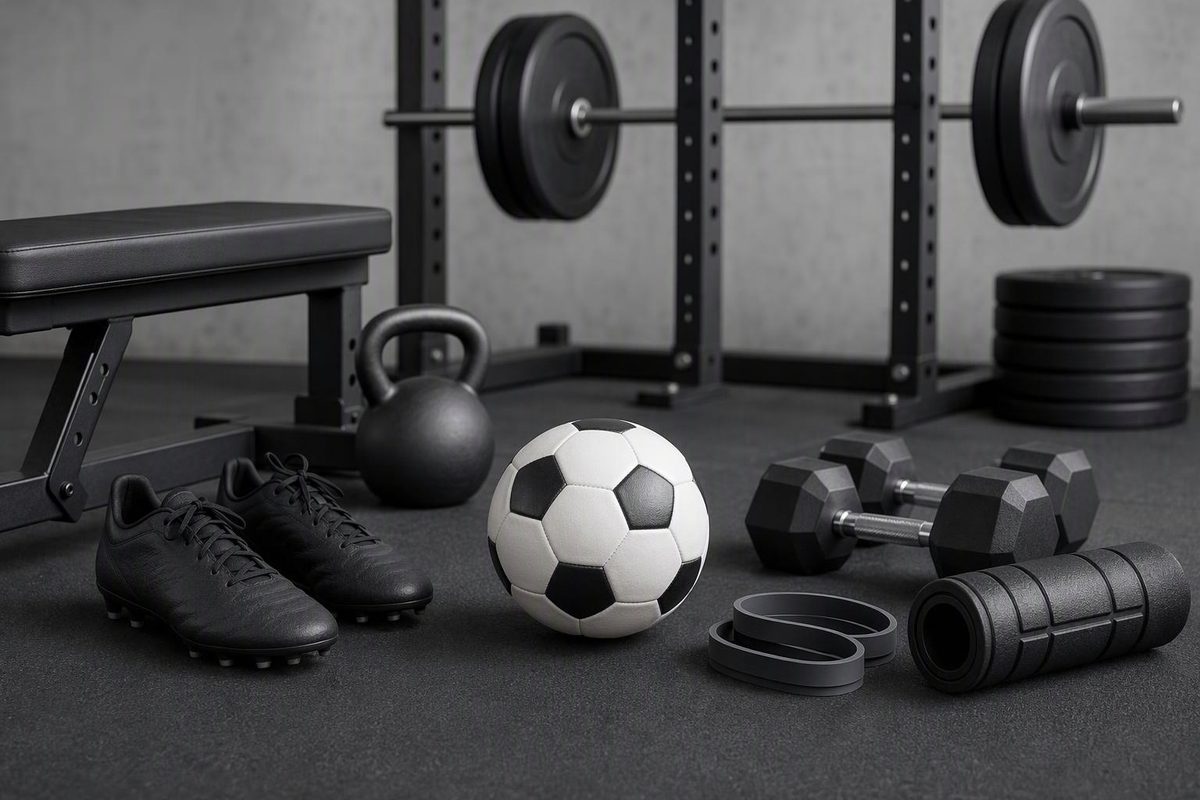
A two-day soccer strength plan with exercises, sets, reps, substitutions, progression and a practical in-season schedule.
For most soccer players with one match per week, two full-body strength sessions are a useful starting point. Build each around a squat or deadlift, a single-leg exercise, hamstring and calf work, an upper-body push and pull, and a small dose of jumping.
This is more useful than collecting dozens of “soccer-specific” exercises. The gym develops force and the capacity to tolerate it; soccer practice still teaches where and when to apply that force.
A meta-analysis of 34 studies involving 1,396 highly trained male youth players found that strength, plyometric and combined training improved strength, jumping, acceleration and pre-planned change-of-direction speed. Maximal-speed improvements were smaller, while strength gains were greater after strength or combined training than after plyometric training alone (Sports Medicine). Those findings support combining loaded strength work with a little jumping, but they do not identify one perfect exercise list.
The two-day soccer strength plan
Use the plan for six to eight weeks before reviewing it. Each session will usually take about 45–60 minutes; pair the upper-body exercises as a superset if time is tight. The repetition ranges are practical starting points, not a claim that one exact prescription is optimal.
Complete a progressive dynamic warm-up first, such as this five-minute soccer warm-up routine. Perform jumps before the heavy lifts and stop a set when height, distance or landing control clearly declines. On strength exercises, finish most sets with about two good repetitions still available rather than lifting to failure.
Day A: Squat and hamstring emphasis
| Exercise | Sets × reps | Main purpose |
|---|---|---|
| Countermovement jump | 3 × 3 | Rapid force production and landing practice |
| Goblet, front or back squat | 3 × 5–8 | Bilateral leg strength |
| Romanian deadlift | 3 × 6–8 | Hip-extension and hamstring strength |
| Rear-foot-elevated split squat | 2 × 6–8 each leg | Single-leg strength and control |
| Nordic hamstring exercise | 2 × 4–6 | Eccentric knee-flexor strength |
| Standing calf raise | 2–3 × 10–15 | Ankle plantar-flexor strength |
| Dumbbell row and push-up | 2 × 8–12 each | Upper-body pull and push strength |
Key cues
- Squat: Keep the whole foot in contact with the floor and use the deepest range that can be controlled without pain.
- Romanian deadlift: Push the hips back, keep the load close and stop before the lower back begins to compensate.
- Split squat: Lower under control and drive through the front foot. Use a stable surface so balance does not limit the strength stimulus.
- Nordic: Keep the hips extended, resist the forward fall and catch with the hands. Use a band or shorter range if four controlled repetitions are not possible.
Day B: Hinge and lateral emphasis
| Exercise | Sets × reps | Main purpose |
|---|---|---|
| Lateral bound with controlled landing | 3 × 3 each side | Side-to-side power and landing control |
| Trap-bar deadlift | 3 × 4–6 | High-force hip and knee extension |
| Reverse lunge or step-up | 3 × 6–8 each leg | Unilateral strength |
| Hip thrust | 2 × 6–10 | Hip-extension strength |
| Copenhagen adduction exercise | 2 × 6–10 each side | Adductor strength |
| Seated calf raise | 2–3 × 10–15 | Soleus and ankle strength |
| Overhead press and cable row | 2 × 8–12 each | Upper-body push and pull strength |
Key cues
- Lateral bound: Jump only as far as you can while holding the landing for one to two seconds.
- Trap-bar deadlift: Brace before leaving the floor and stand tall without leaning backward at the top.
- Copenhagen adduction: Begin with the top knee supported on a bench and the lower foot assisting. Progress to supporting the top ankle only when the shorter-lever version is comfortable.
The Copenhagen exercise is well supported as an adductor-strength exercise, but its isolated effect on groin injuries remains uncertain. A 2025 review found large improvements in hip-adduction strength but no statistically significant reduction in seasonal groin injuries; the certainty of all findings was rated very low (systematic review).
An earlier cluster-randomized trial reached a more favorable injury result using a progressive Copenhagen-based program—not simply two weekly sets. Semiprofessional male soccer players trained three times per week for six to eight preseason weeks, then once weekly for 28 competitive weeks. The intervention group had a 41% lower risk of reporting groin problems than controls (British Journal of Sports Medicine). The practical conclusion is to use Copenhagen work to strengthen the adductors, not to promise that one exercise will prevent every groin injury.
Why the Nordic earns a place
A systematic review of 15 studies and 8,459 athletes found that injury-prevention programs containing the Nordic hamstring exercise had a hamstring-injury risk ratio of 0.49 compared with programs without it—approximately half the rate (British Journal of Sports Medicine). The result applies to programs that included Nordics, not necessarily to the exercise in isolation. Thirteen of the 15 studies involved male athletes, and the programs and adherence levels varied.
More is not automatically better. In a randomized preseason trial involving 45 female soccer players, a low-volume Nordic program totaled 144 repetitions over eight weeks, while a high-volume program totaled 538. Both groups increased maximal eccentric hamstring force by 10–13%, with no meaningful difference between them; neither program improved sprint or jump performance (Scandinavian Journal of Medicine & Science in Sports). This was a strength study, not an injury trial, but it supports building tolerance without immediately copying a high-volume protocol.
A simple starting progression is:
- Weeks 1–2: 1–2 sessions of 2 × 4
- Weeks 3–4: 2 sessions of 2 × 5
- Weeks 5–8: 2 sessions of 2 × 6
Reduce the range or add band assistance if technique breaks down. Significant hamstring soreness is a reason to hold or reduce the dose, not a target.
Choose substitutions by purpose
Equipment matters less than preserving the movement and training goal.
| If this is unavailable | Use this instead |
|---|---|
| Barbell squat | Goblet squat, weighted-vest squat or leg press |
| Trap-bar deadlift | Kettlebell deadlift or conventional deadlift |
| Romanian deadlift | Single-leg Romanian deadlift or cable pull-through |
| Rear-foot-elevated split squat | Reverse lunge, step-up or regular split squat |
| Nordic bench | Partner-held Nordic or hamstring slider curl |
| Copenhagen exercise | Side-lying hip adduction or cable adduction |
| Heavy weights | Slower lowering, pauses, more range or a harder unilateral variation |
A meta-analysis of controlled trials in healthy people aged 8–28 found that resistance training improved pre-planned change-of-direction speed. Its subgroup analyses found similar improvements from machine and free-weight programs, and no measured training variable emerged as a significant predictor of the effect (Sports Medicine). A machine is therefore not automatically “less athletic.” Choose a version the player can perform consistently and load progressively.
Place the sessions around soccer
With one Saturday match, a workable starting schedule is:
- Tuesday: Day A at full planned volume
- Thursday: Day B with one set removed from each main lower-body lift
- Saturday: Match
This is a scheduling example, not a universal rule. It places the larger strength dose earlier in the week and reduces the later dose. Do not introduce an unfamiliar exercise or suddenly increase Nordic, lunge or deadlift volume on Thursday. If Thursday lifting leaves the player heavy or sore for Saturday, move it earlier, cut more volume or use one weekly session.
When a demanding field session and lifting must occur on the same day, completing the lift after the priority speed or soccer work can avoid adding another hard day. The right arrangement still depends on the player’s match minutes, training load, lifting experience and response.
During a two-match week, use one short maintenance session or omit the second lift. Keep the major patterns rather than trying to squeeze in every accessory:
- jump or bound: 2 × 3;
- squat or deadlift: 2 × 4–6;
- single-leg exercise: 2 × 5 each side;
- Nordic: 2 × 4;
- calf and upper-body exercise: 2 sets each.
Strength work may contribute to injury-risk reduction, but it is not protective armor. A meta-analysis of randomized trials across sports found fewer acute and overuse injuries with strength-based prevention programs. However, it included only six studies using five different interventions across varied populations (British Journal of Sports Medicine). Soccer exposure, sprint preparation, previous injury and rehabilitation still matter.
Progress without chasing fatigue
Use a simple double progression:
- Select a load that permits the bottom of the repetition range with about two repetitions in reserve.
- Add repetitions over subsequent sessions while maintaining the same technique and effort margin.
- Once every set reaches the top of the range, add a small amount of load and return to the bottom.
- If performance drops for two sessions, reduce the load or remove one set rather than forcing progression.
Record the exercise, load, repetitions and any pain after each session. Every two to four weeks, check whether the player is lifting more with the same technique and whether the work still fits around soccer. The aim is greater usable strength with manageable fatigue—not exhaustion for its own sake.
Players new to lifting, adolescents and anyone returning from injury should learn the movements under qualified supervision. Pain, a current injury or a medical restriction requires individual assessment from an appropriate coach or physiotherapist rather than a generic program.