
Turn Five Minutes of Mobility Into Match-Ready Movement
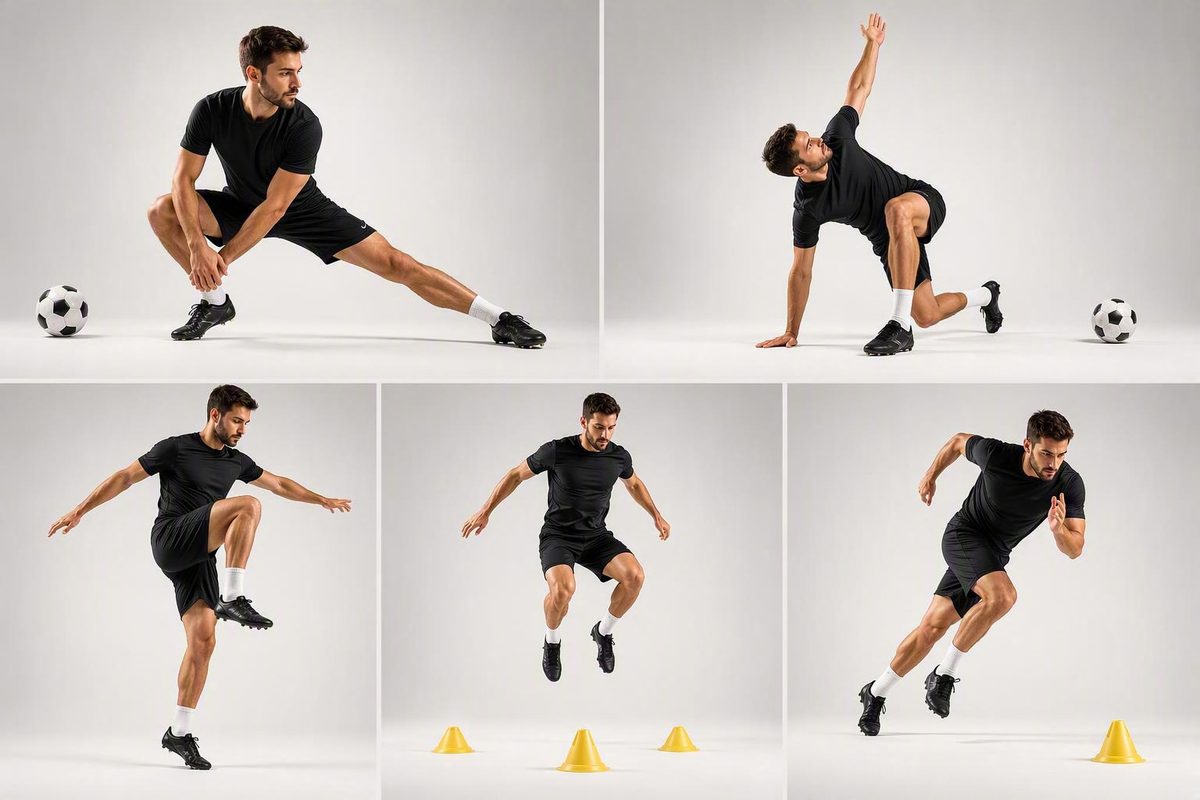
Mobilize the hips and lower limbs, then progress into balance, jumps, accelerations, planting and direction changes before full-speed play.
For healthy players aged 14 and older, use the five-minute sequence below to mobilize the hips and lower limbs without forcing range or creating fatigue. Then continue into balance, strength, landing, jumping, acceleration, planting, and direction changes. This is a mobility block—not a complete warm-up or a standalone injury-prevention routine.
The five-minute soccer stretching routine
| Movement | Practical duration | Target area | Key cue |
|---|---|---|---|
| Easy jogging | 60 sec | Whole body | Start relaxed; raise pace gradually |
| High knees | 20–30 sec | Hip flexors, ankles | Stay tall and find a smooth rhythm |
| Heel or butt kicks | 20–30 sec | Quadriceps, knees | Keep hips forward; do not sprint |
| Hamstring sweeps or straight-leg walks | 30 sec | Hamstrings | Keep a long spine and use a comfortable range |
| Walking lunges with overhead reach | 30 sec | Hip flexors, quadriceps | Control the pelvis; track the knee over the toes |
| Open-and-close hip gates | 30 sec | Hips, groin | Rotate from the hip, not the supporting knee |
| Front-to-back and lateral leg swings | 30 sec | Hips, hamstrings, adductors | Begin small; keep the trunk and pelvis stable |
| Calf raises, ankle bounces, or low skips | 30 sec | Calves, ankles | Use quiet contacts and an easy rhythm |
| Transitions and optional repeat | Remaining time | Player-specific restriction | Repeat one limited area only if time permits |
This is a coach-ready template assembled from commonly recommended movements rather than a validated five-minute protocol. TOCA suggests spending approximately 20–30 seconds on controlled dynamic movements, but that is a practical starting point—not a research-established minimum effective dose (TOCA dynamic stretching guide).
The listed movements take about 4 minutes 10 seconds to 4 minutes 30 seconds. Use the remaining 30–50 seconds for transitions. If players move efficiently, they can briefly repeat one restricted area; if transitions consume the allowance, omit the repeat rather than pushing the block beyond five minutes.
For a squad, arrange players in lanes or around a cone grid and keep the sequence moving. Each exercise should look slightly more active than the previous one, but none should be painful, forced, or exhausting. Players should finish ready to accelerate—not feeling as though they have completed a conditioning set.
Scope note: The main routine is general pre-play guidance for healthy players aged 14 and older. Players aged 7–13 should use an age-specific warm-up with appropriate coaching rather than treating this as a reduced adult programme.
How to perform each movement—and what it prepares
Think about the next soccer action rather than stretching isolated muscles. Mobility earns its place when it helps a player progress from an easy jog toward efficient running, stable planting, controlled landing, and quick ground contacts.
Build running rhythm: high knees and heel kicks. Stay upright, look forward, and let the arms move naturally. During high knees, lift each thigh only as far as posture allows; do not lean backward to manufacture height. During heel kicks, cycle the lower leg smoothly rather than arching the back or sprinting in place. Both movements should establish rhythm, not maximal speed.
Prepare the stride: hamstring sweeps or controlled straight-leg walks. Step forward under control, place the heel lightly, hinge slightly at the hips, and keep the spine long. Sweep the hands past the leg or walk with a comfortably raised straight leg. Do not reach forcefully for the toes. The aim is to rehearse controlled hip motion before stride length and running speed increase.
Open the front of the hip: walking lunges with an overhead reach. Take a manageable step and lower under control. Keep the trunk upright, the pelvis stable, and the front knee tracking in line with the toes. Reach overhead without flaring the ribs or forcing the lower back into an arch. Look for a comfortable moving range through the hip flexors and quadriceps, not pressure in the knee or lower back.
Prepare to plant and turn: open-and-close gates. Lift one knee, rotate the thigh from the hip, place the foot down, and alternate sides. Keep the supporting foot, knee, and hip aligned. Do not gain range by twisting through the planted knee. For lateral mobility, step or sit into a comfortable side-to-side range while maintaining control through the supporting leg.
Increase usable hip range: leg swings. Hold a fixed, secure support if balance limits the movement. Begin with a small front-to-back arc, followed by a small lateral arc. Increase range only while the trunk stays tall and the pelvis remains controlled. A larger swing is not better if the body rotates, the back arches, or the supporting knee collapses inward.
Prepare for acceleration contacts: calf raises, ankle bounces, or low skips. Start with slow calf raises when control is the priority, then progress to small ankle bounces or low skips. Keep contacts quiet and springy, with the knees softly unlocked. Increase the rhythm gradually.
These choices fit broader expert guidance that a soccer warm-up should progress from jogging and mobility into strengthening, balance, plyometrics, changes of direction, and gradually faster sprinting (Johns Hopkins soccer warm-up guidance).
Common errors
- Bouncing aggressively into end range
- Chasing maximal flexibility
- Letting the knee collapse inward
- Twisting through the supporting leg
- Holding the breath
- Turning mobility into conditioning
What should come after the stretches
No—five minutes of dynamic stretching is not enough preparation for full-speed soccer. Mobility does not replace strength, balance, landing, plyometric, cutting, or acceleration work.
| Stage | Purpose | Practical examples |
|---|---|---|
| 1. Light running | Raise activity gradually | Easy jogging, lateral shuffles, gentle direction changes |
| 2. Dynamic mobility | Move the hips and lower limbs through controlled ranges | Sweeps, lunges, hip gates, leg swings |
| 3. Strength and balance | Establish control before speed | Single-leg balance, squats, controlled lunges |
| 4. Jumps and landings | Prepare force absorption and production | Low hops, vertical jumps, soft landings, bounding |
| 5. Soccer-speed movement | Approach the demands of play | Progressive accelerations, plant-and-cut actions, changes of direction |
Keep the early strength work brief enough to preserve freshness. During jumps and hops, prioritize a stable trunk, aligned hip-knee-foot position, and soft landing before adding speed or complexity. Finish with several accelerations that rise progressively toward the session’s required pace, followed by planned planting and direction changes.
The FIFA 11+ shows why stretching should not be separated from the rest of preparation. Its 15 exercises cover running and active mobility, strength and balance, plyometrics, and faster running with planting and cutting. The complete programme takes roughly 20 minutes and is recommended at the start of training, while selected running components are used before matches. Any injury findings associated with the 11+ concern regular performance of the complete programme—not stretching alone (FIFA 11+ manual).
Soccer Science’s full 20-minute soccer warm-up guide provides a broader session template. Use this five-minute sequence for its mobility phase rather than allowing it to replace the complete structure.
Dynamic versus static stretching before soccer
Dynamic stretching means moving joints and muscles through a controlled range. Static stretching means reaching a position and holding it. Immediately before soccer, dynamic movement is the more practical centerpiece because it can progress directly into running, jumping, landing, and cutting.
| Timing | Purpose | Movement and examples | Evidence limitation |
|---|---|---|---|
| Before play | Prepare for increasingly fast action | Dynamic sweeps, lunges, hip gates, swings, and skips | No single duration is proven optimal for every player |
| Before play, if static work is needed | Briefly address a specific restriction without replacing active preparation | Comfortable, non-painful hold followed by dynamic movement | The best duration and total volume are not established here |
| After activity or separately | Work on flexibility when immediate soccer actions are not the priority | Relaxed static holds | This article does not establish recovery or next-session benefits |
A WakeMed soccer handout, for example, prescribes 30-second static holds repeated three to five times. That instruction does not establish that the same timing or volume is optimal immediately before soccer, because the handout does not compare its routine with a dynamic, soccer-specific warm-up (WakeMed soccer stretching handout).
If a player uses static stretching for a specific flexibility goal, it can be done after activity or in a separate session. Before play, it should not displace progressive running, dynamic mobility, balance, landing, or faster soccer actions. This article does not provide evidence that post-session static stretching clears lactate, prevents soreness, accelerates recovery, or improves the next performance.
If you use plyometrics, put dynamic mobility first
A 2026 randomized crossover trial involved 20 male amateur soccer players with a mean age of 20.5 years. Each player completed three conditions in counterbalanced order: dynamic stretching followed by drop jumps, drop jumps followed by dynamic stretching, and standard dynamic activities. Sessions were separated by at least 72 hours (randomized crossover trial indexed by PubMed).
Dynamic stretching followed by drop jumps produced the following pre-to-post changes:
| Test | Change | Effect size |
|---|---|---|
| 10 m sprint | −0.05 sec | d = 0.65 |
| Planned L-drill | −0.15 sec | d = 0.78 |
| Countermovement jump | +1.23 cm | d = 0.29 |
| Standing broad jump | +4.20 cm | d = 0.38 |
The narrow practical takeaway is that when a suitable player is already using drop jumps for acute potentiation, the tested evidence favors performing dynamic stretching first. Neither sequence improved repeated-sprint total time or fatigue index.
Do not extend the conclusion beyond the experiment. The L-drill followed a planned route, so it was not a test of reactive match agility. The trial does not establish the ideal plyometric exercise, drop height, or volume, and it did not examine long-term performance or injury outcomes.
Its sample was small and homogeneous, included only young male amateurs, and measured immediate responses. The trial was also registered retrospectively. The findings should not be assumed to apply equally to women, children, professionals, older adults, or injured players.
Choose an age-appropriate routine
FIFA identifies its standard 11+ programme for players aged 14 and older. That makes it a better reference point for the main routine’s age scope than a general warm-up intended for all players (FIFA injury-prevention programme overview).
Players aged 7–13 have a separate FIFA 11+ for Kids programme. It takes about 15 minutes and consists of seven exercises performed in order. Its emphasis is coordination and attention, balance, leg and core strength, single-leg jumping, controlled landing, and falling skills—not a shortened list of adult stretches (FIFA 11+ for Kids manual).
The children’s programme has five difficulty levels. Players advance only after repeatedly demonstrating correct execution, and coaches are instructed not to skip levels. A child may also be at different levels in different exercises.
Adult exercise doses and findings from the 20-player plyometric-sequencing trial should not be transferred to children. For ages 7–13, use age-specific programme guidance and active coaching supervision instead of arbitrarily cutting adult repetitions in half.
Technique checks and reasons to stop
Before the session:
- Identify existing injuries, pain, or movement restrictions.
- Remove loose balls, unsuitable equipment, holes, and other hazards from the working area.
- Confirm that players have enough space to swing, lunge, jump, and decelerate safely.
- Select a movement level each player can control.
The Fit Football programme manual similarly advises coaches to identify injuries and limitations before starting, remove hazards, adapt exercises to participants, and stop when discomfort or dangerous conditions appear.
During every phase, check for:
- Upright posture
- A stable trunk and pelvis
- Hip-knee-foot alignment
- Knees tracking over the toes
- Soft, quiet landings
Increase range, speed, or complexity only after the current version can be completed correctly and without difficulty. Progress gradually rather than asking players to jump directly from easy mobility to maximal actions.
Stop or modify a movement if it causes pain, instability, worsening restriction, or visibly altered mechanics. General soccer stretching guidance is not rehabilitation or return-to-play advice.
Training carries injury risk. A player with an existing injury or uncertain readiness should seek assessment from a qualified coach or physiotherapist who can observe them directly.