
Five simple soccer games for a five-year-old’s first practices
Run a 30-minute soccer practice for five-year-olds, with simple games, one ball each and easier options for children still finding their confidence.
Start with one ball per child, one instruction at a time and no requirement to beat a defender. For five-year-olds finding their feet in soccer, use exploration, stop-and-go dribbling, wide gates and easy scoring targets. Introduce a shared-ball game only when the children are comfortable joining in.
The aim is to help each child move, control a ball and enjoy returning—not to teach positions or demand early passing. The FA’s guidance for ages four to six puts movement, skills and play at the centre of sessions and warns that too many rules can be difficult to follow. Its foundation-phase guidance also prioritises confidence on the ball over an early emphasis on passing.
A 30-minute first-football practice
This plan translates coaching guidance into a starter session; it is not a tested programme shown to outperform other drills. Timings and dimensions are practical starting points. Repeat a favourite game or finish sooner if the children need it.
| Time | Activity |
|---|---|
| 0–4 minutes | Choose how to move your ball |
| 4–8 minutes | Stop-and-go driving |
| 8–10 minutes | Drink and rest |
| 10–16 minutes | Visit the gates |
| 16–22 minutes | Goal islands |
| 22–24 minutes | Drink and rest |
| 24–30 minutes | Choose a favourite or try 2v2 |
For a small group of roughly six to eight children, prepare a clear area around 15 × 20 metres. Spread out four wide cone gates and several scoring targets before starting. Enlarge or divide the area if children repeatedly collide or bunch together; these measurements are not age-group standards.
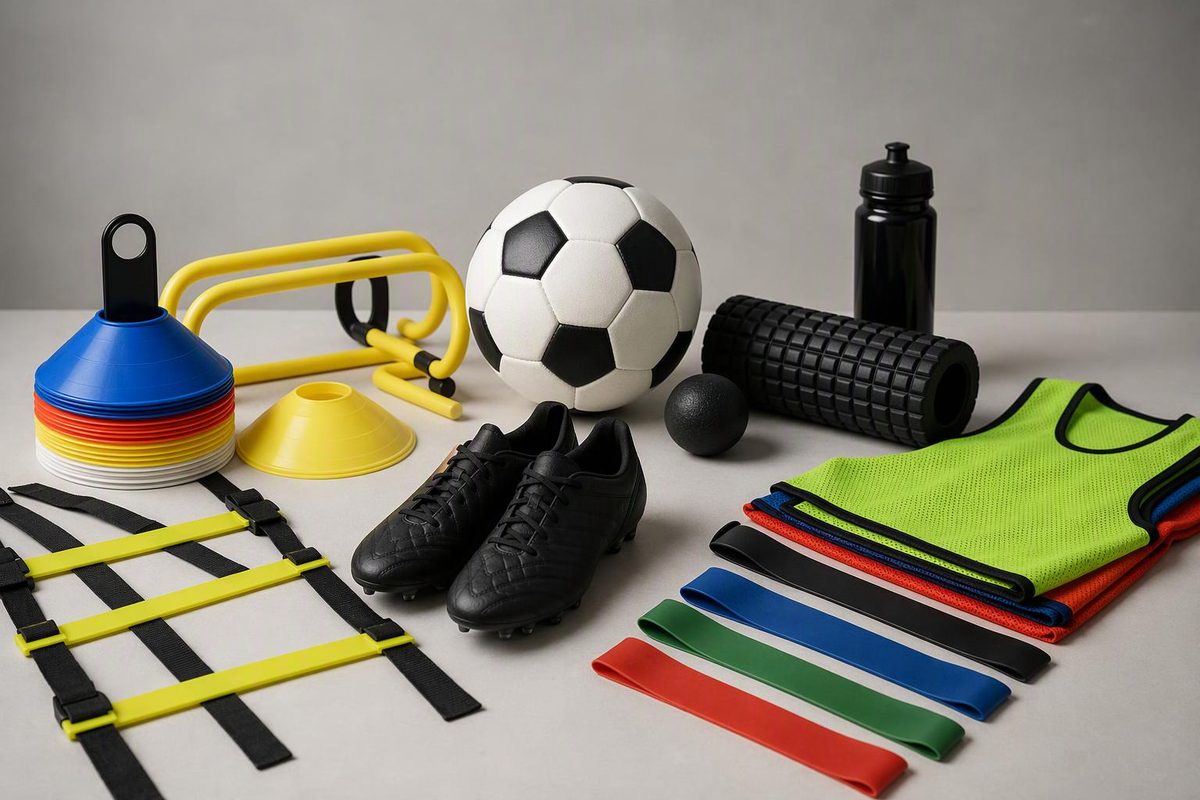
Bring a ball each, flat markers, water and optional bibs. Check the surface and leave space behind targets. If using portable goals, secure them according to their instructions, check they are stable and never allow climbing or swinging on them. These precautions follow the Australian product-safety authority’s goal-safety guidance.
Keep drinks available throughout, not only at the scheduled breaks. Agree supervision arrangements with parents and carers; The FA’s four-to-six guidance specifically says they should remain present to look after their child.
1. Choose how to move your ball
Say: “Can you take your ball to an empty space?”
Let children carry, roll or dribble their own ball around the area. Demonstrate a gentle foot touch, but allow a hesitant child to begin beside a parent or carer. Offer one new challenge at a time: stop the ball, change direction, or take it around a marker.
- Easier: Walk with or carry the ball.
- Next step: Move it with the feet, then stop it within reach.
Carrying is an entry point, not a mistake to correct immediately. The FA’s play-phase adaptation guidance explicitly notes that two five-year-olds may need different tasks: one may dribble comfortably while another benefits from carrying or bouncing.
2. Stop-and-go driving
Say: “Drive your ball. When I say ‘park’, stop it.”
Show both actions before starting. Children travel in any direction, using empty space rather than following a line. Pause briefly between rounds so they can reset.
Use just “drive” and “park” initially. Avoid adding colours, speeds, turns and body-part instructions all at once.
- Easier: Walk slowly and bring the ball to rest with a gentle foot touch.
- Next step: Stop it gently with the sole, then choose a new direction.
Do not ask children to stand with their weight on the ball. If the sole stop causes stumbling, return to another gentle stopping touch. Praise control rather than speed.
3. Visit the gates
Say: “Take your ball through a gate, then find another.”
Use four gates about two metres wide, scattered around the area. Everyone has a ball and chooses their own route. There is no race and no need to count scores.
- Easier: Start beside a wide gate and go through it once.
- Next step: Dribble through, turn in clear space and return through the same gate.
If a gate becomes crowded, add another or spread them farther apart. Don’t impose a fixed route to solve congestion.
This adapts a one-ball-each gates activity published by Ministry of Football for four- and five-year-olds; the wider gates and unscored format here are coaching choices.
4. Goal islands
Say: “Take your ball near a goal, then kick it through.”
Make several cone goals facing away from one another, with clear space beyond each. Each child dribbles towards an available target, kicks through it, retrieves the ball and chooses another. No goalkeeper or shooting queue is needed.
- Easier: Start one or two metres from a wide goal.
- Next step: Approach from a different angle or stop the ball before kicking.
Use “aim through the gap” as the main cue. If balls cross other children’s paths, reposition the targets or run separate supervised areas. Keep this a ground-ball activity; do not introduce heading.
5. Finish according to readiness
Offer a choice: repeat a favourite ball-each game, or try 2v2 without goalkeepers on a small pitch with wide cone goals. For 2v2, show each team its target and restart quickly when the ball leaves the area. Use short rounds with pauses; don’t add compulsory passes or fixed positions.
With eight children, use two supervised 2v2 pitches. With six, four can play while two use a separate supervised ball-each area, then swap. If you cannot supervise parallel activities, repeat a ball-each game with the whole group instead.
Try the shared-ball game when children can recognise their target and cope with someone else having possession. If some withdraw or barely touch the ball, offer a return to a ball-each activity with appropriate supervision. Playing 2v2 is not a graduation test.
The FA recommends adapting space, task, equipment and people to the individual child—not assuming everyone of the same age needs the same challenge.
For a group already comfortable with opponents and directional play, the six-year-old practice plan offers a longer progression into pressure, 1v1s and small-sided games.
What to watch, rather than count
Look for children rejoining after a mistake, stopping the ball within reach, finding less crowded space and willingly trying again. If an activity breaks down, remove a rule or make the task easier before giving a longer explanation. At five, a manageable challenge matters more than completing every drill on the schedule.