
Soccer Drills for 10-Year-Olds: A 60-Minute U10 Session
Run five U10 soccer drills in 60 minutes, with simple setups, coaching cues, progressions and options for different squad sizes and abilities.
For most ten-year-olds, use short explanations, a ball whenever possible and small games that repeatedly ask them to look, choose and act. This 60-minute U10 session progresses from individual control to receiving, 1v1 play, combination play and a final game.
Session objective: Scan before receiving, take the first touch toward useful space, then choose whether to pass or dribble.
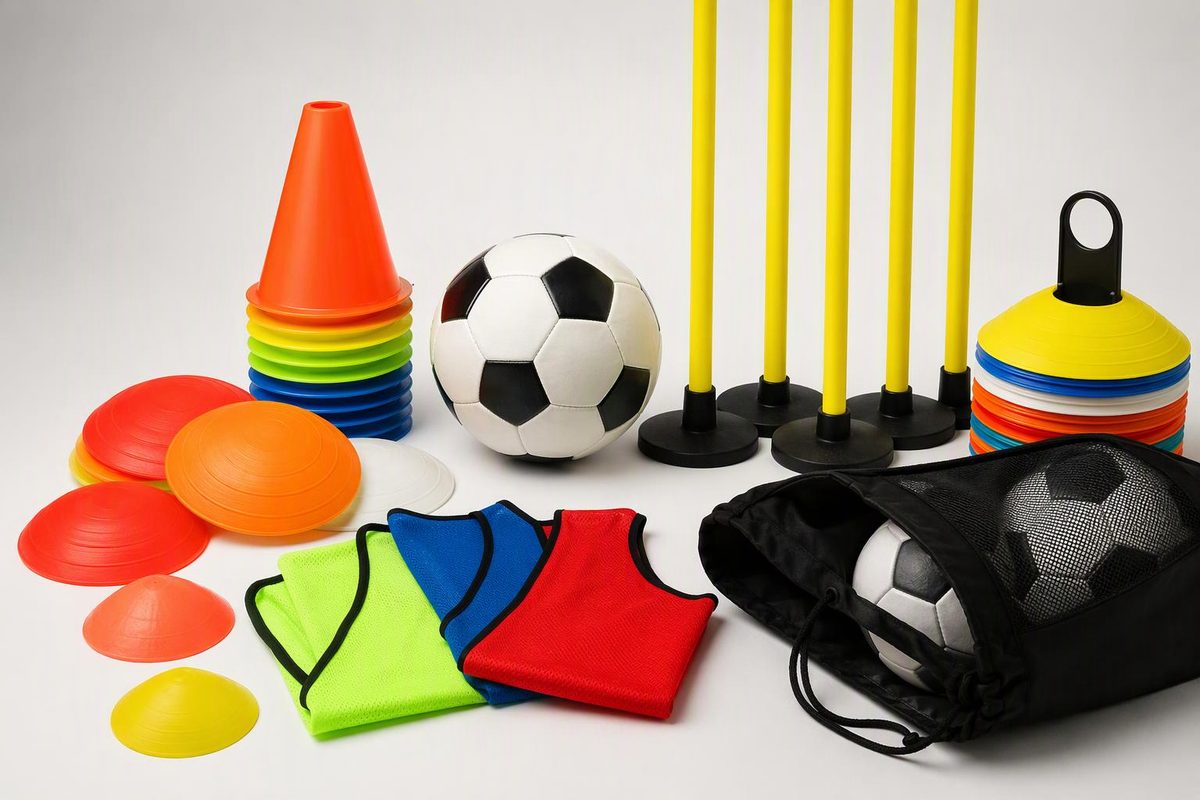
For 12 players, prepare: 12 balls, 20–30 cones, eight small gates, four mini-goals if available and two colors of pinnies. The dimensions below are starting points, not universal rules. Enlarge an area if players cannot complete actions; shrink it if pressure arrives too slowly.
| Time | Activity | Main problem |
|---|---|---|
| 0–8 minutes | Gate hunter | Control the ball while looking up |
| 9–19 minutes | Receive, turn and escape | First touch into space |
| 20–31 minutes | Two-goal 1v1 | Beat or delay an opponent |
| 32–44 minutes | 3v3 four-gate game | Pass, dribble and support |
| 45–60 minutes | Small-sided match | Transfer the skill into play |
The five activities total 56 minutes. Allow roughly one minute for water and changing areas between blocks. Set up the next activity before training if possible.
1. Gate hunter: eight minutes
Setup
- Mark a 20-by-20-yard area.
- Scatter six two-yard cone gates inside it.
- Give every player a ball.
How to play
Players dribble through as many gates as possible in 45 seconds. They cannot immediately return through the same gate. Rest for 20 seconds, ask one brief question, then repeat.
Use four rounds:
- Any part of either foot.
- A different foot through each new gate.
- Perform a turn after crossing a gate.
- Pair players by score; each tries to finish with more gates than their partner.
Coach: “Can you see the next gate before crossing this one?” Praise controlled acceleration and changes of direction, not just the highest score.
Adjust it: Widen the gates or area for players who need more success. For a harder version, place two passive “hunters” without balls in the area; a tagged player performs a turn and continues rather than being eliminated.
This is a warm-up because the intensity rises while players run, turn and control a ball—not because the movements need a separate label. FIFA guidance for ages 8–12 likewise recommends keeping the ball central and using competition or possession games to make warm-ups engaging (FIFA Training Centre). For a fuller pre-training progression, use this dynamic soccer warm-up.
2. Receive, turn and escape: ten minutes
Setup
- Put players in groups of three: passer, receiver and recovering defender.
- Give each group a 10-by-12-yard channel with a two-yard gate on both sides.
- The receiver starts centrally; the passer and defender start together at one end.
How to play
The passer plays into the receiver. When the ball travels, the defender follows at walking speed. The receiver checks a shoulder, receives and escapes through either side gate. Rotate roles after every attempt.
After four minutes, let the defender apply normal pressure. The receiver earns one point for escaping through a gate under control; the defender earns one for winning the ball and dribbling over the starting line.
Coach only three details:
- Look before the ball arrives.
- Receive side-on when that position helps.
- Push the first touch away from pressure, not automatically toward a cone.
Do not prescribe the same turn every time. The defender’s position should determine the solution. A published FIFA U10 session similarly progresses from scanning and first-touch work into opposed small-sided play, although its organization is a coaching example rather than a scientifically proven formula (FIFA Training Centre).
Adjust it: Begin without a defender for a player struggling to control the pass. To increase difficulty, narrow the channel or let the defender start one step closer.
3. Two-goal 1v1: 11 minutes
Setup
- Make six pitches measuring approximately 8 by 12 yards.
- Leave at least two to three yards between pitches and beyond each scoring line.
- Put one pair and one ball on each pitch.
- The end lines are the goals.
How to play
One player attacks either end line and scores by dribbling across under control. If the defender wins possession, the direction immediately reverses. Play ten 40-second bouts with 20 seconds between them, alternating the starting attacker and changing opponents after every two bouts. Use the remaining minute to organize the pitches and explain the task.
Attacking cues: Change speed after moving the defender; keep the ball close enough to change direction; protect it when the route forward closes.
Defending cues: Arrive under control, show the attacker away from the closest line and try to win the ball only when it moves beyond playing distance.
Avoid turning this into a move-recitation exercise. Demonstrate one simple change of direction if needed, then restart the contests. Players need opportunities to perceive an opponent and select an action, not merely copy foot patterns. If individual technique needs more attention, the progression in these soccer footwork drills adds pressure after ball mastery rather than stopping at rehearsed movements.
4. 3v3 through four gates: 12 minutes
Setup
- Create two 18-by-22-yard fields for 12 players.
- Place a two-yard gate near each corner.
- Play 3v3 on each field.
How to play
A team scores by dribbling through any gate. After a goal, it keeps the ball but cannot use that same gate for its next point. Play three bouts of three minutes with one minute between bouts for water, a question and any field adjustment. Allow the remaining minute to organize teams and explain the scoring rule.
The four targets create repeated choices: attack an open gate, combine with a teammate or keep possession until another route appears. This setup adapts a FIFA U10 activity designed around scanning for an available gate and supporting the next attack (FIFA Training Centre). U.S. Soccer’s U9–U10 guide also recommends formats from 1v1 through 7v7, opportunities to solve problems with teammates and experience in different positions (U.S. Soccer).
Ask during breaks: “When the nearest gate was crowded, what other option did you have?” Let players answer before supplying one.
Adjust it:
- If dribblers dominate, require a pass before a team can score again.
- If passing dominates and nobody attacks space, award two points when a player beats an opponent before crossing a gate.
- If the game is congested, widen it by three to five yards.
- If one team rarely has the ball, swap one player or use a neutral player who supports the team in possession.
5. Small-sided match: 15 minutes
Play 4v4, 5v5 or 6v6, using goalkeepers only if appropriate goals and a safe playing area are available. With 12 outfield players, two simultaneous 3v3 games usually produce more involvement than one 6v6; switch to 6v6 for the final five minutes if you want the full group together.
Start with normal rules. Resist adding a mandatory number of passes, a two-touch limit or bonus points immediately. Watch first: are players checking before receiving, taking a useful first touch and recognizing when to dribble or pass? Add one constraint only if it targets the session problem without making play less representative.
Coach mainly between three- or four-minute bouts. During play, use short prompts—“check,” “space” or “support”—rather than narrating every possession. Rotate positions and restart quickly from the goalkeeper, an end line or a spare ball.
Why the session moves into games quickly
The exact five drills and timings have not been tested as a package. The stronger evidence supports the design principles behind them.
A systematic review and meta-analysis of six controlled youth team-sport studies found a small beneficial effect of small-sided-game programs on technical execution compared with controls (effect size 0.59), but it found no eligible evidence for tactical-behavior outcomes. Five of the six studies were in soccer, and the authors warned against broad generalization (Clemente et al., 2021).
A broader soccer skill-acquisition review found that isolated repetition and game-based methods could both improve technical outcomes. Its cautious practical conclusion was to reduce—not necessarily eliminate—decomposed drills because representative games also provide decision-making opportunities. The evidence was heterogeneous and generally moderate in quality, so it does not establish one perfect U10 method (Bergmann et al., 2021). That supports a short period of simplified receiving practice followed by progressively more realistic opposition.
Make the session fit the players in front of you
Age alone does not determine ability. Keep the same learning problem but alter space, pressure or team balance for individuals:
- Too easy: Reduce space slightly, bring the defender closer or ask the player to receive a less predictable pass.
- Too hard: Increase space, slow the defender or add a neutral teammate.
- Uneven numbers: Use a neutral player, create one 2v2 field and one 3v3 field, or rotate a goalkeeper every two minutes. Do not leave one child in a long queue.
- Mixed experience: Pairing the strongest and least experienced players is not always the answer. Balance each contest closely enough that both players make real decisions.
Finally, keep heading out of this session. U.S. Soccer’s U9–U10 guide specifies no heading in practices or games; coaches elsewhere should follow their own governing body’s age rules. Use ground restarts if the ball leaves the field. Any player with pain, dizziness or other concerning symptoms should stop and be assessed under the team’s medical and safeguarding procedures.