
5 Soccer Drills for 8-Year-Olds, Built Into One Practice
Run a 60-minute practice for 8-year-olds with five games for dribbling, 1v1 play, passing and decisions, plus setups and adaptations.
For most 8-year-olds, choose one ball-focused objective, small teams and very little waiting. This 60-minute session develops a simple match problem: Can you keep the ball, recognize space and move toward goal?
It uses a play-practice-play structure: begin with a game, work on the problem without removing decisions, then return to a game. This follows U.S. Soccer’s player-centered model, which emphasizes game-like situations rather than laps, long lines and drills that do not resemble soccer.
The 60-minute plan
| Time | Activity | Main challenge |
|---|---|---|
| 0–10 min | 3v3 or 4v4 arrival game | Find space and attack a goal |
| 10–20 min | Dribble through the gates | Control the ball while scanning |
| 20–30 min | 1v1 to two goals | Beat or escape a defender |
| 30–42 min | 2v1 to goal | Decide whether to dribble or pass |
| 42–58 min | 3v3 or 4v4 match | Apply the skill in open play |
| 58–60 min | Collect balls and review | Recall a useful decision |
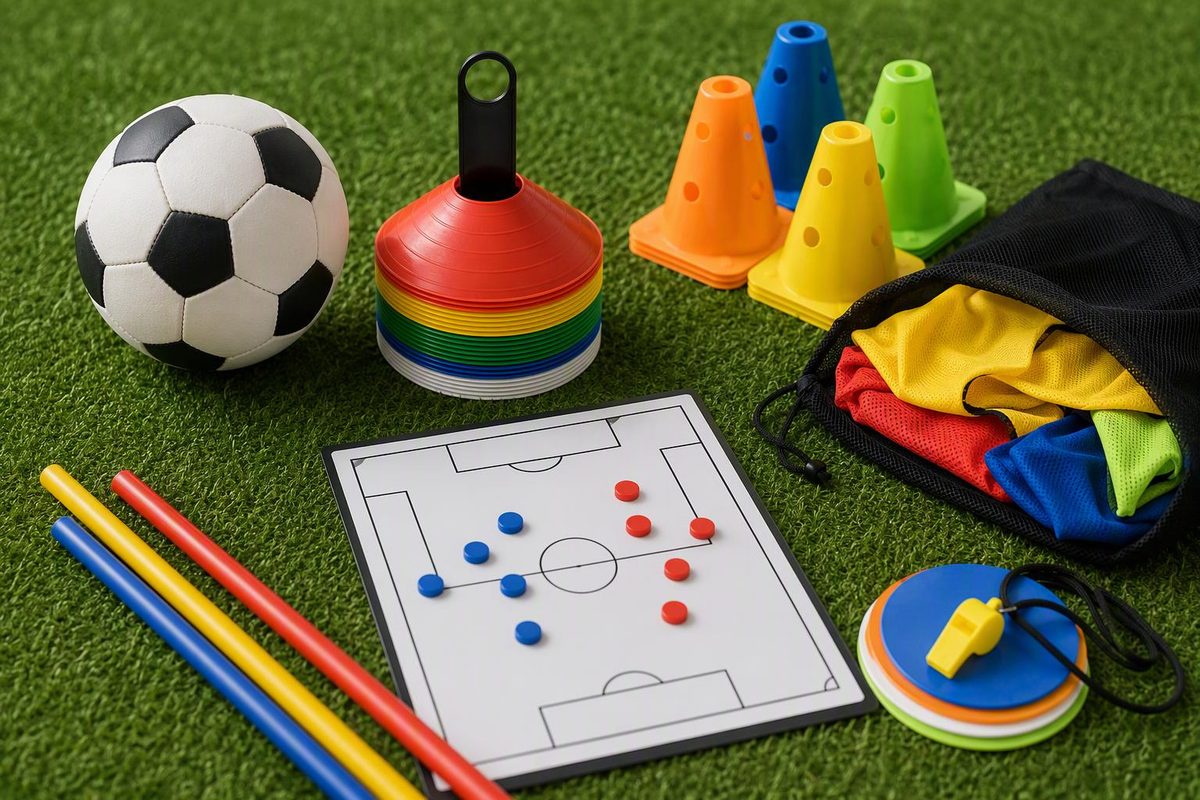
Equipment: one ball per player, plenty of flat cones, two colors of pinnies and small goals if available. Cone goals work too.
Mark the areas before players arrive. Use enough cones to make the boundaries obvious instead of relying on imaginary lines. US Youth Soccer specifically recommends extra boundary markers for players aged eight and younger. It lists 45–60 minutes as a U8 session guideline, while also advising coaches to account for ability, attendance, space and weather (US Youth Soccer). Treat 60 minutes as an upper limit, not a target that must be filled. Age-band names and playing rules vary, so follow the local competition’s rules.
1. Arrival game: 3v3 or 4v4
Time: 10 minutes Area: about 20 x 15 yards for 3v3; enlarge it if players cannot carry or pass the ball Setup: two small goals, no goalkeepers, spare balls beside each goal
Start as soon as four players arrive. Add players or open a second field as attendance grows. Restart quickly from a spare ball when one leaves the area.
Let the first few minutes run with almost no instruction. Watch for the session problem: are players losing the ball because they do not see open space, or because the ball gets too far away?
At a natural break, ask one short question:
- “Where is the space you can attack?”
- “When should the ball stay close?”
Make it easier: widen the field or play 3v2. Make it harder: narrow the field slightly, but avoid a touch limit. Players need enough touches to solve the situation.
2. Dribble through the gates
Time: 10 minutes Area: 20 x 20 yards Setup: scatter eight to twelve gates about two yards wide; every player has a ball
Players score one point each time they dribble under control through a new gate. They cannot use the same gate twice in succession. Play rounds of 45–60 seconds with a short reset.
Across the rounds, ask them to try either foot, different foot surfaces, a turn after a gate and looking up before choosing the next one. Keep the coaching cues simple: small touches in traffic; a larger touch into open space.
This is not a race around a fixed cone course. Players must see traffic, choose an available gate and change their route.
Make it easier: add more gates or make them wider. Make it harder: work in pairs. One player leads through gates while the other follows with a ball; swap after 30 seconds.
For more technique work outside the team session, use this soccer footwork progression. Here, move on before the activity becomes repetitive and detached from opponents.
3. 1v1 to two goals
Time: 10 minutes Area: several fields about 12 x 10 yards Setup: place two cone goals on the defender’s end line
The attacker starts with the ball and scores by dribbling through either goal. The defender scores by winning the ball and carrying it across the opposite line. Keep each turn to about 20–30 seconds, then rotate.
Two goals give the defender more than one route to protect. The attacker has a reason to look up, disguise the intended direction and change speed.
Useful prompts:
- “Can you move the defender before choosing a goal?”
- “If the defender rushes in, where is the escape space?”
- “Can you put your body between the defender and the ball?”
Do not require a named move. A stop, turn, change of speed or simple touch around the defender can all solve the problem.
Make it easier for attackers: move the defender two yards farther away or widen the goals. Make it harder for attackers: bring the defender closer or narrow the goals. For 12 players: build four fields. Eight players compete while four rest, then rotate after every attempt. This avoids one long line.
4. 2v1: dribble or pass?
Time: 12 minutes Area: two or more channels about 15 x 10 yards Setup: one cone goal at the far end; two attackers start opposite one defender
The attackers score by dribbling through the goal. The defender scores by winning the ball and carrying it over the starting line. Rotate roles after every attempt.
The ball carrier must now read the defender while a teammate provides another option. Do not prescribe a pass. Ask:
- “If the defender stays with your teammate, what can you do?”
- “If the defender comes to you, what becomes available?”
- “Where can the player without the ball move to make the choice clearer?”
A useful cue for the supporting player is move away from the defender, not behind them. Praise a sensible decision even if its execution is imperfect.
Make it easier: widen or shorten the channel, delay the defender’s start, or move the support player farther from the defender. Make it harder: add a second goal so the attackers must choose a direction as well as whether to pass.
5. Final 3v3 or 4v4 match
Time: 16 minutes Area: roughly 25 x 18 yards for 4v4, adjusted to the players Setup: two goals, no goalkeepers; play two eight-minute periods
Use normal soccer rules as far as local age-group rules permit. Keep spare balls ready. If attendance allows, run two games rather than leaving several substitutes watching.
Let the first period flow. At halftime, ask: “When did dribbling help, and when was a pass the better choice?” Take two or three answers and restart.
During the second period, observe instead of continually directing possession. Look for:
- a player looking up before entering traffic;
- an attacker changing speed or direction in a 1v1;
- a ball carrier noticing an unmarked teammate;
- a supporting player moving out from behind a defender.
Record two or three examples rather than trying to count everything. The session reflection template provides a simple way to note what appeared in the game and what needs another practice.
Why games dominate the session
Small-sided games retain opponents, teammates, direction and goals—the information players use to select an action. In a 2021 meta-analysis, six studies produced a small pooled benefit for technical execution compared with control training (effect size 0.59). Five studies involved soccer and one involved volleyball; only one soccer sample had an average age close to this group, at nine. None measured tactical behavior (Clemente and colleagues). The result supports small games as a useful option, but it cannot identify the best drill or field size for 8-year-olds.
An umbrella review likewise reported generally positive findings for technical and tactical outcomes, but rated seven of its 12 included reviews as low quality and five as critically low quality (Clemente et al.). The practical conclusion is not that games are the only way to learn. It is to place brief ball work inside a session rich in realistic perception and decisions, then adapt the task to the players in front of you.
Adjust the task before adding a speech
If an activity is failing, change one constraint:
- Players lose the ball immediately: enlarge the area or delay the defender.
- Nobody passes: widen the 2v1 or improve the supporting player’s starting position.
- Players avoid 1v1s: provide two routes to goal.
- One player dominates: match that player against a stronger defender.
- Players are waiting: create another field or start parallel rounds.
- The task is working: leave it alone long enough for players to explore solutions.
Use the same broad objective for several weeks while changing opponents, starting positions or scoring methods. Eight-year-olds do not need an entirely new set of drills every practice; they need repeated chances to solve recognizable soccer problems.
This session deliberately excludes heading. Follow the current rules and safeguarding requirements of your league or federation, inspect the surface and goals before training, schedule weather-appropriate water breaks and follow your organization’s medical protocol if a child develops concerning symptoms.