
A 55-Minute Transition Session for 13-Year-Olds
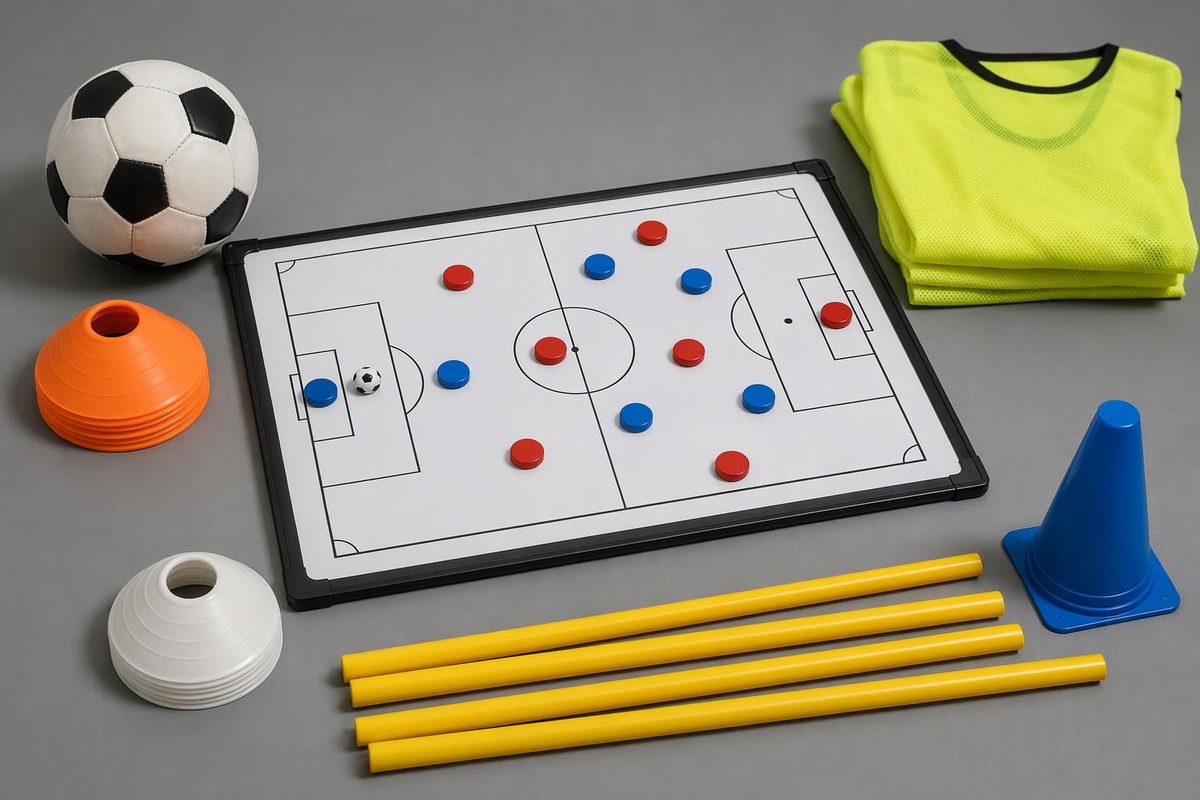
Three soccer drills for 13-year-olds practise defending after a loss, finding an outlet after a regain and applying both decisions in 4v4.
For 13-year-olds who can already pass, receive and dribble, use a session built around changing roles when possession changes. After a loss, players must decide who can close the ball and who protects the space behind. After a regain, they must control the ball, find an available teammate and support the next action—not simply kick forward faster.
The three games below practise those decisions through 2v2 defending, an outlet-passing game and 4v4. For players still struggling with basic control, simplify the pressure or use a short first-touch practice before returning to opposition.
A 55-minute session for eight players
Bring balls, bibs and cones. Mini-goals are optional; cone gates work throughout.
| Time | Activity | Main task |
|---|---|---|
| 0–10 min | Progressive movement and ball warm-up | Prepare for receiving, turning and accelerating |
| 10–22 min | Two parallel 2v2 games | Close the ball, cover and recover |
| 22–36 min | 4v3 plus a target player | Find an outlet after regaining possession |
| 36–52 min | 4v4 directional game | Apply both transitions without fixed roles |
| 52–55 min | Water and player review | Identify one decision worth repeating |
These timings and pitch sizes are coaching starting points, not a research-validated prescription for every 13-year-old. The blocks include explanations, water and rotations.
Warm up progressively. Begin with easy jogging, lateral movement and dribbling. Add controlled lunges, skips and changes of direction, then partner passes with movement after receiving. Finish with a few progressively quicker turns and short accelerations. This opening is not a complete injury-prevention programme.
1. 2v2: close the ball and cover
Setup: Mark two separate areas, each approximately 20 × 15 metres. Put two small cone gates at each end. Four players use each area, with teams attacking opposite ends. Leave safe separation between pitches and clear space beyond the gates.
Play: Score by dribbling through an opposition gate under control. When possession changes, keep playing immediately. Restart with a pass or dribble from the sideline when the ball goes out; after a goal, the conceding team restarts from its end.
Use three three-minute rounds, with the remaining time for recovery, changing opponents and brief feedback.
Coach the pair, not just the tackler:
- The nearest defender closes under control when able to affect the ball, rather than charging past it. If neither defender can apply useful pressure, recover towards the gates first.
- The partner gets goal-side and protects the dangerous route behind the first defender. Avoid standing flat alongside each other.
- As the ball moves, the players exchange responsibility: one pressures, the other covers.
- If the pressure is beaten, recover towards the gates instead of chasing from behind without protecting the goal.
After a regain, ask the ball winner to notice whether dribbling or passing provides the clearer escape. The teammate should move into a visible passing angle.
Adjust: Enlarge the area if players repeatedly lose the ball before making a decision. If attacks are too easy, narrow the scoring gates before adding another rule. Do not require a tackle immediately after every loss; delaying an attack can be the useful defensive action.
2. 4v3 plus a target: escape after a regain
Setup: Start around 30 × 22 metres. Team A has four players on the field and attacks two mini-goals or cone gates at one end. Team B has three players on the field and a fourth—the target—behind the opposite end line.
This is a no-goalkeeper adaptation of FIFA’s transition practice for ages 12–15, which uses a one-player advantage and a moving end-line target. The dimensions here are suggested starting points.
Play: Team A scores with a ground shot into either mini-goal or through either gate. Team B scores by completing a ground pass to its target, who must control it. The target can move along the end line to become available but stays outside the playing area. Possession changes remain live; after a point, the other team restarts from its own end.
Play two six-minute bouts, allowing two minutes overall for water and switching the teams’ tasks. Rotate the target during stoppages roughly every two minutes so nobody spends the whole block outside the field.
Watch the first action after the regain:
- Can the ball winner control the ball away from immediate pressure?
- Is the target actually available, or is a supporting pass needed first?
- Do teammates move to help rather than watch the attempted outlet pass?
- Does the team that lost possession protect the route to the target while closing the ball?
FIFA’s age-targeted coaching questions emphasise using the extra player to find space and passing early and accurately to the target after winning possession. “Early” should not become “forced”: keep possession if the passing lane is blocked.
Adjust: Widen the field if the three-player team cannot connect a pass. If outlet passes are too easy, narrow it gradually. Avoid adding a compulsory one-touch rule or a countdown to score.
3. 4v4: remove the scaffolding
Setup: Use approximately 32 × 24 metres with two gates or mini-goals at each end. Bring the target back onto the field so both teams have four players.
Play: Score with ground shots into mini-goals, or by dribbling through gates under control. Use simple pass-in or dribble-in restarts. Play four three-minute rounds, using the remaining four minutes for recovery and discussion.
In the first two breaks, ask one question each:
- After losing possession, who could affect the ball—and who needed to recover?
- After winning it, which option moved us away from pressure?
For the final two rounds, leave play uninterrupted except for safety and restarts. Do not assign a permanent presser or covering player: the situation should determine the roles.
Observe five turnovers per team. Note whether players pressure and cover when possible, or recover when pressure is not feasible, and whether a regain leads to a controlled next action. These are coaching observations, not validated learning scores. Recheck the same behaviours in a later session or match, rather than treating one good round as proof of learning.
What the evidence supports
A systematic review of 35 soccer skill-acquisition studies found support for approaches encouraging players to explore solutions in game-representative situations. Repetition-based practice also improved technical outcomes, but its transfer to match performance was widely unexplored. The studies varied substantially and were of moderate quality overall: they do not establish an optimal session specifically for 13-year-olds.
The practical inference is to keep opponents, direction and consequences in the task while allowing more than one solution. FIFA’s counter-attacking guidance also emphasises moving the ball away from pressure and coordinating support—not speed alone. That is coaching guidance, not proof that these particular games improve match performance.
Adapt to the players present
With six players, use one 2v2 game with two rotating players, change the outlet game to 3v2 plus a target, and finish with 3v3. With twelve, run three 2v2 pitches, two 3v2-plus-target games and two 3v3 finishing games. Keep rotations short rather than building queues; for smaller games, reduce the playing area if players can bypass opposition too easily.
Match pressure to current ability, not age alone. Give struggling players more space; challenge confident players with closer opposition. Keep this session on the ground, shorten rounds when movement quality deteriorates, and stop participation for pain or suspected injury. General training guidance cannot replace assessment by a qualified coach or physiotherapist who can see the player directly.