
A 50-Minute Passing-and-Support Practice for 11-Year-Olds
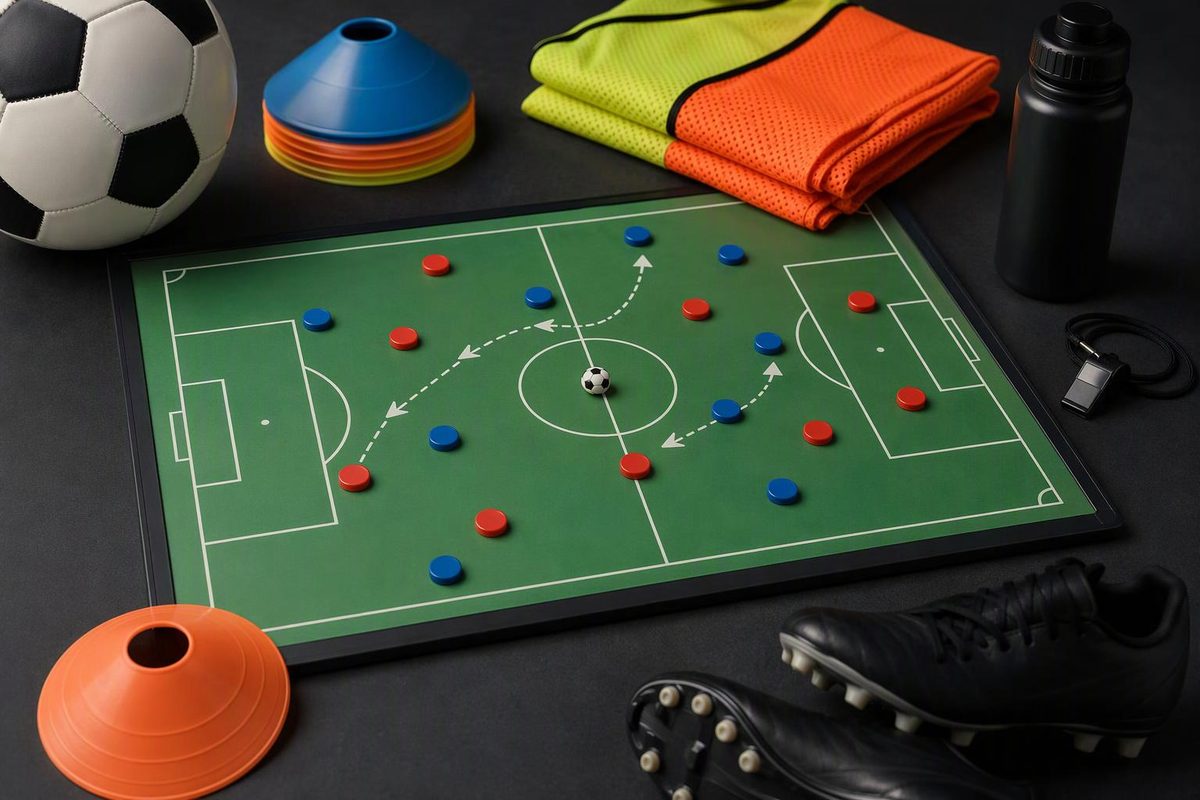
Coach 11-year-olds to receive, pass and offer support with a 50-minute practice, clear setups and adjustments based on what happens in the game.
For 11-year-olds, build this practice around one problem: help the player with the ball find a usable passing option. Start with a small game, briefly repair any receiving difficulty, then give the attacking team extra support before returning to equal numbers.
This is a 50-minute session for eight players—not a checklist of skills every child should have mastered by their eleventh birthday. Eleven-year-olds fall within FIFA’s 8–12 coaching guidance, which recommends introducing basic tactical ideas through games, rotating roles and keeping feedback brief. The layouts and timings below are coaching defaults, not a scientifically established age-11 training dose. (FIFA Training Centre)
The session at a glance
Equipment: eight balls if available, cones, two colours of bibs and two mini-goals or cone goals. No goalkeeper is required.
Mark one field approximately 24 × 18 metres, with a three-metre-wide cone goal centred on each end line, or a securely anchored mini-goal at each end. Score by playing the ball along the ground through the goal. Leave clear space beyond the goals and between neighbouring activities. Enlarge the field if pressure prevents players from controlling the ball and looking up.
| Time | Activity | Coaching task |
|---|---|---|
| 0–6 min | Progressive ball warm-up | Prepare to move, turn and accelerate |
| 6–14 min | Opening 4v4 game | Identify whether receiving or support breaks down |
| 14–20 min | Receive-and-move pairs, if needed | Prepare the ball and create a new passing angle |
| 20–34 min | 3v3 with two support players | Find options around pressure |
| 34–48 min | Return to 4v4 | Check whether support survives without extra players |
| 48–50 min | Water and player review | Identify one useful supporting movement |
Block times include explanations, brief recovery and water. Shorten playing bouts when players need it; do not squeeze recovery out to complete the schedule.
1. Progressive ball warm-up
Give each player a ball within the main field. Begin with easy dribbling and changes of direction. Briefly park the balls for controlled lateral steps, skips and lunges, then return to dribbling with turns and short accelerations. Increase speed gradually rather than opening with races.
Ask players to find clear space before accelerating. There is no elimination and no prescribed trick sequence.
FIFA’s guidance for ages 8–12 supports unopposed ball activities, keeping everyone involved and balancing technique with speed. This six-minute opening is preparation for the session, not a complete injury-prevention programme. (FIFA Training Centre)
2. Opening 4v4: find the actual problem
Play towards the two goals, with ground passes or dribble-ins for sideline restarts. Keep spare balls beside the field. Use two three-minute bouts, with the remaining time for setup, water and one question.
Start without touch limits or a minimum-pass rule. Watch what happens when a teammate receives:
- Does the first touch leave the ball available for the next action?
- Does the passer move to offer another option?
- Are teammates visible beside or beyond the defender, or hidden behind them?
At the break, ask: “Where could you move so your teammate can pass to you?” Demonstrate one example if needed, then restart.
This game-first approach follows FIFA’s Global-Analytical-Global framework for ages 8–12: observe a game, select a technical focus, then test it back in play. It is federation coaching guidance, not proof that this sequence outperforms every alternative. (FIFA Training Centre)
3. Receive-and-move pairs: use only if needed
If players can control passes but teammates are not offering support, skip this drill and extend the supported game by six minutes. Unopposed passing will not recreate that positioning problem.
If receiving is the obstacle, make four pair stations. In each station, mark two cones three metres apart at each end, with approximately seven metres between the ends. One player starts at each end with one ball per pair.
- Pass to the partner.
- After passing, move across to your other cone.
- The receiver takes a first touch that prepares a return pass to the partner’s new position.
- Continue, moving across after each pass.
Use the cue: “Prepare the ball, then find your partner again.” Allow enough touches to execute the action. Shorten the passing distance if control repeatedly breaks down; increase movement speed only while passes remain manageable.
The drill rehearses control and a changing passing angle. It does not test whether players can read a defender. For a separate technical block, use the first-touch practice progression.
4. 3v3 plus two support players
Use the same field and goals. Place three players on each team inside, with one neutral support player on each touchline. Neutrals remove their team bibs, help whichever team has possession and move along their assigned sideline to offer a passing angle. Defenders cannot tackle them; neutrals return the ball into the field and do not score.
The inside teams attack opposite goals. When possession changes, the neutrals immediately support the new attacking team. After a goal, the conceding team restarts from its end.
Play four bouts of roughly two to three minutes, leaving time for water, feedback and rotation. Choose a different pair of neutrals each bout, so all eight players experience the role once.
Coach two actions:
- Move out of the defender’s shadow: become visible to the ball carrier.
- Move again after passing: do not assume the previous angle still works.
A sideways or backward pass is acceptable when the forward route is blocked. Do not demand a pass to a neutral before every goal; the support players are options, not compulsory stops.
Adjust from observation:
- If possession collapses immediately, widen the field or rebalance teams.
- If neutrals receive everything while inside players stand still, ask an inside player to show a second option; avoid narrating every pass.
- If the task becomes easy, move the neutrals inside as active, tackleable teammates before removing the numerical advantage.
5. Return to 4v4: remove the help
Restore the opening teams, field and scoring rules. Play three bouts of about three minutes, using the remaining time for recovery and brief feedback.
Watch whether players now offer support without a protected sideline teammate. Do not add bonus points immediately—the useful question is whether the behaviour appears under the original conditions.
For a simple coaching check, observe five receptions in each game and note whether the receiver had a visible passing option. This is not a validated learning test. Use it to choose the next session’s focus, and look again at the next practice rather than treating one good final game as lasting improvement.
Finish by asking: “Which movement helped your teammate most?”
What the research supports—and what it does not
A 2025 study of 46 male players in one English academy compared smaller and regular game formats across U9, U10 and U11 groups. In the pooled analysis, smaller games produced more receiving-under-pressure actions, opponents beaten by dribbling and shots per player. The U11 comparison was 7v7 versus 9v9, not the 4v4 used here. The study measured action frequency, not long-term learning, so it supports creating repeated game opportunities—not a claim that this exact session improves eleven-year-olds by a known amount. (Conway and Smith, 2025)
For six players, use 3v3 in the opening and final games and 2v2 plus two neutrals in the supported block. For ten, use 5v5 and 4v4 plus two neutrals, enlarging the field if it becomes congested. Rotate neutral roles between bouts. With larger squads, run parallel fields rather than long waiting lines.
Keep every activity heading-free and use ground restarts. Stop participation for pain or concerning symptoms and follow the team’s assessment procedures.