
Four Soccer Drills for 9-Year-Olds to Keep and Connect the Ball
Choose drills for nine-year-olds to protect possession, receive on the move and support teammates, with simple setups and a flexible 45-minute practice.
For nine-year-olds, try protect-and-escape 1v1s, 2v2 end-zone games, moving 4v2 possession and a final 3v3 match. These activities tackle a useful problem: keeping the ball long enough to find the next action, then helping a teammate do the same.
You do not need all four at every practice. If players panic under pressure, spend more time on the 1v1. If they control the ball but stand behind defenders, prioritize the support game.
What to prioritize at nine
Keep individual ball skills central while introducing simple cooperation: a receiver moving into space, a teammate offering a passing angle and players changing roles when possession changes. Do not treat turning nine as a sudden developmental switch.
U.S. Soccer’s U9–U10 guidance recommends fundamental skills with both feet, games from 1v1 to 7v7—including uneven teams—and opportunities to solve problems with teammates. It also advises coaches to blend activities around individual needs. That supports these choices, not a requirement that every nine-year-old perform them at the same difficulty.
A flexible 45-minute practice:
| Block | Time | Purpose |
|---|---|---|
| Easy movement and ball warm-up | 5 minutes | Prepare for running, turning and contests |
| Protect and escape | 8 minutes | Retain possession under pressure |
| 2v2 to end zones | 10 minutes | Receive while moving |
| Moving 4v2 | 8 minutes | Offer useful support |
| Normal 3v3 match | 10 minutes | Check the skills in open play |
| Water and changes between areas | 4 minutes total | Recover and reorganize |
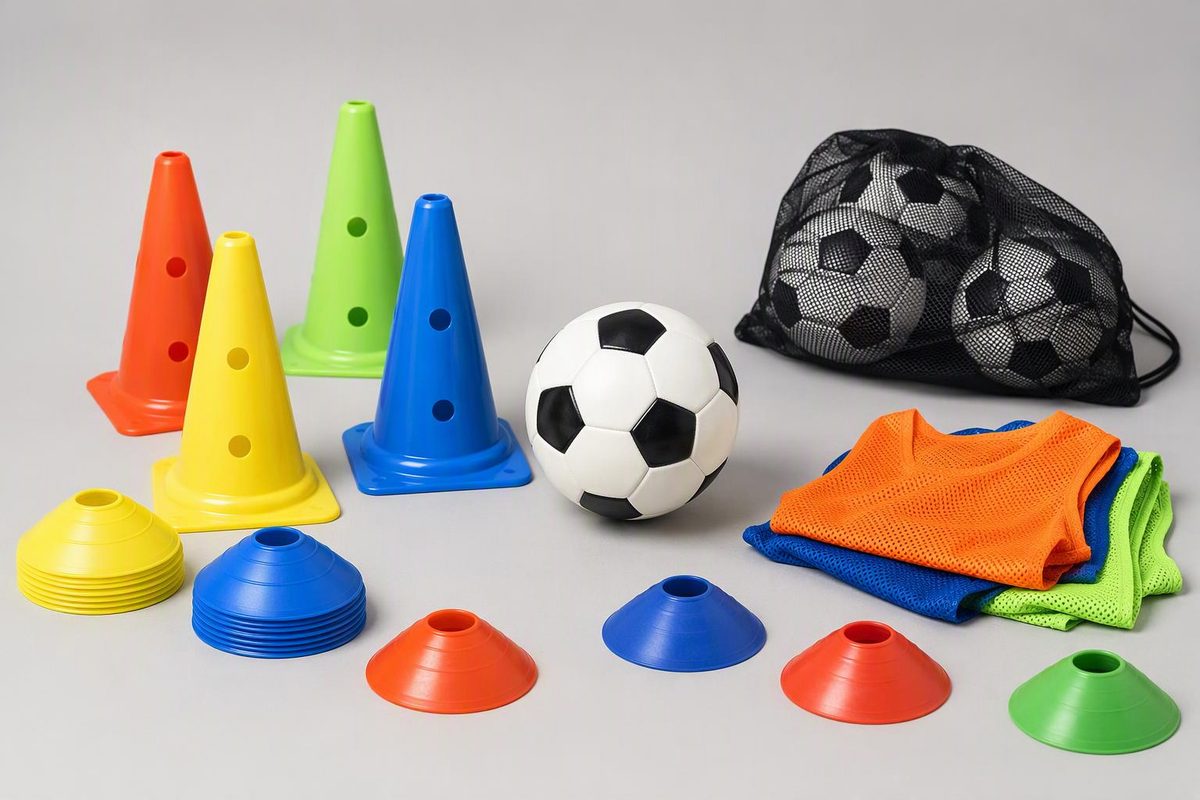
For 12 players, bring 12 balls, flat cones and two colors of bibs. All dimensions and timings below are coaching starting points, not tested prescriptions. Allow extra breaks when players or weather conditions require them.
Begin with easy jogging, skipping, controlled hops and turns, then individual dribbling that gradually becomes quicker. FIFA’s warm-up guidance for ages 8–12 recommends keeping the ball central and balancing enjoyment with learning.
1. Protect and escape: 1v1
Use when: Players lose the ball as soon as an opponent gets close.
Setup: Each pair has one ball in an approximately 8 × 8-metre square. Match players by ability and physical confidence, and leave clear run-off space between squares. The attacker starts with the ball, with the defender a step behind.
Play: For the first three seconds, the attacker tries to protect possession inside the square while the defender attempts to win it. Then the attacker can score by dribbling across any edge under control. The defender scores by winning and retaining the ball. End after a score, an uncontrolled ball going out or 15 seconds; swap roles and allow a brief reset.
Cue: “Keep yourself between the opponent and the ball; escape when a route opens.” Demonstrate turning with the ball on the side farther from the defender. No pushing, holding or slide tackles.
- Easier: The defender shadows without tackling for the first few attempts.
- Harder: Reduce the square slightly, provided players can still protect and turn safely.
The aim is not to stand over the ball indefinitely. Protection should create time for the next action.
2. 2v2 to end zones
Use when: Receivers stand still and wait for passes to reach them.
Setup: For 12 players, make three pitches about 18 × 12 metres. Mark a two-metre-deep end zone at each end. Play 2v2 on each pitch.
Play: Each team attacks one end zone. Score by passing to a teammate who moves into that zone and controls the ball there. Players cannot wait permanently in the zone. After a point, the other team restarts from its own end zone; defenders retreat outside it until the ball enters the central playing area. When the ball goes out, the other team restarts with a ground pass or dribble from that spot.
Cue: “Move where your teammate can see you and pass to you.” Ask the receiver to look for the defender before moving, rather than running straight ahead on every attack.
- Easier: Widen the pitch or enlarge the end zones.
- Harder: Narrow the end zones while retaining unrestricted touches.
Players may dribble to draw a defender before passing. Avoid prescribing a fixed pass-and-run sequence: the opponents should influence the solution.
3. Moving 4v2 possession
Use when: Players pass, then stop—or hide behind an opponent.
Setup: Groups of six use a roughly 12 × 12-metre square, with four attackers and two defenders. Everyone moves within the area; attackers are not fixed at corners.
Play: Attackers earn a point for three consecutive completed passes, then begin a new count without stopping play. Defenders earn a point for winning possession and controlling the ball. Restart with the attackers after a defensive point or the ball leaving the square. Rotate the two defenders every minute, regardless of who lost possession.
Cue: “After your pass, find another angle.” Show how a small sideways movement can open a passing lane without everyone chasing the ball.
- Easier: Use 5v1 or enlarge the square.
- Harder: Reduce space slightly, rather than immediately imposing one-touch play.
If attackers cannot complete passes even with more space or fewer defenders, use brief partner work before adding pressure again. This drill is an option for nine-year-olds who can already control and pass—not an entry test everyone must pass.
4. Normal 3v3 match
Use two pitches about 22 × 16 metres for 12 players, with two-metre-wide cone goals and no goalkeepers. Score with ground shots through the cones. Play two four-minute bouts, using the remaining time for recovery and one short discussion. Restart with a ground pass or dribble when the ball goes out, and from the conceding team’s end after a goal.
Remove the earlier scoring conditions. Watch whether players:
- protect the ball when the forward route closes;
- move to receive rather than wait;
- offer a new passing angle after releasing the ball.
Do not add a mandatory pass count. A successful dribble or direct shot remains a valid solution. For additional receiving detail, use the first-touch practice progression.
What the evidence does—and does not—support
The evidence supports including games, but not claiming that this exact routine is optimal for nine-year-olds.
In a 12-week study of 40 children aged nine or younger, both game-based training and a multilateral program improved shuttle-dribbling performance and physical-test outcomes. The multilateral group performed better on the shuttle-run test at follow-up. The study does not establish that game-only training is best, or that these four drills improve match decisions.
A 2021 meta-analysis of six youth team-sport studies found a pooled advantage for small-sided-game programs in technical execution: standardized effect 0.59, with a 95% confidence interval of 0.29–0.89. Five studies involved boys’ soccer and one involved girls’ volleyball. Most soccer samples were older than nine, and most soccer comparisons were against running or other physical training. None of the included studies measured tactical-behavior outcomes. Use that as support for repeated game practice, not proof of a particular layout or superiority over every alternative skill practice.
Keep heading out of this routine; U.S. Soccer’s U9–U10 guide specifies no heading in practice or games. Follow your local federation’s rules, check the surface and stop participation for pain or concerning symptoms, following your organization’s medical procedures.
After the final match, record one example of useful protection and one example of support. If neither appears, simplify the relevant task next time rather than adding more drills.