
A 40-Minute Passing and Teamwork Practice for Seven-Year-Olds
Four soccer drills for seven-year-olds introduce passing, receiving and support, with simple setups and a flexible 40-minute practice.
For seven-year-olds beginning to link up with teammates, keep dribbling central and introduce cooperation one teammate at a time. Use ball delivery, partner gate passing, receive-and-escape, and 2v2 games. The session question is simple: “Can you help your teammate keep the ball and move toward goal?”
Do not make passing compulsory just because children are seven. FIFA’s guidance for ages 4–8 recommends establishing ball control, then adding passing, receiving and game-like pressure as players become comfortable. Use that progression to choose the challenge, rather than assuming a birthday establishes readiness (FIFA ball-control guidance).
A flexible 40-minute practice
| Block | Time | What to watch |
|---|---|---|
| Opening 2v2 games | 6 minutes | Can players identify their teammate and attacking goal? |
| Ball delivery | 6 minutes | Can they control the ball before passing? |
| Partner gate passing | 8 minutes | Does the receiver move somewhere useful? |
| Receive-and-escape | 7 minutes | Can the first touch create room against a defender? |
| Final 2v2 games | 9 minutes | Does supporting movement appear without prompting? |
| Drinks and transitions | 4 minutes, distributed | Adjust for conditions and the group |
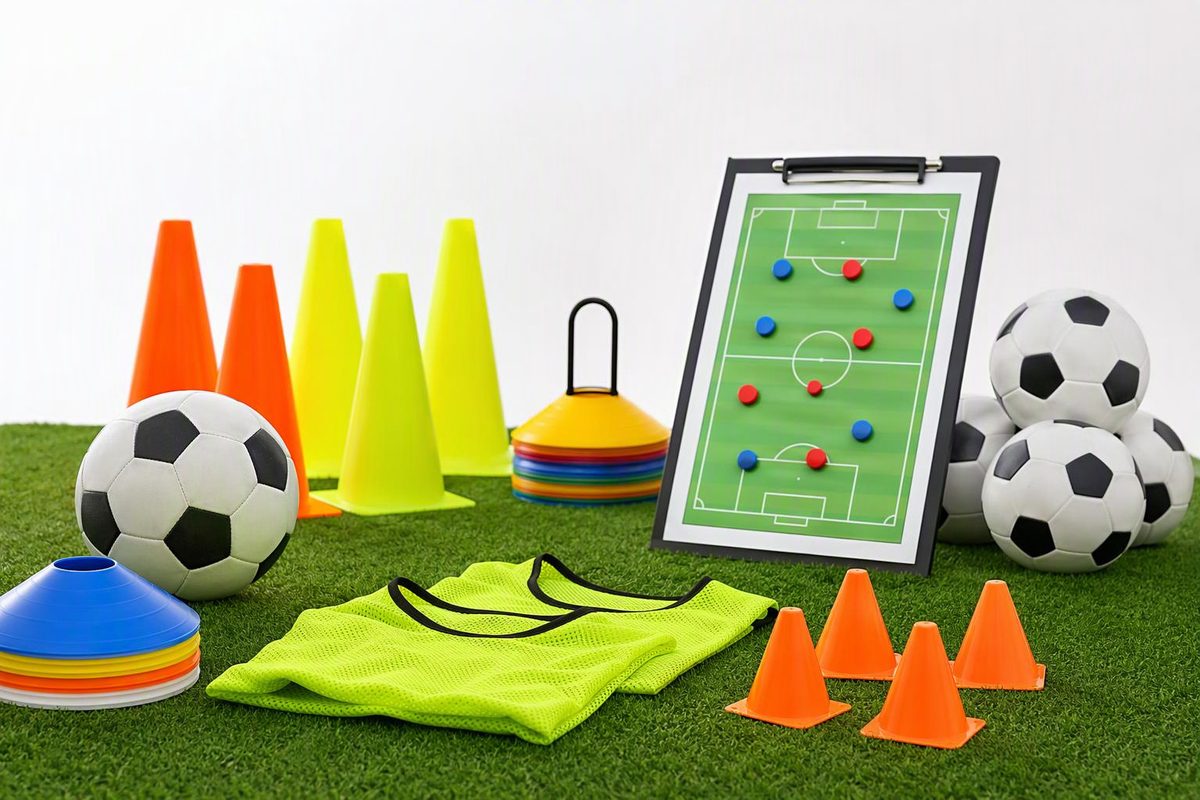
Bring: balls, flat cones, two colors of pinnies and small goals or cone gates. Check the surface and secure any portable goals according to their manufacturer’s instructions before starting.
The timings, dimensions and adaptations below are coaching starting points, not tested optimums for seven-year-olds. The supporting guidance covers ages 4–8, rather than establishing a uniquely effective session for age seven. The structure follows FIFA’s Play-Practice-Play guidance: observe an opening game, practise a relevant skill, then return to less restricted play (FIFA session guidance).
1. Ball delivery: dribble, stop, pass
Setup: Put pairs in separate lanes about 8 yards long and 4 yards wide, with one ball per pair. Partners start at opposite ends. Leave room outside each lane for the passer to return.
Play: The ball carrier dribbles toward their partner, brings the ball under control about 2–3 yards away, then passes along the ground. The receiver settles the ball while the passer returns outside the lane to their starting end. Once that partner is ready, the receiver delivers the ball in the opposite direction: dribble toward them, stop and pass. Repeat, alternating the delivery role.
Demonstrate the whole exchange once. Avoid adding a prescribed turn, a foot restriction or a race initially.
One cue: “Send a ball your partner can stop.”
- Easier: Shorten the pass; allow extra touches to settle the ball.
- Harder: Remove the required stop before passing, while keeping the pass controllable.
- Move on when: Both partners can complete several exchanges without repeatedly chasing the ball outside their lane.
This is a bridge into cooperation: the child still dribbles, but the finish depends on another player rather than a cone.
2. Partner gate passing: find somewhere to receive
Setup: For eight players, start with a 20 × 15-yard area containing six gates, each about 2 yards wide. Use one ball per pair. Leave clear space between gates and enlarge the area if routes become crowded.
Play: Partners earn a point by passing through a gate and controlling the ball on the other side. They then choose a different gate. Either child may dribble to improve the passing angle; alternate the passer after each successful gate.
The important action is not just the pass. The receiver must reach the other side of an available gate and give their partner a visible target.
One question: “Where can you stand so your teammate can reach you?”
- Easier: Let each pair use its own gate before sharing the area.
- Harder: Ask the receiver to control toward the next gate rather than stopping on the spot.
- If it breaks down: Widen the gates or reduce the number of pairs in each area before adding defenders.
This adapts the paired gate-passing activity in Rogue Valley Timbers’ U7/U8 coaching resource. Use points as a playful challenge, not a ranking of children.
3. Receive-and-escape: control with a purpose
Setup: Make several 10 × 8-yard areas, each with two wide gates on one end line. Work in threes: a passer at the opposite end, a receiver near the middle, and a defender about 3 yards beyond the receiver, toward the gates. With eight players, use two trios and one unopposed pair; swap who works in the pair at a break.
Play: The passer sends a gentle ground pass. Once the receiver touches the ball, the defender becomes active. The receiver tries to dribble through either gate; the defender tries to win possession. End the attempt after a score, the ball leaving the area, or about 20 seconds. Rotate all three roles after every attempt.
One cue: “Look for your exit before the ball arrives.”
- Easier: Have the defender walk or remain passive while the receiver controls and turns.
- Harder: Allow the defender to move as the pass travels.
- If receiving is too difficult: Remove the defender temporarily. Do not compensate with a harder pass.
Encourage the passer to deliver a manageable ball. This drill applies the progression from receiving to opponent pressure described in FIFA’s ball-control guidance.
4. 2v2: give your teammate another option
Setup: Start with a field about 15 × 12 yards, two goals and no goalkeepers. For eight players, run two fields where supervision permits. Keep spare balls nearby.
Play: Run short games with quick restarts and brief breaks. Allow players to dribble, pass or shoot. Use this game at both the beginning and end of practice, swapping opponents between rounds.
One cue: “Find a space where your teammate can see you.”
Do not require a pass before scoring. That would turn an option into an obligation, even when dribbling is the sensible solution.
- Easier: Widen the field if possession disappears immediately.
- Harder: Add a second goal at each end, giving attackers another route and defenders another space to protect.
- Uneven attendance: Use a 2v1 game and rotate the lone player frequently rather than leaving someone out.
FIFA’s spatial-awareness guidance for ages 4–8 specifically emphasizes moving into space to receive and supporting teammates—the focus of this game (FIFA spatial-awareness guidance).
Decide what to repeat next time
During the final game, look for three things: a controllable pass, a receiver moving out of traffic, and a player choosing to dribble when space is open. Praise the useful choice even when execution fails.
If passing remains frustrating, repeat ball delivery and simplify the gate game. For children who need more ball familiarity first, use the ball-control games in the six-year-old practice plan. If exchanges work but teammates disappear behind defenders, spend more time in 2v2. Record one example and one next-session adjustment in the session reflection template.
Keep this practice ground-based, without heading or sliding tackles. Adjust breaks for weather and fatigue rather than treating the timetable as a limit on drinks, and stop an activity if contact becomes uncontrolled.