
A Ready-to-Run Practice That Keeps Young Players Moving
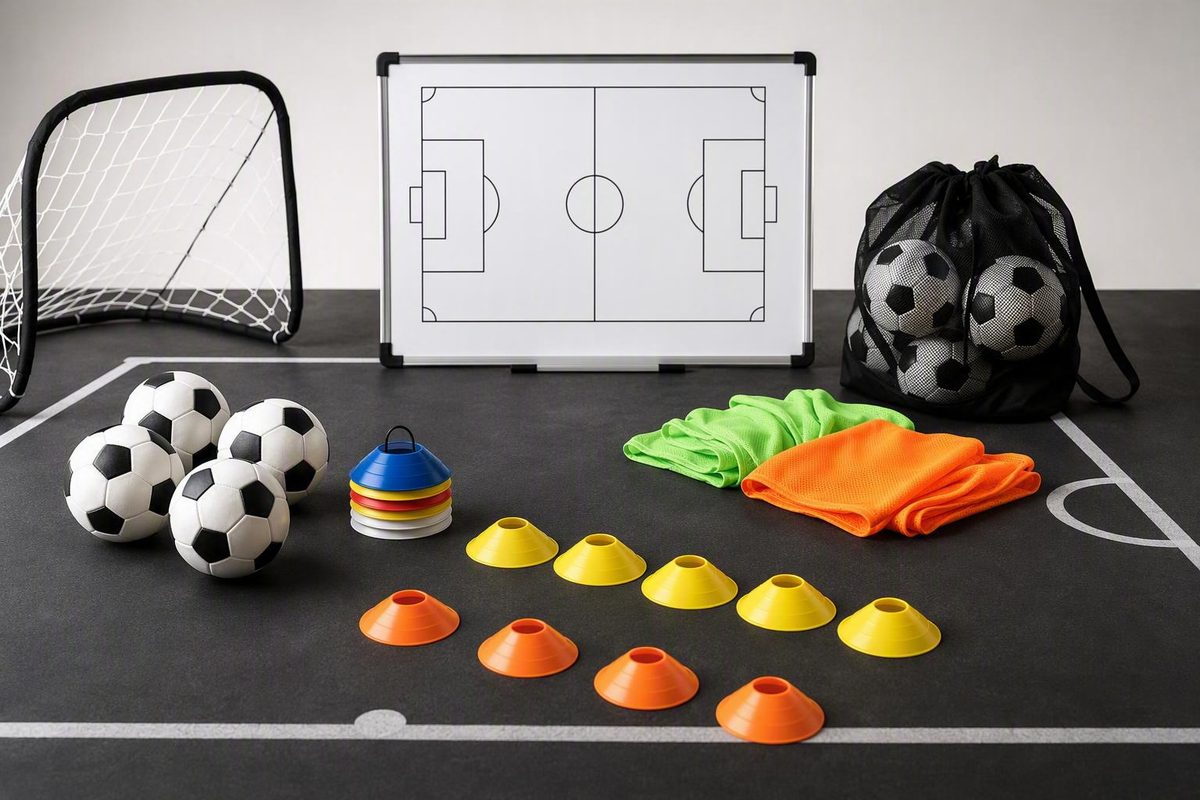
The adjustable 45-minute session moves from ball familiarity to pressure and 1v1 play, then 3v3 or 4v4, with setup and difficulty options.
The most useful soccer drills for 6 year olds are simple games that provide frequent contact with the ball, one clear decision at a time, and very little waiting. For a session you can run immediately, use Follow the Coach, Meet Mr. Ball, Zigzag Cone Dribbling, Sharks and Minnows with immediate re-entry, and then 3v3 or 4v4.
The 45-minute plan below is a practical starting point, not a proven optimum or mandatory schedule. Adjust it for the children who attend, the available space, the conditions, and your local rules.
The 45-minute practice plan at a glance
| Activity | Starting time | Primary skill | Equipment and transition |
|---|---|---|---|
| Follow the Coach | 5 minutes | Dribbling and scanning | One ball per player and cones; begin inside the main area |
| Meet Mr. Ball | 8 minutes | Ball familiarity | Keep each player’s ball and the same boundary |
| Zigzag Cone Dribbling | 8 minutes | Direction changes | Move spare cones into several short lanes |
| Break | 2 minutes | Rest | Drinks as appropriate; rebuild one crossing grid |
| Sharks and Minnows | 8 minutes | Dribbling under pressure | Balls, cones, and pinnies; reuse the main end lines |
| Break | 2 minutes | Rest | Drinks as appropriate; place goals or gates at each end |
| 3v3 or 4v4 | 12 minutes | Free play and decisions | Match ball, two pinnie colors, and goals or cone gates |
Treat every duration as an adjustable coaching estimate. Shorten a round when players no longer understand the rule, congestion is increasing, or most children have stopped participating. Extend it only while the group remains active and engaged—not simply to fill the schedule.
Bring one appropriately sized ball per player when possible, cones, two colors of pinnies, and small goals or enough cones to make gates. Prepare one clearly marked playing area before practice and keep spare cones just outside it. This lets you change the task without moving the group to another part of the field.
For example, start with everyone inside the main rectangle. Move spare cones into lanes for Zigzag Dribbling, restore the original end lines for Sharks and Minnows, and place goals at each end for the final game. The purpose is to reduce explanations, equipment movement, queues, and dead time.
Adjust the template for attendance, ability, weather, surface, local rules, and the behavior of the group. Both 3v3 and 4v4 appear in youth-coaching resources, while U.S. Soccer identifies 4v4 as its U6 game-format reference. If your competition specifies a format, follow it; otherwise, choose the version that keeps the most children involved.
How to choose drills for six-year-olds
Prioritize actions children can repeat without standing in line: dribbling, close control, changing speed and direction, looking for space, shielding, and making a simple choice around an opponent. Passing and shooting can also be introduced, provided the distances are short, the targets are generous, and the task remains playful.
A useful session progression is:
- Unopposed exploration: Each child discovers how the ball responds.
- Light pressure: Space, a chaser, or a passive defender creates a manageable problem.
- 1v1 decisions: The child chooses whether to continue, turn, shield, or attack another route.
- Small-sided play: Players use those actions in a directional game.
Favor short demonstrations and game-like activities over complicated patterns, rigid positions, long lines, or multi-step tactical instructions. Explain one rule, show it, and let the children try. If the activity breaks down, remove a rule or enlarge the space instead of giving a longer speech.
Player numbers change the task. Fewer players generally create more actions per child and reduce complexity, although reducing the numbers too far can work against an objective involving interaction with teammates. More frequent actions can also make small-sided games demanding, which is one reason to use short rounds and suitable breaks. These are session-design principles described by U.S. Soccer’s coaching guidance, not fixed formulas for every group.
Finally, check how your league defines its age bands. “U6” is a registration category and may not correspond exactly to chronological age six under every set of cutoff rules. Coach the children in front of you rather than assuming an age label guarantees the same experience, confidence, or readiness.
The drill cards below separate source-derived activity ideas from practical coaching adaptations. Their time ranges are editor-created starting estimates unless a source dimension is explicitly identified. The drills have not been established as superior to every alternative, and the technical cues should not be treated as universally optimal mechanics.
Ball-familiarity drills: Follow the Coach, Meet Mr. Ball, and Zigzag Dribbling
These activities give each child repeated touches before active defenders are introduced.
| Drill | Best use |
|---|---|
| Follow the Coach | Opening activity |
| Meet Mr. Ball | Ball familiarity |
| Zigzag Cone Dribbling | Controlled direction changes |
Follow the Coach
- Purpose: Dribbling, stopping, turning, changing speed, and looking up.
- Practical time range: 4–6 minutes as an editor-created starting estimate.
- Equipment: One ball per player and boundary cones.
- Player count: The entire group; split into parallel areas if it becomes crowded.
- Setup: Spread players behind and around a dribbling coach inside a clearly marked area.
- Rules: Players copy the coach’s stops, turns, speed changes, and occasional funny actions while keeping their own ball.
- Reset: Call and demonstrate a new movement without stopping for a lecture.
- Coaching cues: “Small touches near traffic.” “Look up to find me.”
- Safety: Change direction only when space is available; remove movements that cause bunching.
- Easier: Walk slowly and use only stops and starts.
- Harder: Add gentle turns, speed changes, or a second leader.
The source activity places ball-carrying players behind a ball-carrying coach and asks them to copy soccer actions and funny movements. Spreading players rather than preserving a tight single-file line is a practical modification intended to reduce waiting and crowding, not a tested intervention. See the original Follow the Coach activity for ages five to seven.
Meet Mr. Ball
- Purpose: Familiarity with controlling and moving the ball using simple foot actions.
- Practical time range: 6–8 minutes as an editor-created starting estimate.
- Equipment: One ball per player and boundary cones.
- Player count: The entire group, provided each child has room to move.
- Setup: Mark a square or rectangle. An ages 4–6 coaching program uses 20 by 20 yards as an example, but the area should be resized for attendance and ability.
- Rules: Players tap the ball between their feet, roll it forward and backward with the sole, and respond to commands such as “stop,” “go,” or “turn.”
- Reset: Ask everyone to bring the ball under control, demonstrate the next action, and resume.
- Coaching cues: “Keep the ball close enough to reach.” “Find your own open space.”
- Safety: Maintain space between players and avoid rapid commands that cause blind changes of direction.
- Easier: Perform each action in place.
- Harder: Add slow movement and changes of direction.
The adjustable 20-by-20-yard example and basic tapping and rolling actions come from an eight-week program for children ages 4–6. That program also includes Cops and Robbers and concludes its practices with small-sided play.
Zigzag Cone Dribbling
- Purpose: Controlled changes of direction.
- Practical time range: 6–8 minutes as an editor-created starting estimate.
- Equipment: One ball per player and several cones.
- Player count: Use several short lanes rather than one line; the exact number per lane depends on available space.
- Setup: Build parallel lanes with widely spaced cones.
- Rules: Players dribble through the cones using both feet and, where manageable, the inside and outside foot surfaces. They return outside the lane or restart from the opposite end.
- Reset: Start the next player only when the lane has safe separation.
- Coaching cues: “Guide the ball around the cone.” “Look up before the next turn.”
- Safety: Separate the lanes so balls and players do not cross neighboring routes.
- Easier: Widen the cone gaps and reduce the number of turns.
- Harder: Narrow the gaps modestly or add a passive shadow defender.
A youth-soccer resource for U6–U7 players describes zigzag cone dribbling with both feet and different foot surfaces. Those contact instructions are simple coaching options, not evidence that one movement pattern is biomechanically superior.
Pressure and 1v1 games: Sharks and Minnows, Cops and Robbers, and Cone Goals
Pressure should create a manageable decision rather than chaos. Start with controlled defenders and increase the difficulty only after players understand the direction, boundaries, and restart.
Sharks and Minnows
- Purpose: Dribbling into space, scanning, shielding, and changing direction.
- Practical time range: 6–8 minutes in short rounds as an editor-created starting estimate.
- Equipment: One ball per minnow, cones, and pinnies for the sharks.
- Player count: Most players begin as minnows, with one or two sharks depending on attendance and ability.
- Setup: Mark two end lines. A published example uses an adjustable 20-by-25-yard grid.
- Rules: Minnows dribble from one end to the other while sharks try to touch a ball or knock it away. Reckless contact is not part of the game.
- Reset: If a ball leaves the area, the player retrieves it, completes three toe taps or another quick ball action at the side, and rejoins through the next clear opening.
- Coaching cues: “Keep the ball close near a shark.” “Look for open space.”
- Safety: Change to touch-only or walking defenders if active ball stealing becomes uncontrolled.
- Easier: Widen the area or require sharks to walk.
- Harder: Narrow the area slightly or add one defender.
The grid example and original crossing-game structure come from a commercial collection describing Sharks and Minnows for six- and seven-year-olds. Immediate re-entry replaces its elimination-style progression here. That is an inclusive coaching choice to avoid leaving a child out, not a research-proven intervention.
Cops and Robbers
- Purpose: Protecting the ball and recognizing pressure.
- Practical time range: 5–8 minutes as an editor-created starting estimate.
- Equipment: One ball per attacker, boundary cones, and defender pinnies.
- Player count: The source activity uses two or three defenders, with the remaining players dribbling.
- Setup: Mark a crossing area. The ages 4–6 program cited above uses 20 by 20 yards as an adjustable example.
- Rules: Robbers dribble across while cops try to knock balls over a boundary.
- Reset: A player retrieves the ball, completes a quick ball action at the side, and immediately re-enters through a clear opening.
- Coaching cues: “Turn away from pressure.” “Use your body to protect the ball.”
- Safety: Do not allow pushing or tackling from behind. Use passive or touch-only defenders if players cannot control the contact.
- Easier: Give beginners a wider crossing channel or passive defenders.
- Harder: Reduce the space or add one defender instead of introducing several new rules.
The two-or-three-defender setup and 20-by-20-yard example are drawn from the same ages 4–6 program as Meet Mr. Ball. The re-entry rule is an adaptation for this session rather than part of a validated safety or learning protocol.
1v1 to Cone Goals
- Purpose: Attacking an opening, changing direction, and shielding.
- Practical time range: 6–10 minutes in brief rounds as an editor-created starting estimate.
- Equipment: Balls and cones.
- Player count: Pairs, with several games operating simultaneously.
- Setup: Build short, parallel fields with a wide cone gate at each end.
- Rules: One player attacks and the other defends. End the round after a goal, when the ball leaves the field, or at a brief coach-set time limit. Switch roles and opponents regularly.
- Reset: Begin the next ball only when both players are ready.
- Coaching cues: “Change direction when the path closes.” “Put your body between the defender and the ball.”
- Safety: Separate fields and retrieve loose balls only when neighboring lanes are clear.
- Easier: Widen the goal and ask the defender to provide passive pressure.
- Harder: Narrow the gate modestly or let the defender begin closer.
Tag and ball-stealing games create opportunities to practice awareness, shielding, and changes of direction. The supplied activity resources do not establish that these games are effective or safe for every group, so the coach still needs to control space, contact, and intensity.
Simple passing and shooting: Passing Into the Square and Breakaway
Passing and shooting do not need to be prohibited at this age. The opposite extreme is unnecessary too: six-year-olds do not need adult-style combinations, crossing patterns, or lengthy technique lectures. Keep the distance short, the target generous, and the objective easy to see.
Both activities below appear in a drill collection for ages five to seven: Passing Into the Square rewards a ball that stops in a target, while Breakaway connects controlled dribbling with a shot beyond a designated line. The versions here remove unnecessary scoring and queuing elements.
Passing Into the Square
- Purpose: Introduce a short, directed ground pass.
- Practical time range: 5–8 minutes as an editor-created starting estimate.
- Equipment: One ball per pair and four cones per target.
- Player count: Pairs.
- Setup: Place a large cone square between partners standing a short distance apart.
- Rules: Players alternate passes. A pass succeeds when the ball rolls into and stops inside the square.
- Reset: The receiver collects the ball and passes back immediately.
- Coaching cues: “Place your other foot beside the ball.” “Use the inside of your foot toward the target.”
- Safety: Separate the pairs and keep passes on the ground.
- Easier: Enlarge the target and shorten the passing distance.
- Harder: Narrow the target or ask for a preparatory touch before the return pass.
These are simple coaching cues rather than claims about universally optimal passing mechanics. With one ball per pair, both children should alternate continuously instead of waiting in a line.
Breakaway
- Purpose: Connect controlled dribbling to a shot.
- Practical time range: 6–8 minutes as an editor-created starting estimate.
- Equipment: Balls, cones, and small goals or cone targets.
- Player count: Small groups distributed across separate lanes.
- Setup: Create shooting lanes and place a cone line before each goal.
- Rules: Each player dribbles under control and shoots after reaching the designated area. Emphasize an approachable final touch rather than repeated long or airborne kicks.
- Reset: Players retrieve balls only after the lane is clear or on the coach’s signal, then return outside the active route.
- Coaching cues: “Take a touch you can run onto.” “Look at the target before you shoot.”
- Safety: Separate shooting lanes and do not allow retrieval across an active lane.
- Easier: Move the starting point closer and widen the target.
- Harder: Add a passive chasing defender.
These activities are practical ways to let beginners experience a pass or shot without a complicated team pattern. The source material does not establish that either drill accelerates development.
Finish with 3v3 or 4v4
End with a game rather than another tightly controlled drill. Use 3v3 or 4v4 without rigid positions. The ages 4–6 program cited earlier recommends a concluding 3v3 game without goalkeepers, while U.S. Soccer uses 4v4 as its U6 reference. Follow local rules when they specify team size or goalkeepers.
Set up small goals or cone gates. Use normal directional play, require no minimum number of passes, and restart quickly from the sideline or coach. Avoid stopping the game for every mistake; the purpose is to let players apply the dribbling, shielding, passing, and shooting decisions encountered earlier.
A useful alternative is a four-goal game. Place two cone goals at each end so the attacking team can choose either target.
Adjust the game according to what you observe:
- Enlarge the field when players cannot find space.
- Reduce it modestly when the ball is rarely contested.
- Add a temporary extra attacker when one team cannot keep the ball.
- Use short rounds and substitutions when attendance exceeds field capacity.
- Avoid leaving the same children inactive for long periods.
Do not chase a universal field dimension. The area is a reasonable fit when most children are moving, receiving repeated chances to act, understanding the direction of play, and avoiding persistent congestion.
Adaptation, troubleshooting, and basic safety
| Problem | Likely adjustment | Reason |
|---|---|---|
| Players repeatedly collide | Enlarge the area, create parallel grids, reduce defenders, or pause contested stealing | Creates clearer routes and reduces congestion |
| Activity is too easy | Add light pressure, narrow the target modestly, or request one direction change | Adds challenge without layering rules |
| Players are frustrated or cannot explain the task | Remove one rule, demonstrate visually, and restart | Makes the task easier to understand |
| Long lines form | Add parallel lanes or give each player a ball | Creates more active turns |
| Balls are limited | Use pairs with continuous alternating turns | Keeps both partners involved |
| Abilities vary widely | Change space, pressure, starting distance, or target width | Adjusts difficulty without publicly ranking players |
| A child dislikes tag or noisy competition | Offer a predictable partner task or unopposed route using the same skill | Preserves participation with less uncertainty |
The supplied evidence does not provide a complete safety, weather, hydration, safeguarding, or medical protocol. Before using these activities, inspect the playing area, establish visible boundaries, separate shooting routes, prohibit reckless contact, and provide breaks appropriate to the circumstances. Apply your club’s safeguarding requirements, governing-body rules, and local procedures for weather, injury, hydration, and emergencies.
This guide cannot prescribe a fixed hydration timetable, player-to-coach ratio, or medical procedure. Training carries injury risk, and general published guidance does not replace a qualified coach or physiotherapist who can observe a player directly.
Coaches wanting more structured material can use the free Massachusetts Youth Soccer session-plan library linked through U.S. Soccer. It includes U6 plans with instructions, diagrams, and progressions that coaches are encouraged to adapt to their teams.
For your next practice:
- Set up one flexible playing area and reuse it.
- Give every child frequent access to a ball.
- Explain and demonstrate one rule at a time.
- Progress from exploration to light pressure and 1v1 decisions.
- Finish with 3v3 or 4v4.
- Simplify when understanding drops.
- Create more space when play becomes congested.
- Keep eliminated or waiting players involved.
The best version of this plan is the one adjusted to the children who arrive—not the one followed most rigidly.