
Five stationary dribbling drills, then a test against pressure
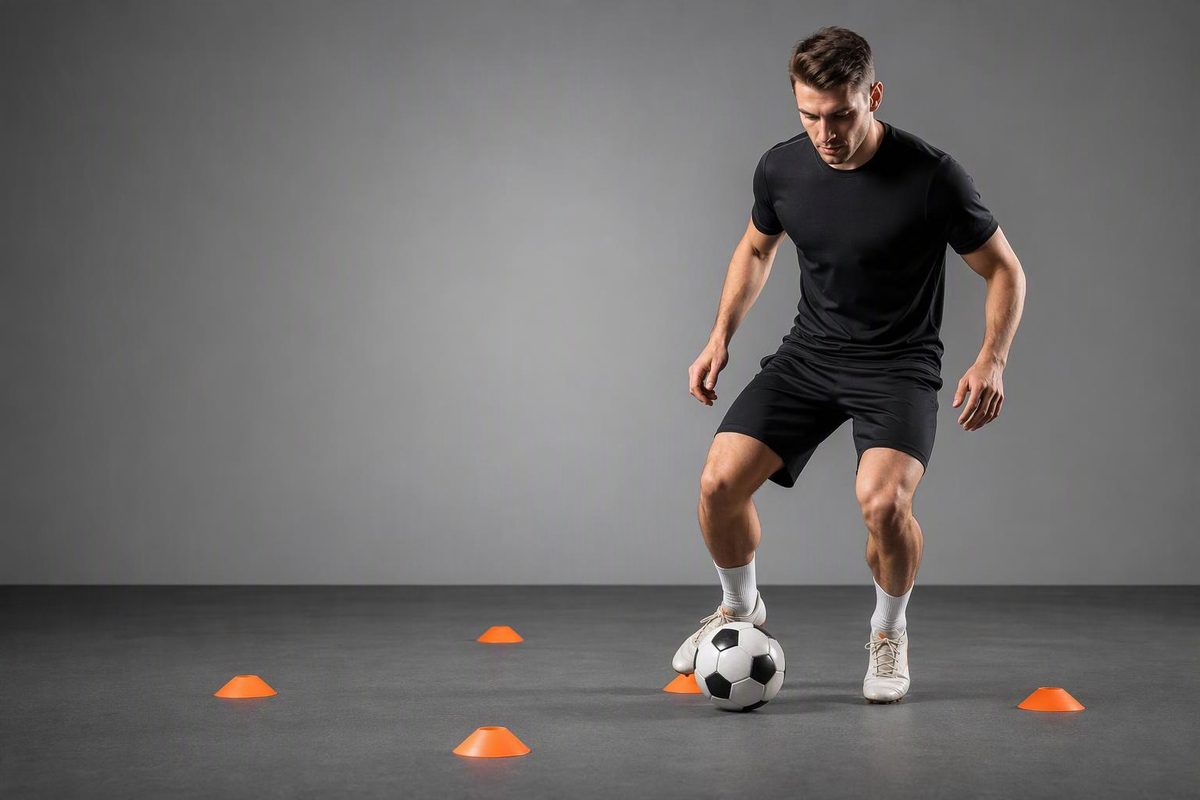
Practise five stationary soccer dribbling drills with clear timings and coaching cues, then progress from close control to movement and live 1v1s.
Use stationary dribbling drills as a short ball-control block, not your entire dribbling session. Practise the contacts below for five minutes, then take them into movement and, when a partner is available, a live 1v1.
“Stationary” means staying in a small area—not planting your feet. Let your feet reposition as the ball moves. These exercises rehearse ball manipulation; they do not include the opponent, space and timing decisions involved in beating a defender.
The five-minute routine
Setup: One ball per player and roughly a 2 × 2m space, with separation between players. Use a flat, non-slip surface, suitable footwear and space clear of furniture or other obstacles.
Timing: Work for 20 seconds, then take 10 seconds to reset or change exercise. Complete all five drills twice: ten 30-second slots, totaling five minutes. Demonstrate unfamiliar movements before starting the timer.
These timings are a practical coaching prescription, not a research-established optimum. Beginners can start with one round and pause whenever they lose control.
The inside-foot exchanges, sole exchanges and outside-touch/sole-return movements below adapt contacts used in FIFA’s ball-control session, where players perform them while moving through space.
1. Alternating sole taps
Keep the ball in front of you. Lightly touch its top with the sole near the toes of one foot, return that foot to the ground, then alternate.
- Cue: Touch the ball; do not stand on it.
- Common error: Putting enough weight through the contact to push the ball away or lose balance.
- Easier option: Walk through the sequence slowly, settling both feet between taps.
2. Inside-to-inside touches
Place the ball between your feet. Pass it a short distance from the inside of one foot to the inside of the other, shifting your weight with each contact.
- Cue: Keep the ball within one comfortable step.
- Common error: Staying rooted while reaching for a ball that has drifted away.
- Easier option: Stop the ball after each exchange before sending it back.
3. Side-to-side sole rolls
Place one sole lightly on the ball and roll it across your body toward the opposite foot. Release it, reposition your feet and roll it back with the other sole.
- Cue: Move with the ball rather than stretching across your body.
- Common error: Rolling farther than the opposite foot can comfortably collect.
- Easier option: Use shorter rolls and pause between directions.
4. Outside touch, sole return
With your right foot, nudge the ball to your right using the outside of the foot. Bring the same sole onto the ball and roll it inward. Repeat, using the left foot in the second round.
- Cue: Make the outside touch small enough to retrieve without lunging.
- Common error: Turning the first contact into a long push and chasing the ball.
- Easier option: Reset fully after every outside-touch/return pair.
5. Pull back and push forward
Start with the ball just ahead of your right foot. Use that sole to draw it back, then use the inside of the same foot to push it forward slightly. Reposition and repeat. Use the left foot in round two.
- Cue: Keep both directions controlled; leave room for your feet to move.
- Common error: Pulling the ball underneath your body and getting tangled.
- Easier option: Pause after the pull before making the forward touch.
The Irish FA’s coaching manual for ages 10–12 also includes sole manipulation and a diagonal V drag-and-push variation. It places ball mastery within sessions containing moving dribbles and game-related practice.
What the research changes
Do not treat a faster stationary sequence as proof of better match dribbling. A 2021 systematic review of soccer skill acquisition covered 35 studies involving soccer players in applied settings. Repetition-based practice improved technical outcomes, but its effect on match performance remained largely unexplored. The review also supported approaches that let players explore solutions in game-relevant situations; study quality was moderate and methods varied substantially.
A practical implication is to combine technical rehearsal with game-relevant practice rather than rely on isolated repetitions alone. The review does not establish that this particular five-minute circuit improves match performance.
Progress beyond the spot
Once the contacts are manageable, use this progression:
- Add travel. Move slowly through an open area using inside touches, sole rolls or outside touches. Look briefly ahead between contacts and avoid other players.
- Add a relevant cue. A partner points toward an available exit gate; control the ball, look up and dribble through it. This adds a response task, but still no defender.
- Add opposition. In a roughly 6 × 8m area, place two small exit gates on the far end line. An attacker starts with the ball at the near end; a defender starts centrally. Score by dribbling through either gate under control. End each attempt on a score, turnover, ball out or after ten seconds, then swap roles. Adjust the space to suit the players.
Do not require a rehearsed move in the 1v1: let the attacker choose based on the defender. To build this short block into a fuller session with turns and receiving or opponent pressure, use the 20-minute soccer footwork progression.
Check control before chasing speed
During a repeat 20-second bout, record how often the ball leaves your practice space or requires a full reset. Compare the same drill and foot across sessions. Fewer resets can indicate better control in that task.
Increase pace only while touches remain manageable. Against the defender, observe whether the player keeps possession and chooses the open gate—not whether they reproduce the stationary pattern. Stop if the exercises cause pain; these drills are not a rehabilitation prescription.