
Soccer defense positions: who protects which space?
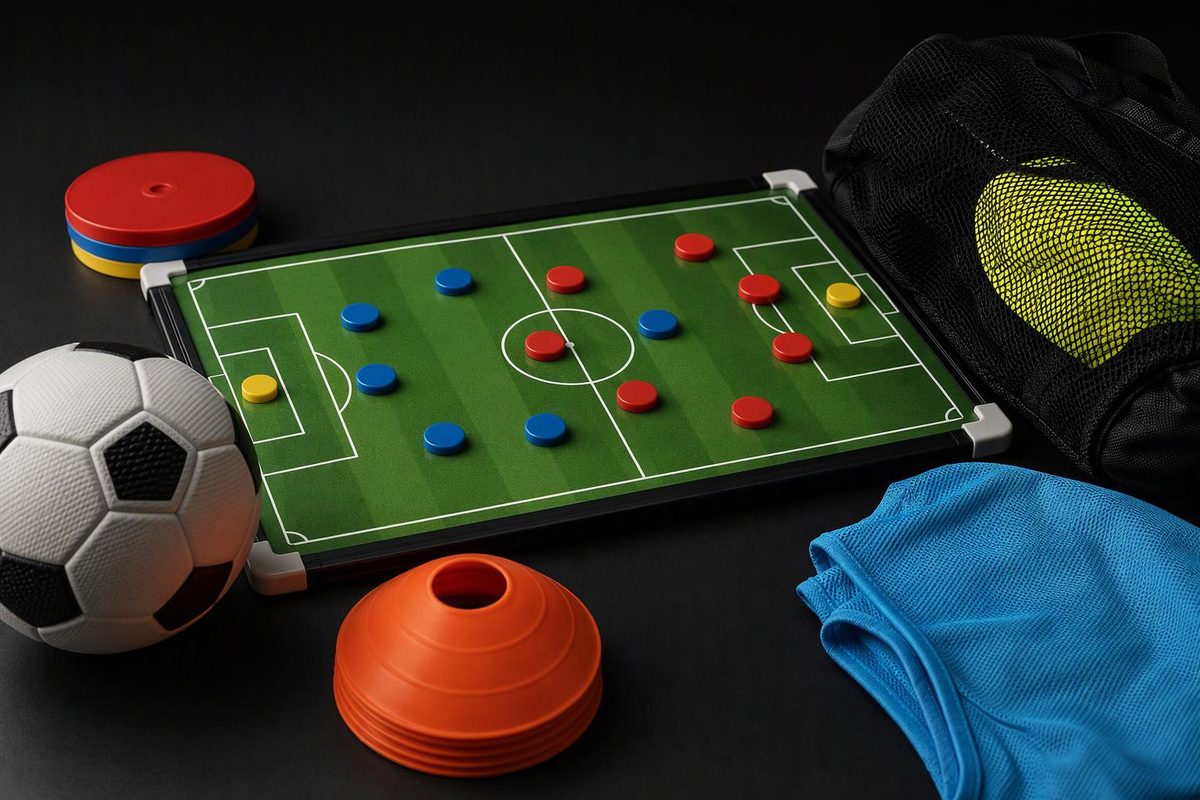
Understand center-backs, full-backs, wing-backs and defensive midfielders, how formations change their jobs, and a 12-minute practice for coordination.
The main soccer defense positions in 11-a-side play are center-back, right-back and left-back. Teams using three center-backs usually add wing-backs on the flanks. The goalkeeper protects the goal and supports the defensive line; a defensive midfielder protects the space in front of it. These positions anchor the defense, but midfielders and forwards also have defensive responsibilities.
For coaching, teach two things together: where the position starts and how its responsibilities change when the ball moves. A defender’s job is not to stay on a fixed patch of grass.
The positions and their main jobs
| Position | Usual starting area | Main defensive responsibility |
|---|---|---|
| Center-back (CB), also called center-half | Central back line, in front of the goalkeeper | Protect central routes to goal, manage forwards and coordinate the line |
| Right-back (RB) / left-back (LB), collectively full-backs | Outside the center-backs in a back four | Defend the flank while staying connected to the central defenders |
| Right / left wing-back (RWB / LWB) | Wide alongside a three-center-back system | Press or defend wide, then recover into the back line when required |
| Defensive midfielder (DM), often called a holding midfielder | In front of the back line | Protect central space and connect the midfield’s defending with the defenders behind |
| Goalkeeper (GK) | Behind the defensive line | Protect the goal and judge when to intercept balls behind the defense |
These are starting references, not exclusive territories. A center-back may need to defend near the touchline; a full-back may need to protect the middle.
Center-back: protect the middle, but be ready to leave it
Center-backs organize the line, track central attackers, intercept passes, block shots and deal with deliveries into the penalty area. They also need to cover wider spaces when a teammate advances and delay counterattacks while support recovers. In possession, their role includes receiving under pressure and starting attacks—not simply clearing the ball. Coaches’ Voice explains these defensive and build-up responsibilities.
Coaching cue: before stepping toward an attacker, check who protects the space you leave.
Full-back versus wing-back
A full-back is normally the wide defender in a back four. A wing-back operates outside three center-backs, often moving high to provide attacking width and dropping back to create a defensive five. The distinction is the surrounding structure, not simply how attacking the player is.
Wing-backs still need to defend 1v1, track runners and recover after possession is lost. Their additional central support does not remove those duties. Coaches’ Voice’s wing-back guide describes these differences.
Coaching cue: when the ball is on the opposite flank, check both your distance from the nearest center-back and the runner behind you.
For role-specific detail, see our full-back responsibilities and training guide.
Defensive midfielder and goalkeeper: connect the lines
The defensive midfielder is a midfield position, not an extra center-back by default. The role helps keep the team compact, communicates with the back line and provides a link into attack.
The goalkeeper must also stay connected to the defenders. Behind a high line, that can mean adjusting forward to intercept through balls; in possession, it includes offering a passing option. Javier Mascherano discusses both roles in FIFA’s interview on the central defensive spine.
What about a sweeper or stopper?
A sweeper, or libero, traditionally plays behind the other defenders to cover balls that get through. It is a distinct arrangement, not a required position in every team. See Coaches’ Voice’s libero explanation.
A stopper traditionally steps out to engage an attacker while a teammate provides cover behind, as described in The Mastermind Site’s role analysis. If a coach uses that label, clarify who supplies cover rather than assuming it identifies a fixed formation.
How formations change defensive jobs
In common formation notation, the goalkeeper is omitted:
- 4-4-2 or 4-3-3: the four defenders usually comprise two center-backs and two full-backs.
- 3-5-2 or 3-4-3: three center-backs usually work with two wing-backs, who can recover into a five-player defensive line.
- 5-3-2: explicitly describes that five-player back line.
A team’s attacking and defending shapes may differ. A back four can become a three during build-up if a midfielder drops in or one full-back advances while the others shift across. In a three-center-back system, the outside center-back may defend beyond the wing-back while the remaining two protect the middle. Coaches’ Voice illustrates these back-three relationships.
Teach pressure, cover and balance—not fixed spots
In zonal defending, players adjust to the ball, teammates and spaces needing protection. FIFA’s coaching framework distinguishes:
- Pressure: engage the ball-carrier.
- Cover: support behind and at an angle to the pressing defender.
- Balance: protect the remaining space and anticipate the next action.
These responsibilities change as play moves. FIFA recommends progressing from individual defending to small groups and then connected defensive lines. This is federation coaching guidance, not proof that one formation is universally superior.
A 12-minute practice to make the roles visible
This suggested setup rehearses a back four plus a defensive midfielder. Use it after a suitable warm-up; the dimensions and timings are coaching starting points, not a tested training dose.
- Players: five defenders, five attackers and one goalkeeper.
- Area: approximately 40 m wide × 35 m long, with a goal at one end and two 2 m-wide counterattack gates at the other. Adjust the space to the players’ age and ability.
- Timing: one-minute briefing, then three three-minute bouts with one-minute breaks between bouts.
- Play: attackers try to score. Defenders score by dribbling through either gate after winning possession. Restart with the attackers when the ball goes out; vary the starting side.
Observe three decisions: does the full-back engage with cover available; do the center-backs protect the middle when one teammate steps out; and does the midfielder prevent easy central progression? Use the breaks to address one recurring gap, rather than repositioning every player after every pass.
For a longer progression, use our 60-minute soccer defending session.
Match training to the role, not the stereotype
FIFA’s analysis of the 2022 men’s World Cup found that center-backs covered the lowest total distance among its outfield position groups, while central and defensive midfielders covered the most. It also showed substantial individual variation and grouped full-backs with wing-backs, so it cannot establish a separate workload prescription for each. These elite adult data are context, not individual targets for youth or amateur players. See FIFA’s positional distance analysis.
The practical inference is to train the actions your system actually demands: wide recovery runs, central cover, stepping out, turning and passing under pressure. Do not assign a position—or a conditioning dose—from height, speed or a distance ranking alone.