
Soccer Striker Training: Movement, Link Play and Finishing
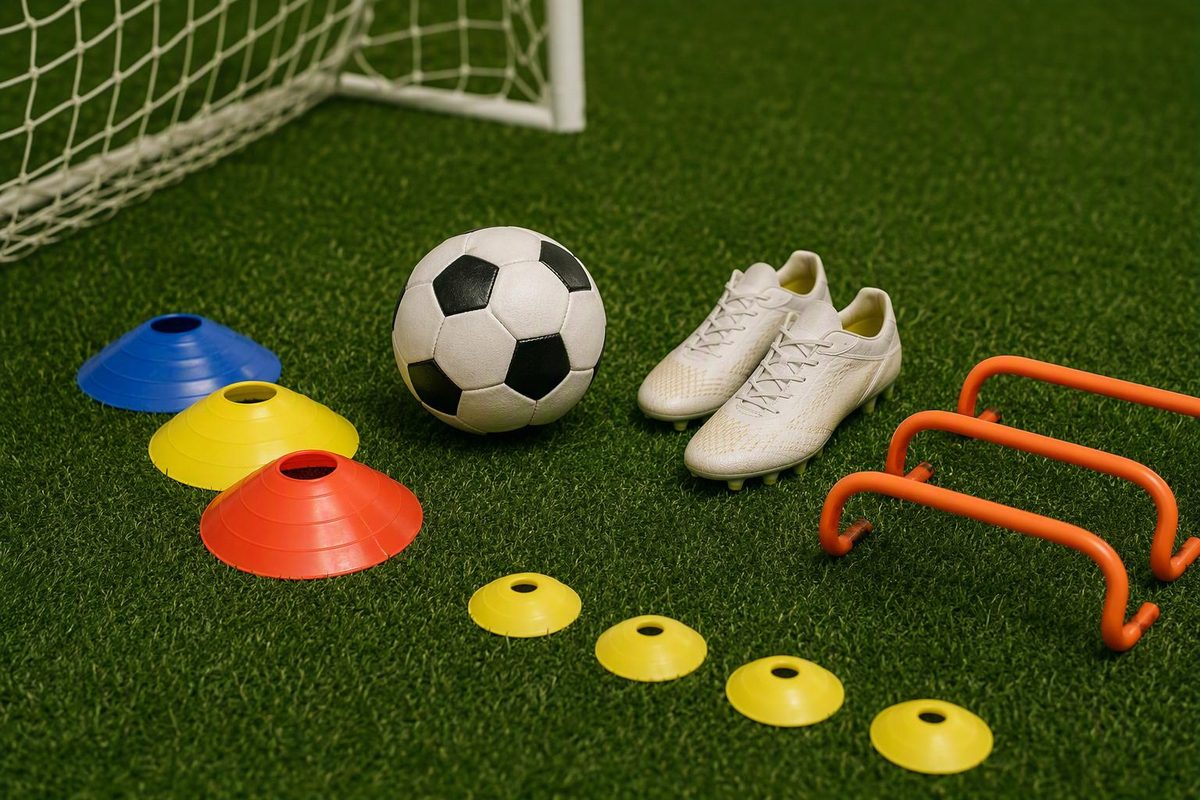
Run a 40-minute striker practice that connects timed runs, receiving, link play and finishing under pressure, with simple measures of progress.
Build striker training around creating a chance before finishing it. Use a short receiving-and-shooting block, then add defenders, supporting players and decisions. A striker needs to practise when to run, when to come short and when to release a teammate—not just how to strike an unopposed ball.
The following 40-minute block is a coaching proposal, not a scientifically validated dose. It needs six outfield players, one goalkeeper, a secured goal, balls, cones and two counterattack gates. Run it after a progressive soccer warm-up; the clock below does not include that preparation. Block timings include resets, role changes and brief explanations.
What the research changes
A systematic review covering 35 soccer intervention studies found support for practice that lets players explore solutions in representative, game-like situations. Repetition-based practice also improved technical outcomes, but its transfer to match performance was largely unexplored. The review focused on experienced soccer players rather than beginners. The studies were heterogeneous and of moderate quality overall—not a basis for declaring one method universally best or promising a particular increase in goals. Read the systematic review.
The practical decision is to keep technical repetitions, but do not stop there. Connect the finish to the information that normally shapes it: the defender’s position, the passer’s readiness, the goalkeeper and available support.
FIFA’s attacking guidance pairs well-timed runs with well-weighted passes and warns that moving too early can make a run predictable or leave the attacker offside. Its finishing progression adds live opposition and teammates through 1v1, 2v2 and 3v3 situations. These are coaching models, not controlled evidence that the exercises increase match goals. FIFA movement session; FIFA finishing progression.
The 40-minute striker session
Use approximately 30 × 25 metres in front of the goal as a starting area. Adjust it to the players’ age, ability and goal size. Make the area larger if every reception is immediately crowded; smaller if attackers can shoot without needing to solve a problem.
Start with ground passes and low cutbacks. This plan does not require heading. Rotate attackers, defenders and servers so everyone practises both sides of the problem.
For the opposed blocks, treat the whole area as the opponents’ half when practising offside. Judge position when a teammate plays the ball: an attacker is in an offside position only if nearer the goal line than both the ball and the second-last opponent. Being in that position alone is not an offence; involvement in active play matters. Use the live opponents, not a fixed cone line. For younger groups whose game format has no offside, omit this condition. IFAB Law 11.
1. Receive, link and finish — 8 minutes
Setup: Two groups of three alternate attacks toward the same goal. Each group has a server, striker and supporting player. Keep the waiting group clear of the shooting area.
Action: The server passes into the striker, who chooses between:
- receiving side-on, taking a touch toward a shooting lane and finishing;
- setting the ball to the supporting player, then moving to receive their return pass beyond the striker’s starting position.
Vary the delivery between feet and into space rather than feeding exactly the same ball every time. Rotate roles after each attempt. Allow the goalkeeper to reset before the next group starts.
Coach one detail: “Look before the pass, then take your first touch toward your next action.” Ask the player what they saw rather than prescribing a turn on every repetition.
Adjust: Begin with comfortable service. Add an approaching, non-tackling defender only if receiving and passing remain controlled; borrow that player from the waiting group. For more focused ball-contact work, use the separate soccer shooting progression.
2. Time the run in a 2v1 — 10 minutes
Setup: A ball carrier starts centrally, roughly 25 metres from goal. A striker starts to one side, level with a defender positioned nearer the penalty area. The other three players wait, retrieve balls and rotate in.
Action: The ball carrier advances toward the defender. The striker chooses whether to offer a short passing option or run behind. The carrier can pass or continue toward goal. The defender tries to win possession and dribble through either counterattack gate at the starting end.
End each attack after a goal, the ball leaves play, an offside offence or the defender escapes through a gate. Reset between repetitions and switch the striker’s starting side halfway through.
Coach one detail: “Match your movement to the passer and defender.” A run is not successful merely because it is fast: it must offer a usable passing route without going offside.
Adjust: Give attackers more space if the defender stops every attack. Progress to 2v2 when the striker repeatedly receives without pressure, bringing in one waiting player as the second defender.
3. Receive under pressure and combine — 10 minutes
Setup: Play 2v2 toward the main goal, with two wide servers supporting the attackers. Defenders counter through the gates. Use two four-minute bouts, with two minutes total for recovery, role changes and brief feedback.
Action: A wide server starts each attack with a pass to either attacker. Play is then live. The attackers can turn, set the ball, combine or use either server again. Servers stay outside the area and cannot shoot. Reset after a goal, the ball leaves play, an offside offence or a successful counter through a gate.
Coach one detail: “If you cannot turn, keep the attack moving.” Do not count a sensible layoff as failure. Watch whether the striker’s movement after passing creates another option or draws a defender away.
Adjust: Start without touch limits. If play becomes slow and comfortable, restrict the servers to two touches before restricting the striker. Forcing every striker reception into a first-time finish would remove the decision this block is meant to train.
4. Test it in a directional 3v3 — 12 minutes
Setup: Three attackers play against three defenders plus the goalkeeper. Attackers score in the main goal; defenders counter through the two gates. Restart with an attacker at the starting end after each completed sequence.
Play three three-minute bouts, with one minute between bouts and one minute for final feedback. Rotate team roles during the breaks.
Action: Apply the offside condition and use no compulsory passing pattern or touch limit. The striker can come short, run behind, combine or create space for someone else. Let play continue without constant coaching interruptions.
Observe: Does the movement practised earlier still appear when the answer is no longer supplied by the drill?
Measure chances, not just goals
For one designated striker, tally these during their attacking bouts in the final game:
- Usable runs: onside runs that offer a clear passing route, whether or not the pass arrives.
- Productive receptions: receptions followed by a controlled shot, retained possession or a useful pass. Record total receptions too.
- Finishing outcomes: total shots, shots on target and goals, recorded separately.
These are coaching observations, not validated performance scores. Record the player’s attacking minutes and compare sessions with similar space, service, opposition and time in the attacking role. Check productive receptions against total receptions rather than comparing successful counts alone. A better goal total against weaker defending is not necessarily better learning.
Choose the next adjustment from the bottleneck: improve timing if runs are repeatedly offside; simplify receiving pressure if possession breaks down immediately; add focused finishing work if good chances consistently end in poor contact. Use a session reflection record to keep that decision specific.
Treat this as part of squad training, not an automatic extra workload afterward. Leave enough recovery between attacks for purposeful movement and controlled finishing. Reduce repetitions when fatigue undermines those aims, and stop for pain; persistent symptoms need assessment by a qualified clinician.