
A 60-Minute Soccer Defending Session: From 1v1 to Team Shape
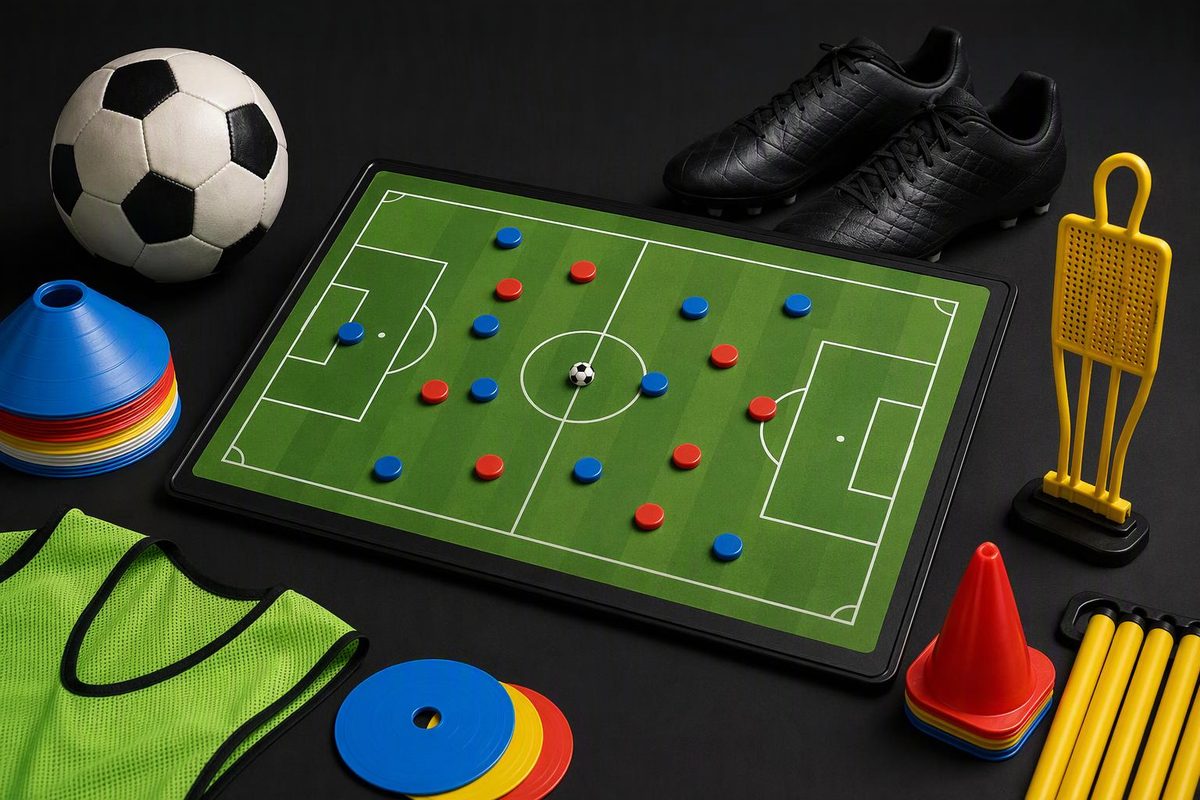
Train delay, pressure, cover, balance and compactness in one 60-minute soccer defending session, with setups and adaptations for different squads.
Build a defending session from the smallest decision to the full-team problem: 1v1 delay, 2v2 pressure and cover, then compact team defending. This 60-minute plan gives each principle repeated practice before asking players to connect them in a realistic game.
It is designed for 16 players, including two goalkeepers, but the adaptations below make it workable for 10–20 players.
Session at a glance
| Time | Practice | Main objective |
|---|---|---|
| 0–10 min | Dynamic warm-up | Prepare for accelerations, decelerations and changes of direction |
| 10–22 min | 1v1 channel defending | Close down, slow the attacker and protect the inside |
| 22–36 min | 2v2 to end lines | Coordinate pressure and cover |
| 36–52 min | 8v8 compact-defending game | Shift together, protect central space and recover when bypassed |
| 52–60 min | Free game | Test whether the behaviours survive without bonus rules |
The exact timings and dimensions are practical starting points, not experimentally established optimum values. Adjust them when the task is too easy or too difficult for the players.
The progression follows a useful coaching logic: individual defending first, small-group relationships next, then connected lines. FIFA’s zonal-defending methodology uses the same broad sequence while stressing that the stages are interconnected rather than rigid steps (FIFA Training Centre).
0–10 minutes: dynamic defensive warm-up
Use a 20 x 20m area. Begin with easy movement, then increase speed:
- Two minutes: jogging, side shuffles and backpedalling.
- Three minutes: dynamic hip and lower-limb mobility.
- Two minutes: partner mirror work—one player leads while the other stays square and adjusts their feet.
- Three minutes: short accelerations into a controlled stop, side-on stance and five-metre recovery run.
Keep the first repetitions submaximal. The final minutes should resemble the actions ahead: closing space, braking, changing direction and recovering. The dynamic soccer stretching routine provides a fuller exercise sequence if the squad needs more preparation.
10–22 minutes: 1v1—close, delay and protect the inside
Setup
- Make four channels, each approximately 15 x 10m.
- Place two players at each end of every channel.
- Designate one side of each channel as the central side, based on where that channel would sit on the pitch.
- Use an end line as the attacker’s target; add a mini-goal behind the starting line for the defender’s counterattack if available.
- A player passes across the channel to start, then becomes the defender.
The attacker scores by dribbling over the far line. If the defender wins possession, they counter over the opposite line or into the mini-goal. Play four two-minute rounds with brief recovery and feedback between rounds.
Coach these decisions
- Close quickly while the ball travels, then shorten the steps before contact distance.
- Protect the dangerous route. In this setup, that means showing the attacker away from the designated central side. In a match, the safer direction depends on the location of the ball, goal, teammates and covering defenders.
- Use a low, side-on stance that permits movement in either direction.
- Delay before tackling. Winning the ball is valuable, but stopping forward momentum may be the correct first action.
- Tackle on a poor touch or exposed ball, not merely because the defender has reached the opponent.
FIFA’s individual-defending practices describe this as recognising when to pressure, when to delay and how to deny progression. They also warn against overcommitting beyond the ball (FIFA Training Centre). In a goal-side 1v1, FIFA similarly recommends a low, side-on approach that guides the attacker wide while protecting the inside route (FIFA Training Centre).
Do not turn this into twelve minutes of diving into tackles. Score one point for forcing the attacker backward or out of play, as well as for a clean regain. That rewards effective defending rather than only possession wins. For technical detail on safe tackle progressions, use the slide-tackling guide separately; sliding is not needed in this practice.
22–36 minutes: 2v2—pressure and cover
Setup
- Keep four groups of four and enlarge each area to roughly 18 x 15m.
- Put an end line at each end.
- Teams score by dribbling over the opponent’s line.
- Play four rounds of 2 minutes 30 seconds, with about 45 seconds for recovery and role-specific feedback.
The first defender pressures the ball. The second defender covers the space behind and slightly inside that pressure. When the pass changes the point of attack, the roles change: the covering defender may become the presser, and the original presser recovers into cover.
Useful cues
- “Nearest player presses.”
- “Second player protects inside and behind.”
- “Move as the pass travels.”
- “If pressure is broken, recover toward goal—not toward your original opponent.”
- “Talk early: hold, show left, step or drop.”
Avoid prescribing one universal covering distance. It depends on the speed and direction of the attacker, the quality of pressure on the ball and the space behind. Ask instead: Can the second defender stop the inside pass or dribble while still helping if the first defender is beaten?
A 2v2 introduces the relationship between the first and second defender; FIFA frames this as pressure plus cover, with defenders deciding when to delay, step in or prevent progression (FIFA Training Centre).
36–52 minutes: 8v8 compact-defending game
Setup
- Play 8v8, including goalkeepers, on approximately 50 x 40m.
- Use full-size or appropriately sized age-group goals.
- Mark three vertical lanes with flat cones. These are visual references, not zones that restrict movement.
- Restart from a goalkeeper whenever the ball leaves play.
- Play four four-minute blocks. Alternate which team receives the main defensive coaching focus.
Both teams attack normally. Give the defending team one objective in each block:
- Protect the centre: keep the block narrow enough to discourage a central pass.
- Shift on the pass: the nearest player presses while teammates move across to close gaps.
- Trap wide: once the ball reaches a touchline, prevent the return pass inside.
- Recover when bypassed: if pressure is broken, drop and reconnect rather than continuing isolated chases.
The lanes help players see whether the whole team has shifted or whether weak-side players have stayed disconnected. Do not demand that all defenders occupy one lane; the aim is to protect dangerous space while retaining enough balance to deal with a switch.
Freeze play only when a clear team picture is available. Check:
- Is the nearest defender applying real pressure, or is the team squeezing behind passive pressure?
- Is the player behind covering the route through the block?
- Has the far side moved across while remaining able to defend a switch?
- If one line steps, do the other lines step too?
- When the press is beaten, does the team retreat together?
An official FIFA compact-defending game targets the same connected actions: pressing high in a compact shape, shifting laterally as the ball moves and dropping together when the press is bypassed (FIFA Training Centre).
52–60 minutes: remove the conditions
Remove the internal lane markers and play a normal game. Coach sparingly. The question is no longer whether players can follow a rule; it is whether they still recognise when to press, cover, shift and recover without the visual prompt.
Track three simple outcomes for the coached team:
- central entries conceded;
- times the first defender is beaten without cover;
- regains or forced exits near a touchline.
Those observations give the next session a clearer target. Frequent central entries suggest a compactness or cover problem. Repeated fouls and easy dribbles past the first defender point back toward approach speed and 1v1 control. Successful pressure followed by an uncovered pass usually indicates that the unit behind is reacting too late.
Adjusting the session
| Situation | Adjustment |
|---|---|
| 10–12 players | Use two or three 1v1/2v2 areas, then finish with 5v5 or 6v6 to mini-goals on about 40 x 30m. |
| 18–20 players | Add a fifth small area, then play 9v9 or 10v10; enlarge the final pitch only enough to preserve realistic pressure. |
| Beginners | Narrow the 1v1 channel slightly, start defenders closer and rehearse the approach at walking speed before live play. |
| Defenders cannot get close | Reduce the area or serve slower passes; do not solve every problem with more verbal instruction. |
| Attackers rarely progress | Enlarge the area, give attackers a small head start or create a temporary attacking overload. |
| No goalkeepers | Use two mini-goals at each end or dribble-over end lines. |
Small-sided games are useful here because player numbers, pitch size and rules can be changed to emphasise particular decisions while retaining opponents, teammates and direction. A 2020 systematic review of 47 youth team-sport studies supported small-sided games as a technical-tactical teaching method, while also finding that responses varied with age, playing level and task design (Fernández-Espínola et al., 2020). That supports the broad format—not this exact sequence or a “perfect” grid size. Adjust the space when the practice is producing the wrong problem.
The session has worked when defenders do more than chase and tackle: the first player influences the ball, the next player protects the space that matters, and the rest of the team moves early enough to stay connected.