
Slide Tackling in Soccer: A Safer Decision and Training Progression
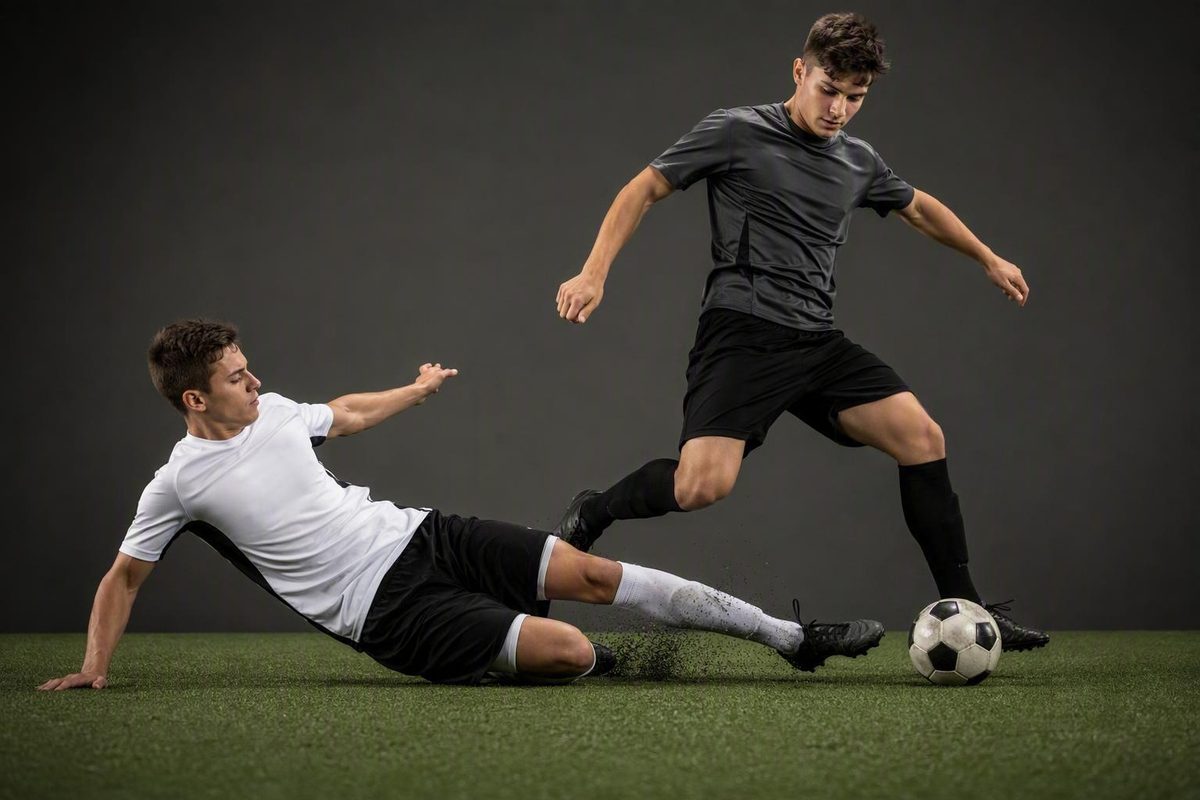
Learn when a soccer slide tackle is legal, when it is worth the risk, the key technique cues, and a controlled drill progression for training it.
A slide tackle should be a defender’s recovery tool, not the default way to defend. Stay on your feet when you can delay, steer or dispossess the attacker without going to ground. Slide when the ball is briefly exposed, the attacker is about to escape and a clean intervention is realistically within reach.
That decision matters more than an exaggerated “perfect” sliding motion. A player on the ground cannot immediately adjust to a feint, second touch or loose ball.
Is slide tackling legal?
There is no blanket ban on slide tackles in the IFAB Laws of the Game. Legality depends on how the challenge is made.
Under Law 12, a careless tackle is a direct-free-kick offence, a reckless tackle also brings a caution, and excessive force or a challenge that endangers an opponent requires a sending-off. A lunge can constitute serious foul play whether it comes from the front, side or behind.
Winning the ball first is therefore not an automatic exemption. The referee still judges the speed, force, point of contact and danger created by the whole challenge. Studs directed toward an opponent, contact high on the leg, a two-footed lunge or arriving after the attacker has moved the ball can turn the attempt into a foul or serious foul play.
Youth and recreational competitions may impose tighter local rules. Check the rules for the actual league before teaching the skill: for example, AYSO Region 161 permits slide tackling from 10U but prohibits it in its younger divisions. That is a regional rule, not a universal age threshold.
Use this decision hierarchy
Teach defenders to work through these options in order:
- Recover goal-side. Get between the attacker and the goal.
- Slow the attack. Approach under control, become side-on and show the attacker away from the most dangerous space.
- Wait for separation. A heavy touch creates the moment to tackle.
- Use a standing tackle if possible. It preserves balance and keeps the defender involved in the next action.
- Slide only when staying upright will not reach the ball in time. Typical cases include blocking a shot or cross, intercepting a ball pushed beyond the attacker, or making a last-ditch recovery beside the attacker.
This is consistent with FIFA’s 1v1 guidance: defenders should use a low, side-on position, force the attacker wide and decide whether to engage or maintain a short distance (FIFA Training Centre).
Do not slide when the ball is beneath the attacker, the opponent’s next touch is unpredictable, a teammate has cover, or missing would expose the goal unnecessarily.
Technique cues for a controlled slide tackle
These cues are practical coaching guidance, not a scientifically proven injury-prevention formula:
- Close the distance under control. Sprint to recover, then shorten the final steps so the attacker cannot eliminate you with one touch.
- Watch the ball. Do not launch from a body feint. FIFA’s analysis of elite defender Irene Paredes identifies a heavy touch as the opening to tackle and emphasizes that precise timing is especially important when sliding (FIFA Training Centre).
- Approach from the side when possible. This creates a path toward the ball rather than through the opponent.
- Use one tackling leg. Keep the knee slightly bent and direct the foot toward the ball, not the opponent’s planted leg. Do not lead with both feet or expose the studs toward the player.
- Play through the ball’s path. Either knock it safely out of play or hook it into a space you can recover toward. “Touching the ball” is not enough if the follow-through endangers the opponent.
- Protect the landing. Slide along the outer hip and thigh rather than dropping directly onto the knee. Avoid planting a hand rigidly to stop the fall.
- Get up immediately. The tackle is incomplete if the attacker, a teammate or a second opponent reaches the loose ball first.
A four-stage training progression
Players should already be physically prepared before this work. Use a progressive dynamic soccer warm-up, then begin at walking speed on a suitable, inspected surface. Do not introduce full-speed contact to players who cannot yet defend a 1v1 while standing.
1. Stationary ball and landing rehearsal
Place a ball one step to the player’s side. The player steps toward it, lowers their center of mass, extends one leg to pass the ball away and slides gently onto the outer thigh. There is no opponent.
Perform three or four repetitions on each side. Coach a bent tackling leg, studs away from an imaginary opponent and a quick return to the feet. Stop if the surface causes pain, cuts or uncontrolled bouncing.
2. Rolling-ball interception
A partner rolls the ball diagonally across the defender’s path. The defender starts two or three metres away and intercepts it before a cone gate. Begin slowly and increase ball speed only after clean, balanced repetitions.
Score the action as successful only if the player contacts the ball cleanly, sends it to the intended area and regains their feet.
3. Shadowed attacker
An attacker dribbles along a channel at controlled speed while the defender recovers from slightly behind and to the side. The attacker must take a prescribed longer touch; that touch is the defender’s cue to slide and play the ball out through a side gate.
Keep the paths separated enough that the defender can reach the ball without travelling through the attacker. Rotate after every attempt and limit repetitions to preserve control.
4. Live 1v1 with a standing-first constraint
Use a channel about 12–15 metres long with a scoring gate at the end. The attacker tries to dribble through; the defender scores by winning possession or forcing the attacker outside the channel.
Award two points for a successful standing intervention and one for a clean slide tackle. This scoring rule prevents players from treating going to ground as the main objective. Stop immediately for exposed studs, two-footed action, contact through the opponent or a slide made when delay and recovery were still available.
What the injury evidence can—and cannot—tell us
Slide tackles clearly can cause injury, but available injury counts do not establish the risk of one slide tackle compared with one standing tackle.
A US study of lower-extremity soccer injuries in players aged 18 or younger estimated that slide tackles accounted for 1.3% of cases presenting to emergency departments from 2013–2022. Among cases coded as slide-tackle injuries, 27% were fractures and 40% were strains or sprains (study in Arthroscopy, Sports Medicine, and Rehabilitation). These figures cover only injuries that reached an emergency department, many records lacked a specified mechanism, and the study did not measure how many slide tackles occurred. They describe that clinical sample; they do not calculate the probability that a given tackle causes injury.
The practical conclusion is narrower: treat slide tackling as a high-consequence skill. Train the decision before adding speed, reward staying upright, and stop any practice in which players cannot control their approach, leg position or contact.