
Dribbling in Soccer: Control the Ball, Move the Defender
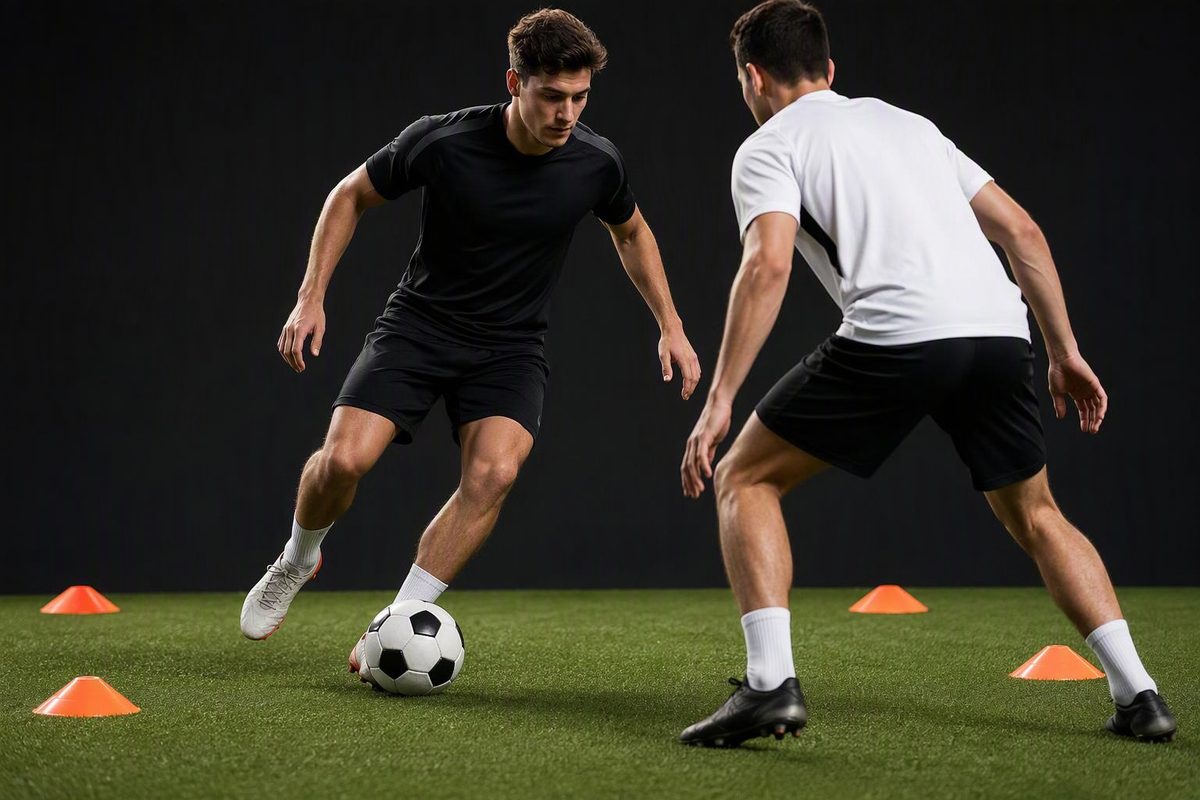
Learn the technique and decisions behind effective soccer dribbling, then progress training from ball control to live 1v1 play.
Good dribbling is not simply moving quickly with the ball. It is keeping enough control to read the situation, shift a defender and complete the next action.
That distinction changes how coaches should train and assess the skill. Cone work can develop ball familiarity, but players also need opponents, choices and a target if practice is meant to transfer to a match.
What counts as dribbling?
Coaches often use dribbling for two related actions:
- Carrying the ball: moving into available space while retaining possession.
- Taking on a defender: using the ball, body movement and acceleration to get past an opponent.
Both matter. A centre-back carrying into an open midfield lane is dribbling even without attempting a trick. A winger facing a full-back is solving a different problem: manipulate the defender, protect the ball and escape into useful space.
A successful take-on is not necessarily an effective team action. The player still needs to pass, shoot or continue carrying. In an observational study of 36 Italian U10 players, the measure that distinguished three coach-assigned skill groups was the percentage of successful dribbles followed by a correct pass that created an advantageous situation. The study was small and cannot establish a universal benchmark, but it supports a useful coaching principle: judge the advantage created after the opponent is beaten, not the move in isolation.
The technique: six connected actions
There is no single ideal dribbling style for every player or situation. These principles give players adaptable options rather than prescribing one movement.
1. Scan before receiving
Look for the nearest defender, open space, support and the next target before the ball arrives. A player who starts deciding only after the first touch gives the defender more time to close.
“Head up” should not mean never looking at the ball. Players need brief looks down to control it and repeated looks up to update the picture.
2. Put the first touch toward the solution
The first touch should fit the pressure:
- Into open space when there is room to accelerate.
- Across the body to escape pressure.
- Close to the feet when a defender can challenge immediately.
- To the safe side of the body when shielding is necessary.
A moving first touch can begin the take-on before the defender gets set. In a live 1v1 finishing practice, FIFA’s Training Centre asks attackers to receive on the move and use the foot that lets them place their body between the defender and the ball.
3. Match touch size to available space
Use smaller, more frequent touches in traffic so the ball remains available for a cut, pass or shield. Push it farther ahead when the route is open and sprinting speed matters.
“Keep it close” is therefore incomplete advice. The useful question is whether the player can reach and control the next touch before an opponent can intervene.
4. Threaten more than one route
Approach with a body shape that leaves at least two plausible exits. A change in hip, shoulder, foot or gaze can invite the defender to commit. The attacker does not always need an elaborate move; a convincing shift followed by a touch in the opposite direction may be enough.
5. Change direction or pace—then escape
The move creates separation; acceleration uses it. Once the defender shifts weight or reaches for the ball, touch beyond the tackling line and accelerate. FIFA coaching material similarly emphasizes awareness, control and an abrupt change of pace or direction.
6. Finish the action
After getting past the defender, scan again. The best next action might be a pass, shot, cross, continued carry or protection of possession. Do not let practice end automatically at the moment the defender is beaten.
When should a player dribble?
Dribble when carrying or taking on an opponent can create a better situation than releasing the ball immediately. Useful cues include:
- Open space ahead with no teammate in a clearly better position.
- A defender isolated without close cover.
- A route toward goal or into a more dangerous area.
- A defender approaching too quickly or with their balance committed.
- An opportunity to draw pressure before releasing a teammate.
Passing may be the better option when a teammate can exploit the space faster, a second defender is ready to cover or losing possession would expose the team badly. These are not rigid rules: field position, match state and the player’s abilities change the risk.
Research increasingly treats a dribble as an interaction rather than an isolated technique. One mathematical model fitted to tracking data from Major League Soccer represented 1v1 dribbling through the coupled movement of attacker and defender, using parameters such as attacker aggressiveness, defender hesitance and each player’s top speed. It was not a coaching trial, but it illustrates why a take-on changes as the defender changes.
How to train dribbling for match transfer
Use a short controlled phase to establish contact with the ball, then add information and opposition.
- Ball familiarization: Practise inside, outside and sole contacts, cuts and speed changes. Keep this brief and give each player a ball.
- Reactive dribbling: Have players respond to a partner’s movement, a directional signal or a changing gate rather than follow a memorized route.
- Live 1v1: Give the attacker a direction, scoring target and realistic start. Vary the defender’s starting angle and distance.
- Overload: Progress to 2v1 or 3v2 so the ball carrier must choose between dribbling and passing.
- Small-sided game: Use goals, end zones or bonus points that reward useful penetration without requiring a dribble every time.
A systematic review of 35 soccer intervention studies found support for coaching approaches that encouraged exploration in representative situations. Repetition-based practice also improved technical outcomes, but its effect on match play remained largely untested. The studies were of moderate quality overall and differed considerably in methods, so the practical conclusion is a blend rather than an either-or choice: use repetition for ball control, then representative opposition for perception and decisions.
A randomized trial provides a more specific example. Forty-two adult male amateurs completed six weeks of preplanned change-of-direction training, agility training with unpredictable cues, or agility plus a multiple-object-tracking task. All three groups improved a dribbling test without a cognitive task, but only the two agility groups improved when the test added a cognitive demand. Adding object tracking produced no extra benefit over agility training alone. This supports combining movement with unpredictable information, although a test improvement is not proof of better match dribbling and the result should not automatically be generalized to children, women or elite players.
For a ready-to-run practice, use this 35-minute dribbling drill progression, which moves from scanning and speed changes into live take-ons and 3v3 play.
Measure outcomes, not decoration
A player can complete a slalom faster without becoming better at beating opponents. Track match-relevant outcomes during 1v1s and games instead:
- Take-ons attempted.
- Opponents beaten while possession is retained.
- Penetration into the target area.
- Useful pass or shot after the dribble.
- Turnovers and where they occur.
- Ability to escape in either direction rather than relying on one route.
Do not reward attempt volume alone. A player who attacks every defender may inflate the count while ignoring better passes. The aim is a dribbler who can control the ball, recognize the opportunity and create a useful next action under pressure.