
Curve a Soccer Ball With Control, Not Just Spin
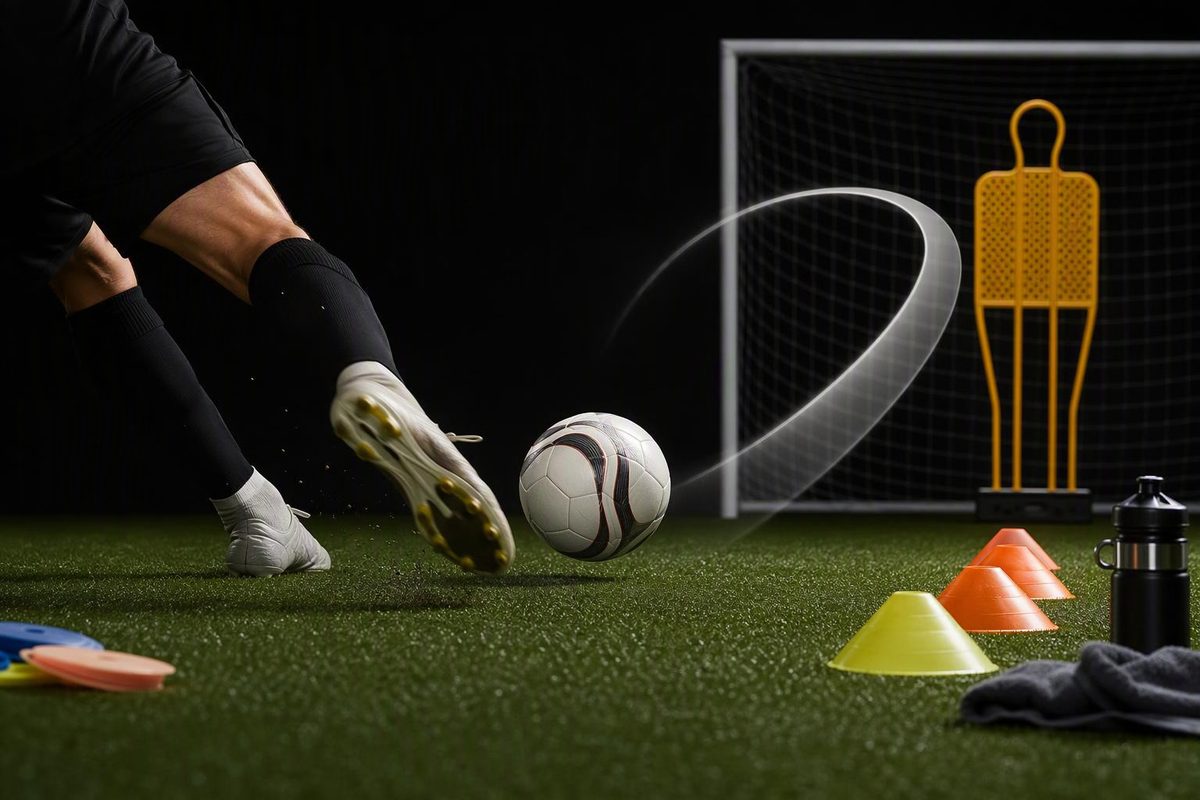
Master the contact, approach and aiming cues for bending a soccer ball, then use a 20-minute drill, scorecard and fixes for common ball-flight errors.
To curve a soccer ball, strike it off-center with a firm foot while sending it along an initial line outside the final target. For an inside-foot curl, approach diagonally, plant beside the ball, turn the kicking foot outward and contact the ball with the inside of the instep.
For a right-footed player, striking slightly right of center—as viewed from behind the ball—makes it bend left. A left-footed player mirrors the action.
Choose your kicking foot, then score a gate-and-target practice set.
Curve Setup and Practice Score
The direction guide assumes an inside-foot curl. Enter one completed set to calculate its gate-and-target score.
Right foot: start right of the final target, strike just right of center and let the ball bend left.
Enter all three counts. Blank values remain unknown rather than being treated as zero.
Scoring method: 2 points for passing through the gate and reaching the target, 1 for either outcome, and 0 for neither. Technique basis: Sakamoto et al., 2018.
The Six-Step Curving Technique
1. Choose an Initial Line and Final Target
Do not aim directly at where you want the ball to finish. Identify three features before the run-up:
- an initial line for the first part of the flight;
- an obstacle to travel around, such as a wall or defender; and
- a final target, such as the far corner or a teammate’s run.
A right-footed inswinging kick can start to the right of the target and curve left. “Start outside, finish inside” is a more useful cue than simply trying to generate spin.
2. Use a Short, Angled Approach
Take two to four controlled steps from a comfortable diagonal angle. This gives the kicking leg room to move across the initial line.
There is no universal angle to copy. A biomechanics review reports a self-selected approach angle near 43 degrees in skilled players and cites separate research associating about 45 degrees with maximum ball speed. However, a preliminary study of seven recreational players found no accuracy or velocity benefit when prescribed angles replaced their normal approach (Lees et al., 2010; Scurr and Hall, 2009). Start with a natural diagonal run rather than forcing an exact number.
3. Plant Beside the Ball
Place the support foot beside the ball, with its toe broadly facing the initial launch line. Keep the support knee slightly flexed and stay balanced over that leg.
If the plant foot is too far away, you will tend to reach for the ball. If it is too close, the kicking leg has little room to pass through. Adjust the position a few centimeters at a time rather than changing the entire run-up.
4. Present a Firm Inside Surface
Turn the kicking foot outward and hold the ankle firm. Contact with the solid area running back from the base of the big toe toward the inside of the instep, rather than using a loose ankle and the soft middle of the arch.
Players will not all use the same body shape. The objective is to deliver a stable surface on a repeatable path. Kicking uses a proximal-to-distal sequence in which the thigh, shank and foot accelerate in turn; the brief foot–ball collision then largely determines the ball’s speed, path and spin (Kellis and Katis, 2007).
5. Strike Off-Center
For a right-footed shot that bends left, contact just right of the ball’s center. Mirror that contact for a left-footed shot that bends right.
Stay near the horizontal midline for a flatter delivery. Move slightly below it when the ball must rise, but avoid getting far underneath, which tends to trade useful sideways bend for excessive height.
A study of 15 right-footed collegiate players compared straight, curve and knuckle kicks. Curve kicks contacted a lower area nearer the inside of the foot and used a foot path with greater lateral displacement, which the researchers interpreted as producing spin around the ball’s vertical axis (Sakamoto et al., 2018).
6. Swing Through and Finish Across Your Body
Accelerate through contact rather than stabbing at the side of the ball. Let the leg continue across your body, then recover your balance.
“Wrap your foot around it” can be a useful feel, but the ball is not carried around the foot. The off-center collision and angled foot path produce the spin. Modeling summarized in the biomechanics literature found that spin increased as the foot’s attacking angle increased, but fell beyond roughly 55 degrees as the foot slipped excessively across the ball (Lees et al., 2010). More sideways is not always better.
Why a Spinning Ball Curves
Sidespin produces an aerodynamic side force, commonly called the Magnus force, that deflects the ball from its initial path. In one 23-meter motion-capture experiment, a representative kick launched at about 19 m/s with 5.8 revolutions per second moved more than 0.7 meters sideways in one second (Hong et al., 2020).
That experiment involved only two collegiate players, so the figures illustrate the mechanism rather than prescribe a target. Useful curve requires a workable combination of spin, speed and launch direction. A ball can rotate visibly yet travel too slowly to make the curve useful; a hard central strike can have speed but little bend.
A 20-Minute Curve-Kick Practice
Complete this block after a progressive soccer warm-up. Use several balls, cones, a goal or target net, and one pole or mannequin. Train from both sides when your position requires both inswinging and outswinging deliveries.
Minutes 0–4: Make the Curve Visible
Set up 7–10 meters from a net or wide target. Use a two- or three-step approach at roughly half pace.
Focus on one outcome: start outside the target and bring the ball back. If the ball spins but misses badly, use a less sideways foot path. If it flies straight, shift contact slightly farther off-center while keeping the ankle firm.
Minutes 4–10: Build an Initial-Line Gate
Place a one-meter cone gate 3–5 meters in front of the ball. Put a larger final target farther downfield and offset from the gate.
Score each attempt:
- 2 points: through the gate and into the final target;
- 1 point: achieves one of those outcomes;
- 0 points: achieves neither.
The gate shows whether the ball started on the intended line. Without it, a pulled shot can look like a successful curve.
Minutes 10–16: Add an Obstacle
Move to a realistic crossing or free-kick distance. Use a mannequin, pole or passive defender. The objective remains passing the initial-line constraint and reaching the final zone—not producing the largest possible bend.
Take sets of three:
- normal curve;
- slightly flatter and faster;
- slightly higher, if the obstacle requires it.
Change one variable at a time—contact height, initial line or pace—so you can connect the adjustment to the result.
Minutes 16–20: Add a Decision
Have a teammate or coach call one of two targets as you begin the approach, or alternate between an inswinging cross and a shot. Keep the same scoring system.
A systematic review covering 35 soccer skill-acquisition studies found support for self-exploration in representative tasks. Repetition-based practice also improved technical outcomes, although its effect on match performance was largely untested and the overall evidence was methodologically mixed (Otte et al., 2021). A sensible progression is to establish reliable contact, then add realistic distances, obstacles and choices.
For a broader finishing progression, use these soccer shooting drills.
Fix Common Ball-Flight Problems
| Problem | Adjustment to Test |
|---|---|
| Ball travels straight | Contact slightly farther off-center while preserving a firm ankle and angled foot path |
| Ball spins but lacks pace | Strike through the ball more decisively and reduce an excessively sideways swing |
| Ball starts at the target, then curves wide | Move the initial line farther outside the final target |
| Ball rises too high | Contact nearer the horizontal midline and avoid leaning back |
| Contact is inconsistent | Shorten the run-up and stabilize the plant-foot position |
| Bend changes from kick to kick | Use the same ball and track gate-plus-target success, not only goals |
An external cue such as “through the gate, then into the far zone” is worth testing before adding several instructions about body parts. In a study of 120 moderately skilled male players, an external focus combined with choice produced better immediate penalty accuracy than internal-focus and control conditions, though not every comparison condition (Abdollahipour et al., 2019).
End the block when contact quality consistently deteriorates. Curving the ball is a precision task, not a contest to accumulate tired repetitions. A player with pain or a current lower-limb injury should seek individual assessment rather than trying to change technique through discomfort.