
Build a Short Jump Session That Supports Soccer Performance
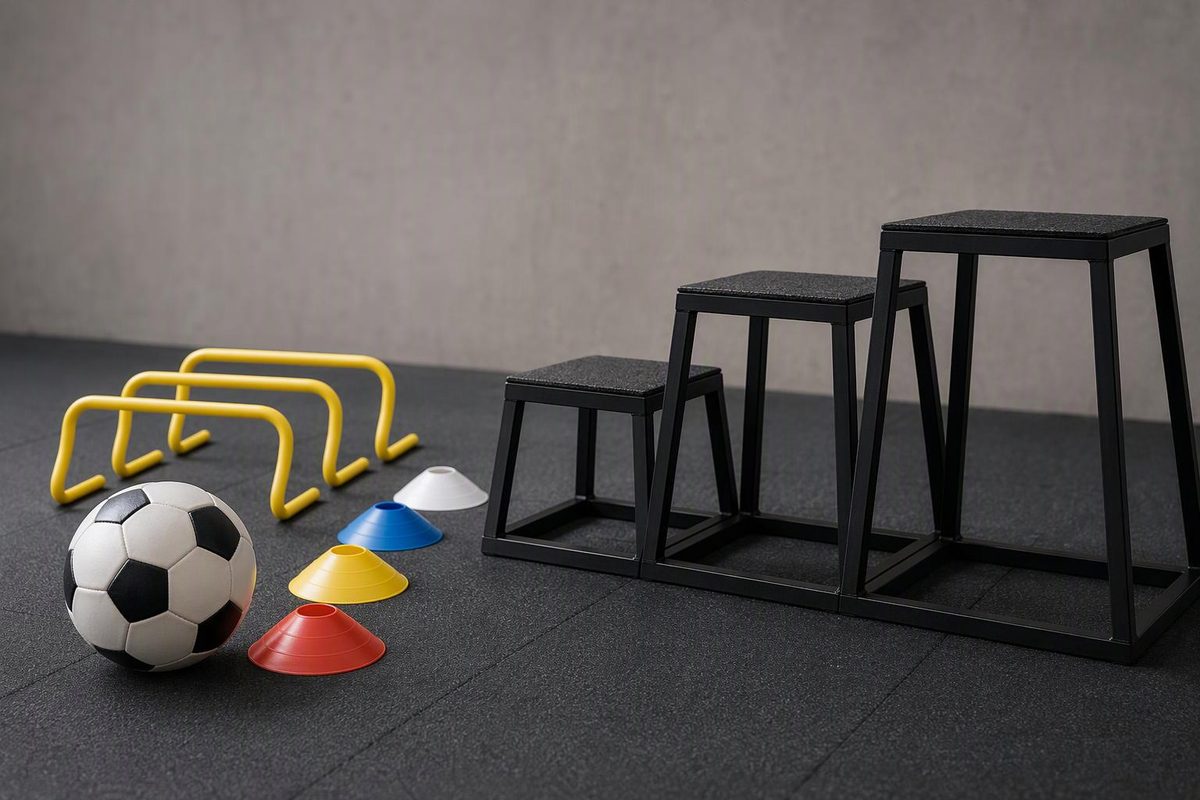
Plan soccer plyometrics with four exercises, 26 or 52 landings, clear rest periods and gradual progression, plus what adolescent research actually supports.
Use plyometrics for soccer as a short power-training block, not a fatigue circuit. Start with one session a week, after the warm-up and before demanding soccer work. Add a second session only when players are recovering well, usually leaving 48–72 hours between jump sessions. For healthy adolescent and adult players, the introductory template below starts at 26 landings and builds to 52 when technique and recovery allow.
Choose the player’s readiness and training stage to see the introductory jump dose.
Choose an Introductory Jump Dose
Start With 26 Landings
Use one set of each exercise, once a week after the warm-up and before demanding soccer work. This is a coaching template, not a proven optimum dose.
| Exercise | Dose | Landings |
|---|---|---|
| Low two-foot pogos | 1 × 8 | 8 |
| Countermovement jumps | 1 × 5 | 5 |
| Standing broad jumps | 1 × 5 | 5 |
| Lateral bounds, held landing | 1 × 4 each leg | 8 |
| Total Landings | 1 set each | 26 |
Landing Rules and Recovery
Count a two-foot landing once, not twice. Each lateral landing also counts once. If single-leg landings are uncontrolled, replace bounds with small two-foot sideways jumps and held landings: four in each direction per set.
Rest 60–90 seconds between sets and exercises, longer if needed. Allow about 10–15 seconds between separate vertical and broad jumps. Pogos are continuous; pause to establish balance between bounds.
End the set if height, distance or landing control deteriorates. Stop for pain. Add a second weekly session only when recovery allows, usually leaving 48–72 hours between jump sessions.
Source: the article's conservative coaching template; 26 and 52 landings are not trial-tested optimum doses.
Jump training can improve jumping, sprinting and planned changes of direction, but the best dose is not settled. A review of soccer jump-training programmes supports one or two weekly sessions, adequate rest and training in a non-fatigued state. A small randomized trial in 17-year-old boys also found larger physical-fitness improvements when jumps were performed after the warm-up rather than after soccer practice.
A Four-Exercise Session Builds From 26 to 52 Landings
This is a conservative coaching template for healthy adolescent and adult players, not a trial-tested programme or a return-to-play prescription. No boxes or hurdles are needed.
Warm up first with progressive running, dynamic movement and a few easy practice jumps. The soccer warm-up guide provides a fuller structure.
Allow roughly 15–20 minutes for the following block, including recovery and transitions. Use level, clear ground with reliable footing and suitable footwear.
| Exercise | Full Introductory Dose | Execution and Coaching Cue |
|---|---|---|
| Low two-foot pogo jumps | 2 × 8 | Make small, rhythmic rebounds using the ankles, with a slight knee bend. Keep the body tall; stop if rhythm or landing control breaks down. |
| Countermovement jumps | 2 × 5 | Dip, then jump vertically with strong intent. Land on both feet, absorb the landing and reset. |
| Standing broad jumps | 2 × 5 | Jump forward from two feet. Choose a distance you can land and hold without stumbling; reset between repetitions. |
| Lateral bounds with a held landing | 2 × 4 landing on each leg | Push sideways from one leg onto the other. Hold the landing briefly with the trunk controlled and knee aligned over the foot. Start with a short distance. |
Total: 52 jump landings per player. Count a two-foot landing as one jump, not two. Each lateral landing counts once. Keep this convention consistent in the training log; published studies do not always report volume the same way.
Rest 60–90 seconds between sets and exercises, longer if needed. For the separate vertical and broad jumps, allow about 10–15 seconds between repetitions. Pogos are continuous within the short set; lateral bounds include a deliberate pause to establish balance. These are practical choices within the recovery ranges described in the programming review, not proven optimum intervals.
For a squad, give players separate landing lanes. Pair them so one performs while the other watches landing control and counts repetitions. Do not turn the rest period into shuttle runs.
Scale by Competence, Not Just Age
For players new to jump training, begin with one set of each exercise: 26 landings. If single-leg landings are uncontrolled, replace lateral bounds with small two-foot sideways jumps and held landings, keeping eight jumps per set—four in each direction.
Use strong take-off intent on the vertical and broad jumps only within a movement the player can control. Low pogos are not a maximum-height contest. Holding landings is a teaching step; it is different from the rapid rebound used in more reactive plyometric exercises.
End a set when jump height or distance clearly falls, balance deteriorates, or the player cannot follow the landing instructions. Stop for pain. Players with current symptoms, recent injury or rehabilitation restrictions need an individually assessed plan; this template does not replace advice from a qualified coach or physiotherapist who can assess them directly.
Research Supports Physical-Test Improvements, Not Better Decisions
Plyometric exercises use rapid lengthening followed by shortening of the muscle–tendon system—the stretch–shortening cycle. Soccer programmes commonly combine vertical jumps, forward jumps, bounds and hops rather than relying on one elaborate drill.
A 2025 systematic review and meta-analysis pooled 20 studies involving 796 adolescent soccer players. Compared with regular soccer training alone, it found:
| Physical Test | Standardized Mean Difference | Reported Improvement |
|---|---|---|
| Jump performance | 0.76 | Moderate |
| Sprint performance | −0.45 | Small |
| Change-of-direction performance | −0.76 | Moderate |
The negative values mean faster completion times, not worse performance. These are standardized effects—not 45% faster sprinting or a guaranteed number of centimetres gained.
The adolescent evidence was predominantly from boys. The broader programming review included adult and female players, but female studies were much fewer and optimal prescriptions remained uncertain. These findings concern physical tests: faster pre-planned direction changes do not establish better decisions when reacting to an opponent. Keep sprint practice, strength work and live soccer tasks in the programme.
Progress Across a Six-to-Eight-Week Block
Plan an initial six-to-eight-week block, with an introductory period if needed. The adolescent studies used multiweek programmes, not occasional jump sessions.
A simple progression is:
- Learn: use one set, modest distances and controlled landings.
- Build: move to the full two-set session when technique and subsequent recovery are acceptable.
- Progress selectively: add one set to one exercise, or make an exercise more reactive. Do not increase volume, distance and complexity together.
The programming review proposed roughly 80 jumps per session, while acknowledging that the optimum is unknown. The lower starting volume here is an introduction—not a claim that 52 jumps is the most effective dose. Account for jumps already included in warm-ups and strength sessions before adding more.
For a team playing on Saturday, Tuesday is a reasonable starting slot. A second session on Thursday is optional for players already tolerating the work, depending on recovery and the rest of the week’s load. This is scheduling guidance, not a scientifically established match-day formula. During congested weeks, reduce or omit the added block rather than force it into the calendar.
Check Performance and Tolerance Before Keeping the Block
Before the block and after six to eight weeks, repeat one relevant measure: a standing broad jump, countermovement jump or short sprint. Keep the warm-up, surface, footwear, timing method and recovery conditions consistent.
Record the exercise, jump count, landing quality and any subsequent symptoms. The training-session reflection template can help keep that record useful. Judge the block by repeatable performance and player tolerance—not by how exhausted the squad looks afterward.