
There Is No Proven Safe Header Count—Here Is How to Manage Exposure
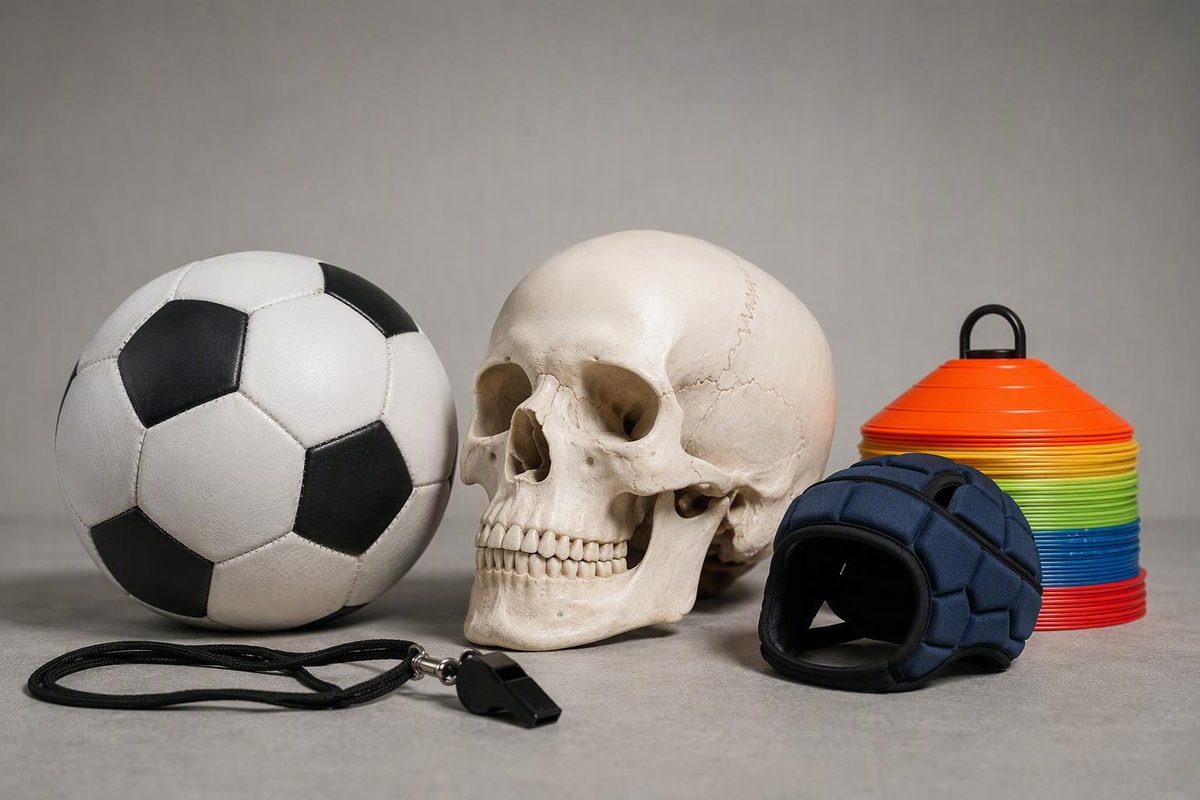
No count is scientifically proven safe. See youth policy caps from U11 to U18, why force and cumulative exposure matter, and when symptoms override limits.
There is no scientifically proven safe number of soccer headers per practice, match, week, season, or career. If heading is allowed, follow the strictest rule that applies to the player’s age and competition, treat every numerical limit as a ceiling rather than a target, and reduce avoidable high-force exposure.
A count can help manage exposure, but it cannot certify safety. After a significant head impact or possible concussion symptoms, remove the player from play and arrange an appropriate medical assessment regardless of the count, consistent with Lurie Children’s concussion guidance.
Related: Passing Activities for Soccer: 6-Drill Progression.
The direct answer: no number of headers is proven safe
No study or governing-body policy establishes a universally risk-free header count. A 2026 narrative review of 27 studies found no consensus on the neurological effects of heading in any age group. Only three studies followed players through a season, and differences in assessment methods prevented meaningful comparison across the literature.
Three kinds of numbers are commonly confused:
- Organizational exposure limits: Rules or guidance designed to reduce heading in particular age groups or playing environments.
- Experimental doses: The number and type of headers administered under controlled research conditions.
- Observed match counts: Descriptive totals recorded during actual matches.
None is automatically a medical safety threshold. A policy cap can reduce exposure without proving that every contact below the cap is harmless. Completing a laboratory dose without a detected short-term deficit does not establish safety across a season or career. An observed match average describes what happened; it does not prescribe what should happen.
The practical rule is to use the applicable age-specific policy as the maximum, stay below it whenever heading is unnecessary for the session objective, and never let a numerical count override symptoms or a significant impact.
Youth heading limits by age and organization
Youth restrictions vary by governing body, league, school, tournament and country. The table reports the restrictions stated in the cited official materials. It should not be taken as confirmation that no newer or stricter local rule exists.
The FA entries come from its official 2021–22 youth heading chart and are date-labelled accordingly. Coaches should verify the latest official rules immediately before planning a session.
| Organization | Age group | Training and game restriction in the cited material | Status |
|---|---|---|---|
| U.S. Soccer | U11 | No heading in practice or games | Official development guidance; policy, not a safety threshold (U.S. Soccer) |
| U.S. Soccer | U12 | No more than 30 minutes of heading practice and 15–20 headers per player per week; the cited guide does not state a game limit | Official development guidance; policy, not a safety threshold |
| US Club Soccer | 11-U and younger | No heading in practices or games | Required organizational rule under the cited policy (US Club Soccer) |
| US Club Soccer | 12-U and 13-U | Maximum 30 minutes and 15–20 headers per player per week in practice; no game restriction under this policy | Required organizational rule; other competitions may be stricter |
| The FA | U7–U11 | Heading should not be introduced in training; the chart does not state a numerical match allowance | 2021–22 welfare guidance, not a safety threshold (The FA) |
| The FA | U12 | If introduced, no more than one session per month and five headers per player; no numerical match allowance stated | 2021–22 welfare guidance, not a safety threshold |
| The FA | U13 | No more than one session per week and five headers per player; no numerical match allowance stated | 2021–22 welfare guidance, not a safety threshold |
| The FA | U14, U15, U16 and U18 | No more than one session per week and 10 headers per player; no numerical match allowance stated | 2021–22 welfare guidance, not a safety threshold |
The U.S. Soccer material specifically says U11 players should not head in practices or games. For U12, it gives a weekly practice ceiling of 30 minutes and 15–20 headers per player. It does not establish that this exposure is medically safe, and its omission of a U12 game figure should not be interpreted as proof that no separate competition rule applies.
US Club Soccer is explicit that players in 11-U programs and younger may not head in practices or games. Players in 12-U and 13-U programs are restricted in practice but not in games under that particular policy. Leagues and organizations may impose stricter standards.
The cited FA chart treats heading as a low training priority. At U12 and U13, any introductory work should use light balls, self-service or short service, limited repetition and no opposition. Its numerical figures concern deliberate training; they do not create a medically safe match allowance.
Chronological age can also affect which restriction applies. Under the cited US Club Soccer policy, a 10-year-old playing in 12-U or above should not head at all. An 11- or 12-year-old playing in 14-U or above should still follow the restricted-practice limits.
Before every session, check the current rules for the player’s governing body, league, school, tournament, chronological age, competition age group and location. Where several standards apply, follow the strictest one.
Why counting every header as equal gives a false sense of precision
Two players can complete the same number of headers while receiving substantially different mechanical loads. A raw count does not capture:
- Ball speed, mass or pressure
- The distance the ball has travelled
- Frontal, oblique or rotational contact
- The player’s technique and neck control
- Whether the contact was anticipated
- Whether the header was unopposed or contested
- Additional contact with another player or the ground
The FA’s professional heading evidence review identified long balls and crosses travelling approximately 35–45 metres as the highest-load situations in the cited elite-training research. A short, self-served technique header should therefore not be treated as mechanically equivalent to a contested header from a goal kick, corner, free kick or long cross.
Direction matters too. In a controlled experiment involving experienced players aged 13–18, oblique headers produced greater angular head motion than frontal headers, according to the Children’s Hospital of Philadelphia report. This was a measured mechanical difference, not a calculation of concussion probability or future neurological illness.
A 2026 study of high-level amateur male players found its largest biomarker response after higher-intensity headers involving balls that had travelled more than 20 metres, as reported by Amsterdam UMC. The available source is an institutional research report; it does not establish the study’s peer-review status.
These findings support a practical distinction between low-force introductory technique and long-flight or contested contacts. They do not validate numerical “safe,” “moderate” or “dangerous” bands. Coaches should track total exposure while also identifying the contacts likely to produce greater load.
What short-term and long-term studies actually show
The evidence does not support either extreme: heading has not been proved harmless, but the research also does not establish that every header causes permanent brain injury.
The controlled adolescent experiment reported by CHOP included 19 experienced players aged 13–18: 17 male and two female. Participants completed 10 frontal headers, 10 oblique headers or kicks as a control. Across assessments of eye movement, pupil response and balance, the researchers detected no neurophysiological deficits immediately or approximately 24 hours after heading compared with the control group.
That result does not establish that 10 headers are safe. The sample was small and predominantly male, follow-up was short, and the experiment did not measure repeated exposure through a season or career. It involved experienced teenagers under controlled conditions, so it cannot be transferred uncritically to younger children, beginners, adults or different types of heading.
The 2026 study reported by Amsterdam UMC followed 302 high-level amateur male players across 11 matches. Players who headed the ball showed acute elevations in blood p-tau217 and S100B compared with non-headers. The reported response increased with exposure and was greatest after higher-intensity, longer-flight headers. Biomarker levels returned to baseline within 24–48 hours.
Neither part of that result settles the safety question. A temporary biomarker elevation does not by itself demonstrate permanent injury or predict future disease. A return to baseline does not prove complete recovery, rule out other changes or establish that repeated exposure has no cumulative effect. The findings also come from high-level amateur men and should not be assumed to apply identically to children, women or recreational players.
An AAIC 2026 conference release highlighted the acute biomarker findings alongside research involving former elite players, including reported mental-health and gray-matter differences relative to controls. It was a conference summary covering several presentations, did not quantify each former player’s heading exposure and cannot establish that heading caused those outcomes.
The cumulative picture therefore remains uncertain. Studies measure different outcomes, including head motion, blood biomarkers, symptoms, functional performance, diagnosed concussion and long-term clinical conditions. Samples are often small or male-heavy, while few studies capture exposure across practices, matches, seasons and entire careers.
Match counts provide context, not an allowance
An observational analysis covered 116 official Dutch national-team matches: 96 male and 20 female. Among male players completing a full match, the average exposure was 4.2 headers. The mean maximum for the most-exposed player in a match was 10.6, and individual match maxima reached 20. Defenders had the greatest mean and maximum exposure, according to the peer-reviewed match analysis.
These figures do not mean that four, 10 or 20 headers are safe. They describe exposure in elite matches and should not become practice targets, recreational-player allowances or medical thresholds.
Match data also show why a weekly practice total is incomplete. Practice-only youth limits may not include game headers, while match studies omit training exposure. Accidental head contacts sit outside both deliberate-heading categories.
For monitoring purposes, keep practice headers and match headers separate. A low training total should not conceal a high-exposure match, and an uneventful match should not obscure repetitive heading performed during the week.
A conservative heading plan for coaches
Start with the rule, then reduce exposure further whenever heading is unnecessary for the session objective.
| Situation | Coaching action |
|---|---|
| Heading is prohibited for the player | Do not run heading drills; use passing, receiving, movement, positioning or chest-control alternatives |
| Introductory heading is permitted | Use short or self-service, controlled frontal technique and few repetitions |
| The drill requires long, fast or contested service | Remove the heading element or replace it with a lower-force technical task |
| Symptoms or a significant head impact occur | Stop the activity and follow the medical-assessment approach described below |
Check the applicable rule before the session rather than relying on a remembered number. Treat any stated limit as an upper boundary, not a quota the squad should reach.
Where the applicable guidance permits, coaches can make introductory work more conservative by using:
- A lighter or age-appropriate, properly inflated ball
- Self-service or short service distances
- Controlled frontal contact
- Unopposed practice
- Limited repetitions with adequate time between attempts
These choices may reduce measured head load, but technique and equipment cannot guarantee protection from concussion or long-term harm. They should not be used to justify more repetitions.
Do not turn heading practice into conditioning volume. Once the technical objective has been achieved, extra contacts add exposure without necessarily adding useful learning. Positioning, timing, scanning, jumping mechanics and unopposed movement can often be trained without repeatedly heading the ball.
A simple exposure log can include:
- Deliberate practice headers
- Match headers
- High-force or long-flight headers
- Accidental head contacts
- Symptoms reported during or after play
This log is a practical coaching aid, not a validated medical exposure standard. Its purpose is to reveal patterns that one total can hide. Pay particular attention to defenders and other players who repeatedly record high match exposure, but do not invent a personalized “safe allowance” for them.
Symptoms override every numerical limit
Staying below a practice cap does not justify continued participation after a significant head impact or possible concussion symptoms.
Supported warning signs include:
- Headache or dizziness
- Memory or concentration difficulty
- Confusion or mental fogginess
- Balance or coordination problems
- Mood changes or irritability
- Slowed reactions
Remove the player from play and arrange assessment by a healthcare professional experienced in concussion care. Return-to-play decisions require individual medical assessment; a header count cannot provide clearance. Lurie Children’s guidance also notes that many soccer head injuries arise from player collisions or contact with the ground rather than purposeful heading, so restricting headers cannot eliminate overall head-injury risk.
Is there a safe heading limit for adult or recreational soccer players?
No scientifically validated count exists for adult or recreational players. The 2026 narrative review discussed above found no consensus on neurological effects across age groups and did not identify a safe maximum per practice, match, week, season or career.
Professional guidance and match studies can describe exposure or impose precautionary limits in particular environments. Those numbers do not become risk-free thresholds for recreational players.
Follow the competition rules, minimize unnecessary repetition and long-flight service, and monitor practice and match exposure separately. Do not borrow a youth cap, elite match average or professional guideline and relabel it as a medical allowance.
Which rule applies when a younger child plays in an older age group?
Check both chronological-age restrictions and competition-age rules. Some policies continue to restrict a younger player based on actual age even when that player competes in an older division.
Under the cited US Club Soccer policy, a 10-year-old playing in 12-U or above should not head the ball. An 11- or 12-year-old playing in 14-U or above should continue to follow the restricted-practice limits. Referees may enforce the rules by competition age group, so coaches must identify any stricter individual restriction themselves.
Verify the current governing-body, league, school and tournament requirements before the session or match.
Does soccer headgear make heading safe?
No. Headgear does not turn heading into a risk-free activity or create a higher safe count. Lurie Children’s reports that studies have not proved soccer headgear reduces concussion rates, although laboratory work suggests it may reduce forces in some player-to-player collisions.
The usable rule is straightforward: there is no scientifically proven safe header count. Follow the strictest applicable policy, keep permitted practice controlled and below the cap, track high-force and cumulative exposure rather than count alone, and stop immediately for symptoms or a significant head impact. Numerical limits manage exposure; they do not certify safety.