
Learn five useful soccer tricks—then train the defender, timing and exit touch that make them work in a match.
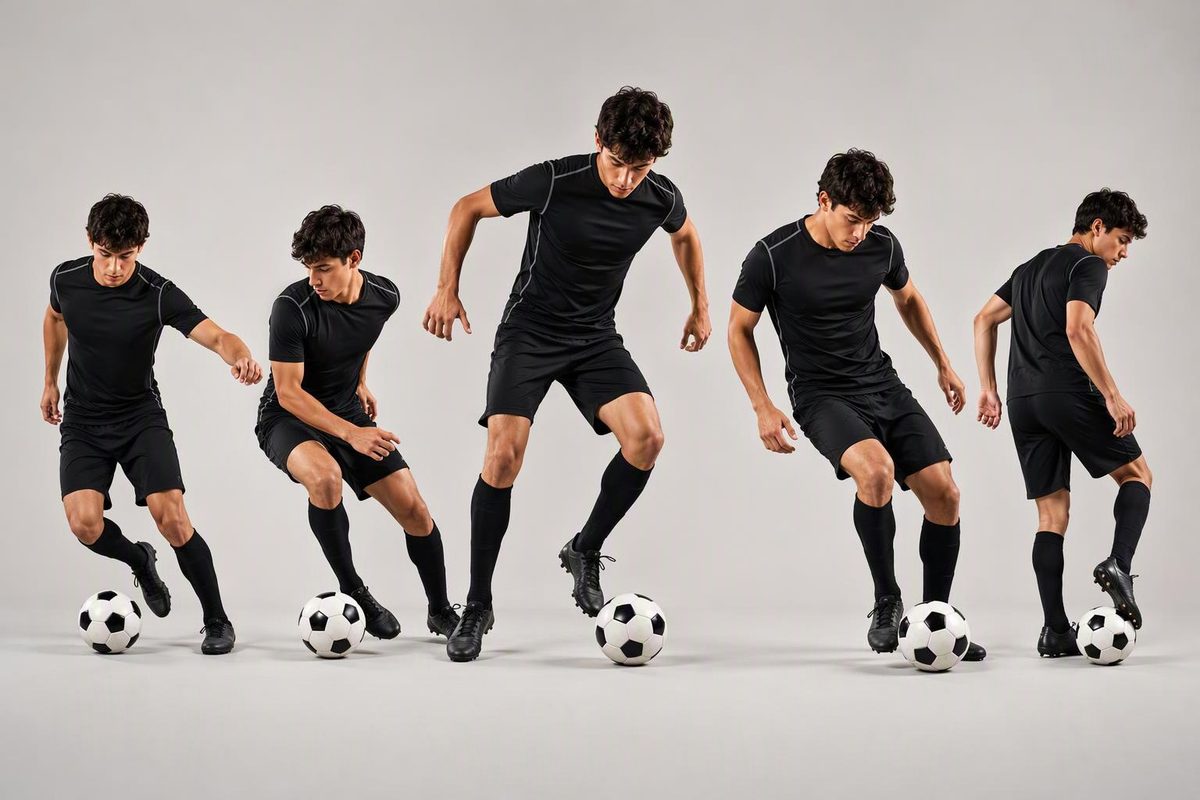
Five practical soccer tricks with step-by-step cues and a 20-minute progression from unopposed practice to realistic 1v1 pressure.
A useful soccer trick is not necessarily an elaborate one. It is a move that makes a defender shift, stop or reach—and gives the attacker a route out with the ball.
Start with five transferable moves: the body feint, scissors, inside-out touch, Cruyff turn and drag-back. Learn the contacts without pressure, but do not leave the moves there. To become useful in a match, they must be practiced against an opponent, toward a destination and alongside the option to pass or shoot.
Five useful soccer tricks
1. Body feint
Use it when: facing a defender with space to accelerate either side.
- Dribble toward the defender under control.
- Dip the shoulder and shift the trunk as if attacking one side.
- Touch the ball with the outside of the opposite foot into the other side.
- Accelerate for two or three steps.
The ball movement can be small. The attacker’s approach, eyes and body shape provide the false information.
Common error: exaggerating the fake but taking the exit touch sideways. The move has not succeeded until the attacker gets beyond the defender’s reach.
2. Scissors, or step-over
Use it when: the defender is square and the attacker can threaten both directions.
- Approach with the ball slightly in front of the body.
- Swing one foot from inside to outside around the front of the ball.
- Plant that foot beyond the ball and shift weight onto it.
- Push away with the outside of the other foot.
One step-over is enough to learn the deception and exit. More step-overs add complexity but do not guarantee a better result.
Common error: circling the foot while the hips and speed remain unchanged. Sell a real route, then leave quickly.
3. Inside-out touch
Use it when: running at a defender and wanting a compact move without crossing the feet.
- Use the inside of one foot to nudge the ball across the body.
- Before transferring weight fully, use the outside of the same foot to push it back.
- Accelerate into the new line.
Keep both contacts small enough to disguise the second touch but large enough to move the defender. At first, pause between the contacts. Gradually combine them into one rhythm.
Common error: looking down throughout the move. Glance at the ball when contact demands it, but check the defender and available space before choosing the exit.
4. Cruyff turn
Use it when: apparently preparing to pass, cross or shoot while a defender approaches from the side or behind.
- Place the non-kicking foot beside or just ahead of the ball.
- Shape as if striking forward.
- Instead, use the inside of the kicking foot to pull the ball behind the standing leg.
- Turn the hips and accelerate onto the ball.
The fake strike matters. Without it, this is simply a cut behind the leg.
Common error: turning into a second defender. Scan over the shoulder before receiving or while the pass travels.
5. Sole drag-back and exit
Use it when: the forward route is closed and the defender is pressing tightly.
- Put the sole on top of the ball.
- Pull it back beyond the defender’s reaching foot.
- Open the hips and take the next touch diagonally with the inside or outside of the same foot.
- Protect the ball or accelerate away.
This move is an escape rather than just a flourish. The attacker can also drag back and pass if the defender blocks the dribbling lane.
Common error: pulling the ball straight back and stopping. Add an angled exit or an immediate pass.
For more isolated touches and turning work before adding opposition, use this 20-minute soccer footwork progression.
A 20-minute soccer-tricks practice
Run this block after an appropriate warm-up. If it begins the session, prepare players for its accelerations and changes of direction first; this dynamic soccer warm-up provides a fuller structure.
Minutes 0–4: Ball rehearsal
Set two cone gates 5 metres apart. Players dribble toward the middle, perform one selected move and accelerate through either gate.
- Complete the move on both feet.
- Alternate the exit direction rather than repeating the preferred side.
- Keep players moving; do not require perfection before progressing.
Cone work establishes the ball contacts, but it does not reproduce the information supplied by a defender. That is why isolated rehearsal occupies only four minutes here. A systematic review of soccer skill-acquisition research also found substantial variation across practice-design studies and limited examination of whether learning transferred to competition (Bergmann et al., 2021).
Minutes 4–8: Passive defender
Place a defender 3–4 metres from the attacker. The defender closes space at half speed and commits left or right; the attacker reads that movement and escapes through one of two gates.
The attacker may use any of the five tricks. Do not announce the move in advance: recognizing which solution fits is part of the skill.
Useful coaching cues direct attention toward the intended effect:
- “Move the defender before moving the ball.”
- “Push the exit beyond the reaching foot.”
- “Win the gate in two touches after the fake.”
These exact dribbling cues have not been tested. There is, however, some task-specific support for focusing feedback on movement effects. In a study of 10- to 12-year-olds practicing a soccer throw-in, external-focus feedback after every trial produced better immediate and delayed transfer than less-frequent external-focus feedback and body-focused feedback (Chiviacowsky et al., 2011). Treat that as support for the wording style, not proof of an ideal feedback frequency for dribbling.
Minutes 8–14: Live 1v1 to gates
Create channels approximately 10 metres long and 7 metres wide, with a gate at each end. An attacker scores by dribbling through the far gate under control; the defender scores by winning the ball and crossing the opposite gate.
Play for 20–30 seconds, then switch roles. Adjust the space rather than demanding a particular trick:
- Too easy for attackers: narrow or shorten the channel.
- Too difficult: widen it or give the attacker a one-step head start.
- Move attempted but no escape: award the point only when the player crosses the gate with control.
The defender now supplies the information missing from cone work: distance, angle, momentum and a reaching foot.
Minutes 14–20: 2v2 or 3v3 to goal
Finish with a small game in which a player can dribble, pass or shoot. Use normal scoring, plus an optional bonus point when a successful 1v1 action leads directly to a shot or completed forward pass. Do not reward a named trick by itself; that can encourage players to force a move when a pass is better.
The evidence does not isolate “trick learning.” A systematic review and meta-analysis examined small-sided-game programs against controls in under-18 team-sport players, across sports rather than soccer alone (Clemente et al., 2021). The practical reason to finish with a game is simpler: the move must survive pressure and connect to the next action.
What to measure
Count outcomes rather than decorative repetitions:
- 1v1 attempts
- successful escapes beyond the defender
- possession retained after the next action
- successful exits on the weaker side
- occasions when passing was chosen instead
A useful trick creates an advantage. If a player completes the foot pattern but remains within tackling distance, simplify the move, improve the approach angle or make the exit touch more decisive.
Train two moves deeply before collecting ten. For most players, a reliable body feint plus one turning escape offers more match value than a long catalog that works only against cones.