
There Is No Single Heat Cutoff for Every Soccer Practice
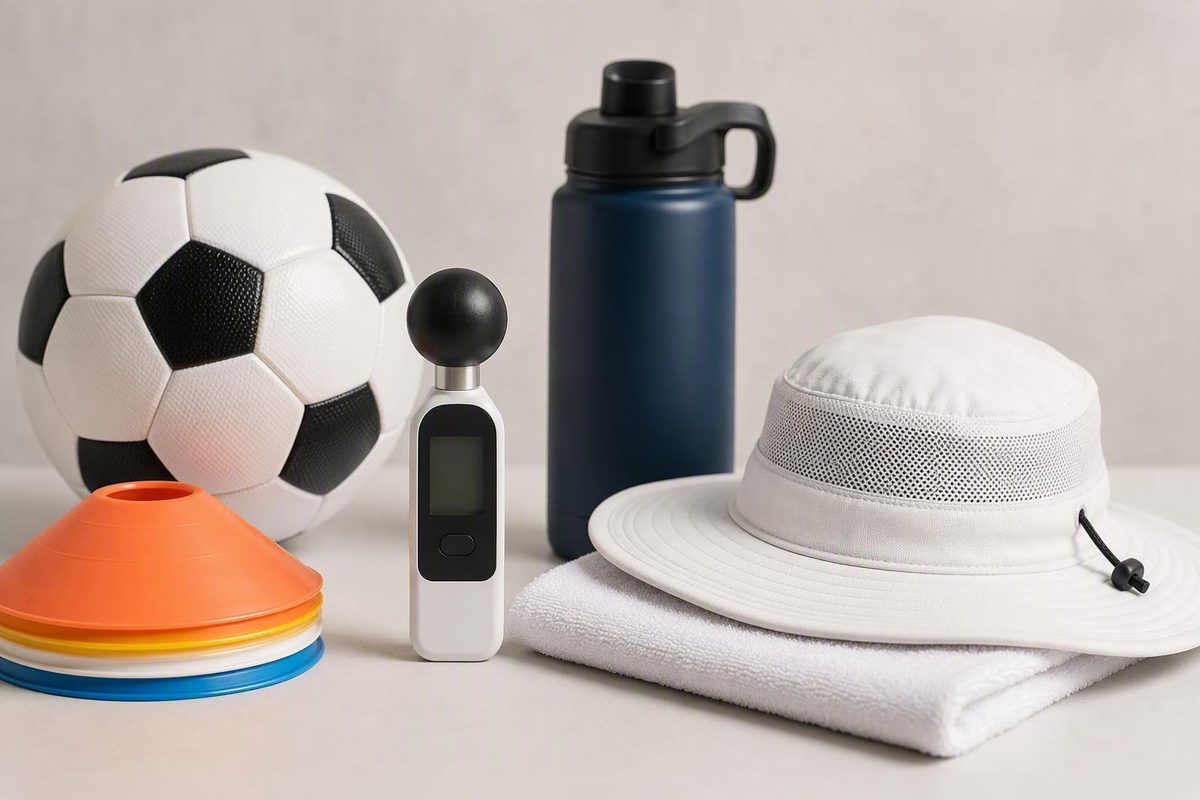
Cutoffs vary by governing policy and regional category; compare practice limits, required breaks, monitoring, and stop thresholds before training.
There is no nationwide WBGT value at which every soccer practice must stop. The correct cutoff comes from the current policy governing that session—whether set by a state association, school, league, club, tournament, or facility. Identify that policy first, measure conditions using its approved method, and apply every required break, duration, conditioning, cooling, delay, or cancellation provision.
The short answer: check the governing policy before choosing a cutoff
Under U.S. Soccer guidance, Black-alert outdoor training should be delayed or canceled above 86.2°F WBGT in Category 1, approximately 89.8–89.9°F in Category 2, and above 92.0°F in Category 3. These are recommendations, not universal law. Any binding policy governing the practice takes precedence.
Published U.S. Soccer material contains a small discrepancy: the Category 2 Black threshold appears as above 89.8°F in one alert table and above 89.9°F elsewhere. The current document adopted by the governing organization should control. The available cutoff table also does not establish which locations belong to Categories 1, 2, and 3, so staff must consult the applicable regional-category map rather than assign a category by assumption. The bands and training responses appear in the U.S. Soccer Heat Guidelines.
Use this sequence before practice:
- Identify who governs the session.
- Find the current policy, effective date, and regional or venue category.
- Take the required WBGT reading at the site.
- Apply all restrictions attached to that reading.
- Continue monitoring and respond if the category changes.
Do not search for a cancellation number in isolation. Practice may require shorter work periods, longer breaks, reduced conditioning, cooling equipment, or a shorter total duration before conditions reach the cancellation band.
WBGT is not the air temperature or heat index
Wet Bulb Globe Temperature, or WBGT, is an environmental heat-stress measure that accounts for ambient temperature, humidity, radiant heat from sources such as direct sun, and wind or air movement. It is not the same as ordinary air temperature or heat index. A peer-reviewed review of football heat policies similarly describes WBGT as a tool for deciding when activity may continue and when hydration, cooling, delay, or cancellation measures are needed (BMJ Open Sport & Exercise Medicine).
A standard thermometer reading of 90°F is therefore not equivalent to a WBGT of 90°F. Air temperature alone does not represent all the environmental conditions included in WBGT and cannot simply be inserted into a WBGT policy.
Heat index is also a separate measure. Some guidance may permit it as a fallback, but it is not universally interchangeable with WBGT. The controlling policy determines whether staff must use a direct-reading WBGT device, may use an approved estimate, or may use another measure when a meter is unavailable.
Temperature-and-humidity lookup tables have their own limitations. U.S. Soccer’s table estimates WBGT under stated assumptions, including full sunshine and light wind. It is not equivalent to a direct measurement at the field, where cloud cover, wind, playing-surface exposure, and other local conditions can differ.
There is no universal conversion that turns any air-temperature or heat-index value into the exact WBGT required by every policy. Use the measurement method specified by the organization governing the practice.
U.S. Soccer’s WBGT practice table
U.S. Soccer’s framework changes both the applicable regional band and the required practice response. The following figures and actions come from the published U.S. Soccer guidance cited above.
| Alert level | Regional WBGT bands | Duration and breaks | Conditioning and action |
|---|---|---|---|
| Green | Category 1: below 76.1°F; Category 2: below 79.8°F; Category 3: below 82.1°F | Normal activity; three separate 3-minute breaks per hour, or one 10-minute break every 40 minutes | Normal activity |
| Yellow | Category 1: 76.3–81.0°F; Category 2: 79.9–84.6°F; Category 3: 82.2–87.0°F | Use discretion; three separate 4-minute breaks per hour, or one 12-minute break every 40 minutes | Apply the stated breaks and governing-policy requirements |
| Orange | Category 1: 81.1–84.1°F; Category 2: 84.7–87.7°F; Category 3: 87.1–90.0°F | Maximum 2 hours; four separate 4-minute breaks per hour, or one 10-minute break after every 30 minutes of continuous training | Shorten and restructure training |
| Red | Category 1: 84.2–86.1°F; Category 2: 87.8–89.7°F; Category 3: 90.1–91.9°F | Maximum 1 hour; four separate 4-minute breaks | No additional conditioning |
| Black | Category 1: above 86.2°F; Category 2: above 89.8°F in the alert table but above 89.9°F elsewhere; Category 3: above 92.0°F | No outdoor training | Delay until cooler or cancel |
The printed bands contain small gaps and leave some exact boundary values unresolved. Do not interpret an unassigned value as permission to continue. Consult the current version adopted by the governing organization; if the applicable category or response cannot be resolved, pause and escalate the decision.
This framework is useful only when it applies or has been adopted. Coaches still need the current regional map and must follow any stricter state, school, league, tournament, club, or facility rule.
Match guidance is separate. U.S. Soccer recommends a four-minute hydration break for every 30 minutes of continuous match play at 89.6°F WBGT. That is a match recommendation, not a practice-cancellation threshold, and it cannot replace the Black-alert practice rule.
Texas UIL rules effective August 1, 2026
For Texas University Interscholastic League programs, mandatory WBGT monitoring for outdoor athletic and marching-band activities took effect August 1, 2026, for the 2026–2027 school year. Monitoring had previously been recommended. For a covered practice, the reading must be taken within 15 minutes of the start, and schools must have equipment available for full-body ice-water immersion, according to the UIL Heat Stress and Athletic Participation Required Plan page.
Two UIL figures require careful interpretation:
- 79.7°F WBGT or higher at a Class 2 venue
- 82.0°F WBGT or higher at a Class 3 venue
These are rapid-cooling-equipment triggers, not established practice-cancellation thresholds. A coach should not decide to cancel—or continue—a session by treating either number as a universal stop point.
The UIL summary does not define Class 2 and Class 3 venues or reproduce the complete activity-modification table. Texas staff should consult the current UIL Required Plan and FAQ for venue classification and the exact restrictions applying at each WBGT level.
UIL describes the change as an effort to create statewide consistency in light of continuing medical research and national best practices. It does not characterize the requirement as criticism of previous coaching practices.
An NFHS heat-illness-prevention summary promotes gradual heat acclimatization and WBGT-based practice-cancellation policies but does not provide numerical nationwide cancellation thresholds. Its brief reference to four Texas rest breaks per hour does not include enough scope or conditions to reconstruct the complete UIL rule, so it should not replace the full UIL plan.
Why the same WBGT can produce different decisions
Organizations use different thresholds, measurement procedures, and practice responses. A number may therefore be correct for one team but wrong for another.
| Governing body and covered setting | Measurement requirements | Practice modifications | Outdoor-practice cutoff |
|---|---|---|---|
| NJSIAA policy document for New Jersey interscholastic sports | On-site reading 30 minutes before activity and at least hourly; readings and modifications documented | 85.1–88.0°F: maximum 2 hours and at least four separate 4-minute breaks per hour. 88.1–90.0°F: maximum 1 hour, no conditioning, and 20 minutes of rest distributed through the hour | Above 90.0°F: no outdoor workout (cited NJSIAA policy) |
| Georgia Soccer practices | Clubs or organizing bodies monitor conditions; coaches are also encouraged to monitor | The published policy specifies suspension at 92°F but does not establish unrestricted practice below that point | 92°F or higher: suspend until cooler (Georgia Soccer policy) |
| U.S. Soccer regional guidance | Determine WBGT and the applicable regional category | Orange: maximum 2 hours with specified breaks. Red: maximum 1 hour, four 4-minute breaks, and no additional conditioning | Category-dependent: above 86.2°F, approximately 89.8–89.9°F, or above 92.0°F |
The cited NJSIAA document requires unrestricted access to water or electrolyte beverages during rest periods and calls for rest in shade or a cooling zone. It states that its restrictions cover all sports, not only football. Because the cited document is an older policy version, New Jersey schools should verify the current NJSIAA rule before relying on its figures for a present-day practice.
Georgia illustrates why practice and match rules cannot be interchanged. At 92°F WBGT or higher, its policy suspends practice until conditions cool, while games use a separate water-break procedure. The suspension threshold does not establish that every lower reading permits unrestricted practice.
Consider a 91°F WBGT reading:
- Under the cited NJSIAA policy, a New Jersey school practice cannot proceed because the reading is above 90°F.
- Under U.S. Soccer Category 3 guidance, 91°F falls in Red, allowing at most one hour with four separate four-minute breaks and no additional conditioning.
If the cited NJSIAA requirement remains the applicable rule for that school, it controls. The more permissive U.S. Soccer recommendation does not override a binding state-association policy.
A field-side WBGT decision checklist
Treat heat planning as an operating procedure rather than a last-minute temperature check.
- [ ] Identify the governing policy and version. Confirm whether the activity is controlled by a state association, school, league, club, tournament, facility, or another organization.
- [ ] Classify the activity correctly. Practice, conditioning, scrimmages, warmups, and matches may be treated differently.
- [ ] Assign responsibility. Name the person who takes and records the reading, communicates restrictions, and makes or escalates the stop decision.
- [ ] Take the required on-site reading. Follow the device, timing, location, and procedure specified by the controlling policy.
- [ ] Determine the applicable category. This may be a regional category, venue class, or locally defined alert band.
- [ ] Apply every restriction. Check breaks, total duration, conditioning, work-to-rest structure, cooling equipment, delay, and cancellation—not only the final cutoff.
- [ ] Provide unrestricted access to water. Use shade or a cooling zone for rest when the governing guidance requires it.
- [ ] Document readings and responses when required.
- [ ] Continue monitoring. Follow the policy’s recheck interval and its requirements for suspension or resumption.
- [ ] Prepare for an emergency. Integrate emergency communication and immediate cooling into the emergency action plan.
Heat protection begins below the cancellation threshold. Outdoor practice may still be permitted while requiring shorter work blocks, more rest, reduced intensity, no extra conditioning, or a shorter total session.
Acclimatization also matters. U.S. Soccer describes a typical 10–14-day gradual progression and recommends avoiding the hottest part of the day—identified as 11 a.m. to 4 p.m.—when scheduling permits. Its guidance also recommends unlimited access to water during practices and competitions.
Do not invent universal rules for meter placement, stabilization time, calibration, recheck frequency, or when activity may resume. Those operational details must come from the controlling policy.
Educational guidance cannot replace decisions by the applicable governing organization or qualified athletic trainers and medical professionals. If the policy is unclear, pause the session and contact the responsible administrator or athletic trainer rather than selecting the most convenient cutoff.
If heat stroke is suspected, cool immediately
Warning signs of possible exertional heat stroke include altered mental status, confusion, irritability, slurred speech, loss of balance, falling, or collapse. U.S. Soccer’s heat-illness guidance places immediate cooling alongside emergency medical activation.
Emergency readiness belongs in the organization’s heat policy and emergency action plan. Staff should know who calls 911, who begins cooling, where immersion equipment is kept, and how emergency responders will access the field. UIL schools must have equipment available for full-body ice-water immersion.
The practical rule is jurisdiction first: find the current policy governing the team, measure WBGT using its approved method, and apply every required modification rather than relying on a single internet cutoff. If the rule is unclear, pause and escalate. If exertional heat stroke is suspected, call 911 and cool immediately.
Can a coach use the heat index instead of a WBGT meter?
Only if the controlling policy allows it. Heat index and WBGT are different measures, and an air-temperature or heat-index value cannot be universally converted into an exact WBGT reading. If the policy requires an on-site WBGT measurement, a heat-index app or weather report is not a substitute. Estimated-WBGT tables should likewise be used only when permitted and under their stated assumptions.
Who has authority to suspend a soccer practice because of heat?
The governing policy should designate that authority. It may rest with a coach, athletic trainer, athletic director, club administrator, tournament official, facility operator, or another assigned decision-maker.
Georgia Soccer, for example, states that the club or organizing body typically decides before an activity. Once participants are present, coaches have decision authority for practices or other gatherings, while games use a separate authority structure involving field officials. Staff should establish responsibility before players arrive and follow the controlling policy or emergency action plan if the assigned decision-maker is unavailable.