
“Practice Makes Permanent” Is a Warning, Not a Law
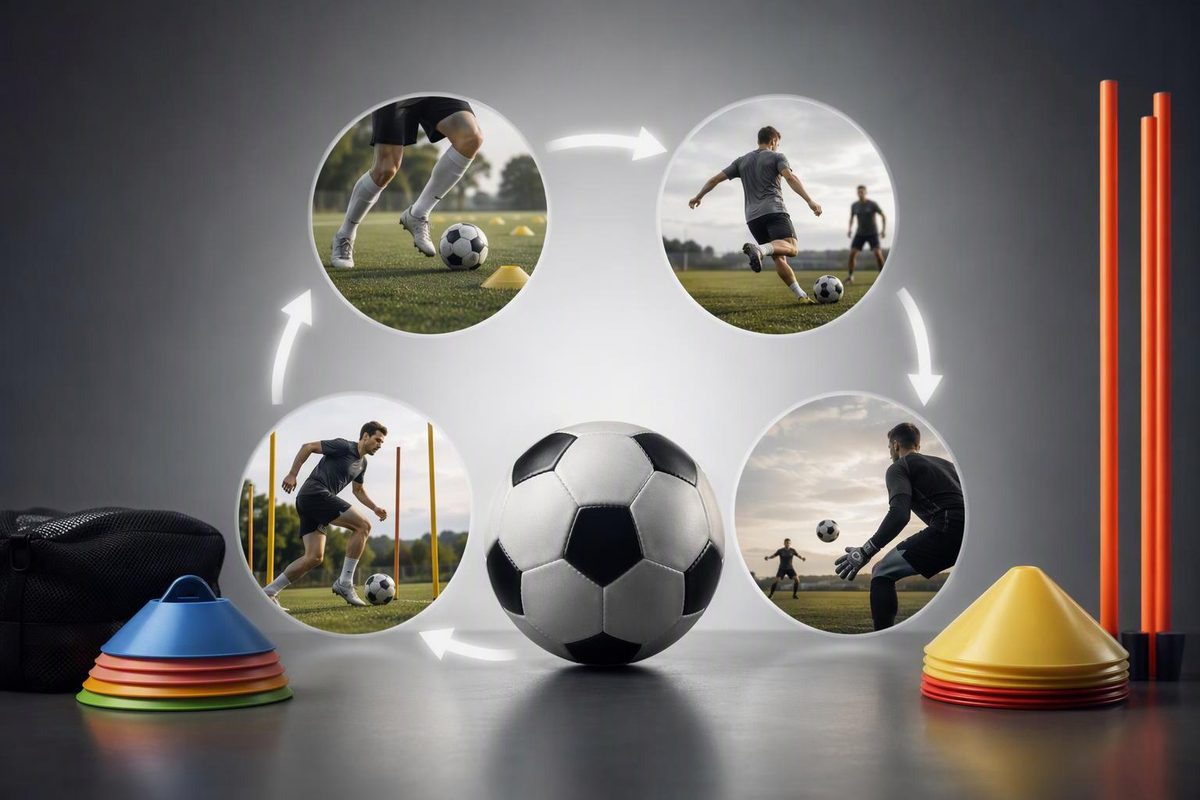
Practice does not permanently lock in every error. Use repetition, variation, pressure and delayed checks to build soccer skills that transfer.
“Practice makes permanent” is useful as a warning against mindless repetition. It is not a scientific law.
A player who mishits 10 passes has not permanently installed a faulty technique. Players can continue to adapt when the task, information, feedback and consequences change. A more useful coaching rule is:
Practice strengthens what the task repeatedly asks the player to perceive, decide and do.
That distinction matters in soccer. A drill can produce clean-looking passes while teaching players little about when, where or why to pass. Conversely, mistakes in a demanding activity can show that players are being challenged to adjust—not that bad habits are becoming permanent.
Repeat the problem, not one frozen solution
Repetition gives a player opportunities to coordinate an action and detect what produces the intended result. A beginner may therefore benefit from a short, stable period in which the distance, target and task are manageable.
But soccer skills are not performed under one fixed set of conditions. The ball arrives at different speeds and angles. Space closes. Teammates move. Opponents disguise their intentions. A useful passer must connect perception and decision-making to the kick itself.
That does not mean replacing every drill with a game. A systematic review of 35 applied soccer studies found that both repetition-based practice and approaches involving variability or self-organization could improve technical outcomes. Evidence that isolated practice improves match performance was scarce, while game-based activities offer more opportunities to make decisions. The authors suggested reducing—not necessarily eliminating—isolated drills (Bergmann et al., 2021).
This supports a practical sequence:
- Stabilize the task briefly when a player needs to understand the goal or organize an unfamiliar action.
- Vary relevant conditions such as the receiving angle, distance, pressure, target or available time.
- Add representative information through teammates, opponents and a direction of play.
- Check whether the skill survives later and elsewhere.
The aim is not perfect repetition. It is repeated adaptation around a clear game problem.
A mistake is not automatically a learned mistake
Coaches should distinguish a performance error from an established pattern.
If a player loses the ball after pressure is introduced, the error may reveal an appropriate challenge: the player now has to scan, orient the first touch and protect the ball. Removing all difficulty could improve the drill’s appearance while removing information the player must learn to use.
The opposite problem also occurs. If failure is constant, players may get too few successful attempts to recognize workable solutions. Scale the task rather than choosing between “no errors” and chaos:
- enlarge the area;
- reduce defender numbers or delay their release;
- slow the first pass;
- provide an extra supporting player;
- simplify the scoring condition;
- restore difficulty as success becomes more consistent.
There is no evidence-based error percentage that suits every player and task. Soccer studies also do not support a blanket rule that random or highly variable practice is always superior. A 2023 systematic review found no differences between practice groups in most comparisons, with some support for differential learning among skilled players. The authors stressed that effects depend on the player and task constraints (Pacheco et al., 2023).
The evidence remains limited: that review included 44 studies, but only 14 used retention or transfer tests, and 83% of the 1,736 participants were male. Apply its findings as design guidance, not as a universal recipe.
Do not confuse a smooth drill with learning
Immediate improvement shows current performance, not necessarily durable learning. In the 2023 review, 30 of 44 studies measured performance without a retention or transfer test (Pacheco et al., 2023).
For coaches, a later test is often more informative than another five minutes of the same drill:
- Retention: Can the player solve the problem at the next session without being retaught?
- Transfer: Can the player solve it from another position, against a different defender or in a game?
A passing pattern completed flawlessly after several rehearsals may mainly show that players remember the pattern. Put the same principle into an opposed, directional activity and see whether they recognize the opportunity independently. A structured passing progression can move from controlled execution to a conditioned game without pretending that either stage does the whole job.
Give feedback without controlling every attempt
Constant correction can make a session look efficient because the coach supplies the answer each time. It can also leave players waiting for instructions instead of reading the result themselves.
Soccer research does not identify one ideal feedback frequency. In one study covered by the 2023 review, prescriptive feedback after 33% of soccer throw-in attempts produced better transfer of movement form than feedback after every attempt, but retention did not differ. Other findings varied with the task and type of feedback (Pacheco et al., 2023).
A practical approach is to add feedback when it provides information the player cannot readily detect or when the player is stuck—not merely because an attempt was imperfect:
- Let the player complete the attempt.
- Ask what they saw or intended.
- Give one cue tied to the outcome: “Can your first touch take you away from pressure?”
- Allow several attempts before intervening again.
That is not ignoring errors. It gives players room to compare intention, action and result.
A 20-minute skill block that avoids mindless repetition
Use this structure for passing, finishing, receiving or 1v1 defending.
1. Establish the action — 4 minutes
Use a simple setup with a clear target. Allow enough repetition for players to understand the objective. Give one or two concise cues rather than continuous technical commentary.
2. Introduce useful variation — 5 minutes
Change one relevant feature: service angle, distance, target position or starting foot. Keep the objective constant so the variation demands adaptation rather than unrelated novelty.
3. Add information and opposition — 8 minutes
Use a directional 2v1, 3v2 or small-sided game. Preserve the intended problem through the space, player numbers or scoring rule. If the objective is receiving to play forward, for example, reward successful forward progress rather than prescribing one body position for every attempt.
4. Remove the prompt — 3 minutes
Play without the special cue or stop condition. Observe whether players identify the opportunity themselves. Check it again in the next session or in a purposeful scrimmage.
“Practice makes permanent” should not make coaches afraid of mistakes. It should make them careful about what the activity repeatedly rewards. Build repetitions, but also build perception, choice, adjustment and a genuine opportunity to transfer the skill into soccer.