
Six beginner soccer drills, from ball control to game decisions
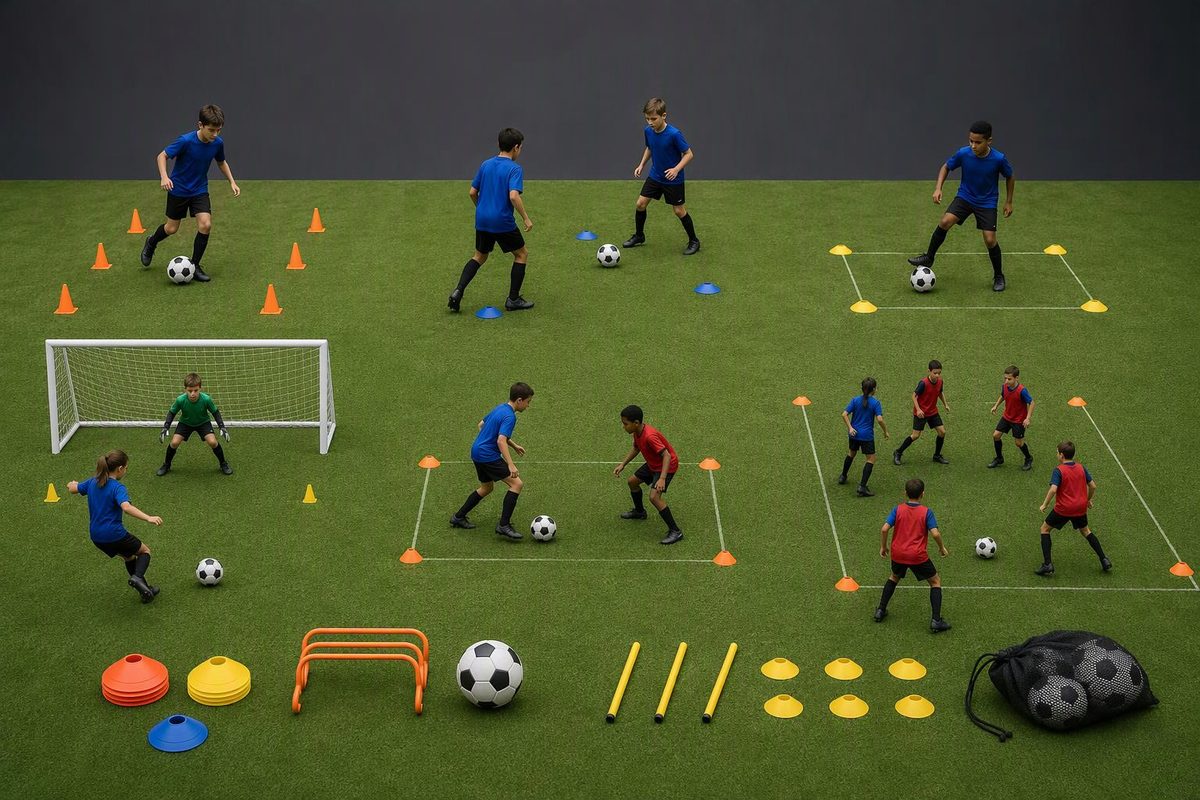
Build a beginner soccer practice with six drills covering dribbling, passing, first touch, shooting, defending and small-sided play.
Start with six activities: gate dribbling, partner passing, directional first touch, receive-and-shoot, 1v1 defending, and a small-sided game. Together, they cover the main outfield skills without turning practice into a long collection of cone exercises.
Use the routine below as a 50-minute starter session, including a five-minute warm-up. The dimensions and timings are coaching starting points, not a scientifically established optimum. Adjust them to players’ control and comfort—not simply their age.
You need balls, flat markers, bibs and a safe playing surface. Cone gates can replace goals. If using portable goals, anchor or counterweight them securely and check their connecting hardware before use. Keep shooting lanes and neighbouring playing areas separated. Stop if a player develops pain or feels unwell; this routine cannot replace individual assessment by a qualified coach or physiotherapist.
The beginner practice
Begin with five minutes of easy movement: walking and jogging, comfortable changes of direction, then gentle dribbling. Build speed gradually rather than opening with races. Each block below includes time for a short demonstration, resets and drinks as needed.
1. Gate dribbling — 6 minutes
Set-up: For four to six players, scatter five gates, each about 1.5 metres wide, inside a 12 × 12-metre area. Each player has a ball. Duplicate the area for larger groups.
Task: Dribble through a gate, change direction and find a different one. There is no elimination or queue. After players understand the task, try short rounds counting different gates reached under control.
Cue: “Keep the ball close enough to change direction; look up between touches.”
Adjust: Widen the gates if players repeatedly hit markers. Progress by asking players to use the other foot through a gate, rather than immediately making it a speed race.
2. Partner passing through a gate — 6 minutes
Set-up: Partners stand about four metres apart, with a two-metre-wide gate halfway between them. One ball per pair.
Task: Pass along the ground through the gate. The receiver controls the ball before returning it. Try both feet, allowing extra touches when needed.
Cue: “Use the inside of the foot and send a pass your partner can control.” Start with a stationary ball; avoid demanding one-touch passing.
Adjust: Move closer or widen the gate if accuracy breaks down. When passes are consistently manageable, increase the distance slightly or ask the passer to move sideways after passing.
3. First touch into space — 6 minutes
Set-up: Keep the pairs. Put a gate to the receiver’s left and another to their right, about one metre away.
Task: The feeder rolls or gently passes the ball. The receiver looks towards a chosen gate before the ball arrives, directs the first touch towards it, then dribbles through. Reset after each feed. After five feeds, players exchange positions and roles.
Cue: “Let the first touch set up your next action.” The ball should remain within reach, not be knocked several strides away.
Adjust: Begin with one gate and predictable feeds. Later, the feeder indicates left or right before passing. This adds a simple response task, not the full challenge of reading an opponent. For a focused follow-up, use the first-touch practice.
4. Receive, set and shoot — 7 minutes
Set-up: In pairs, place a three-metre-wide target gate four to six metres from the shooter. The partner feeds from the side. Leave a clear area beyond the target.
Task: Receive a gentle pass, take a settling touch and shoot along the ground through the gate. Swap after three attempts. Use several separate lanes rather than one long shooting queue; retrieve balls only when your lane is clear.
Cue: “Find the target first; choose accuracy before power.” FIFA’s grassroots session similarly prompts players to consider accuracy versus power and offers finishing without a goalkeeper as an easier option. FIFA Training Centre
Adjust: Move closer for early success. Later, receive from a different angle or add a moving approach—not maximum-power strikes. The shooting progression offers more focused options.
5. Two-gate 1v1 — 8 minutes
Set-up: Use an 8 × 12-metre rectangle per pair. Place two two-metre gates on one end line. The attacker starts with the ball at the opposite end; the defender starts centrally, about four metres away.
Task: The attacker tries to dribble through either gate. For the first few attempts, the defender only shadows. Then allow standing challenges and interceptions. End each attempt when someone scores, the defender wins possession or the ball leaves the area; swap roles.
Cue: Defender: “Stay slightly side-on and guide the attacker away from a gate.” Attacker: “Change direction or speed when space opens.”
The passive-to-live progression and side-on defensive stance adapt principles used in FIFA’s Costa Rica women’s national-team session, with a much simpler beginner layout. No slide tackles in this starter activity.
Adjust: If attackers lose the ball before they can attempt a move, return to shadow defending or widen the area.
6. Small-sided game — 12 minutes
Set-up: Play 3v3 on approximately 20 × 15 metres, with two target gates at each end and no goalkeepers. Duplicate pitches for larger squads. With four players, use 2v2; with seven, one neutral player can help whichever team has possession.
Task: Score by passing or shooting through either opposing gate. Use three three-minute games with short rests and resets. Allow unlimited touches and restart quickly when the ball goes out.
Cue: “When we have the ball, find space to help. When we lose it, get between the ball and our goals.” FIFA’s grassroots guidance uses comparable support and recovery questions in its 3v3 four-goal game. FIFA Training Centre
Adjust: If players cannot find room to receive, enlarge the pitch or add a neutral supporter. Avoid mandatory pass counts at first: let players choose between dribbling, passing and shooting.
Why include both drills and games?
Simple tasks give beginners a manageable introduction; opponents then change where, when and how they use a skill. FIFA’s ball-control guidance for ages 4–8 recommends building from control into passing, receiving and game-like pressure. That is coaching guidance, not proof that this exact routine works for every beginner. FIFA Training Centre
A 2021 meta-analysis of six youth studies—five in soccer and one in volleyball—found better technical-test performance with small-sided-game programmes than control training: standardised effect size 0.59, 95% confidence interval 0.29–0.89. This is not a 59% improvement. Most soccer comparisons involved conditioning or other no-ball training, so the result does not show that games outperform technical drills. Several soccer samples already had years of experience, and no included study measured tactical-behaviour outcomes. The findings support including games, but do not establish the best drill order or guarantee results for adult novices. Systematic review and meta-analysis
Choose the next practice from what you see
Watch three things: whether first touches stay reachable, whether passes are manageable for the receiver, and whether players find space or recover towards their own goals in the game. Keep the layout similar next time so comparisons mean something; cone scores alone do not show game improvement.
If control repeatedly breaks down, simplify the feed, distance or defensive pressure. If players succeed comfortably, change one challenge at a time. A solo player can practise dribbling, wall passing, directional receiving and target shooting, but needs a partner or group to practise live defending and game choices.