
Set Piece Soccer: Train Roles, Delivery and the Next Action
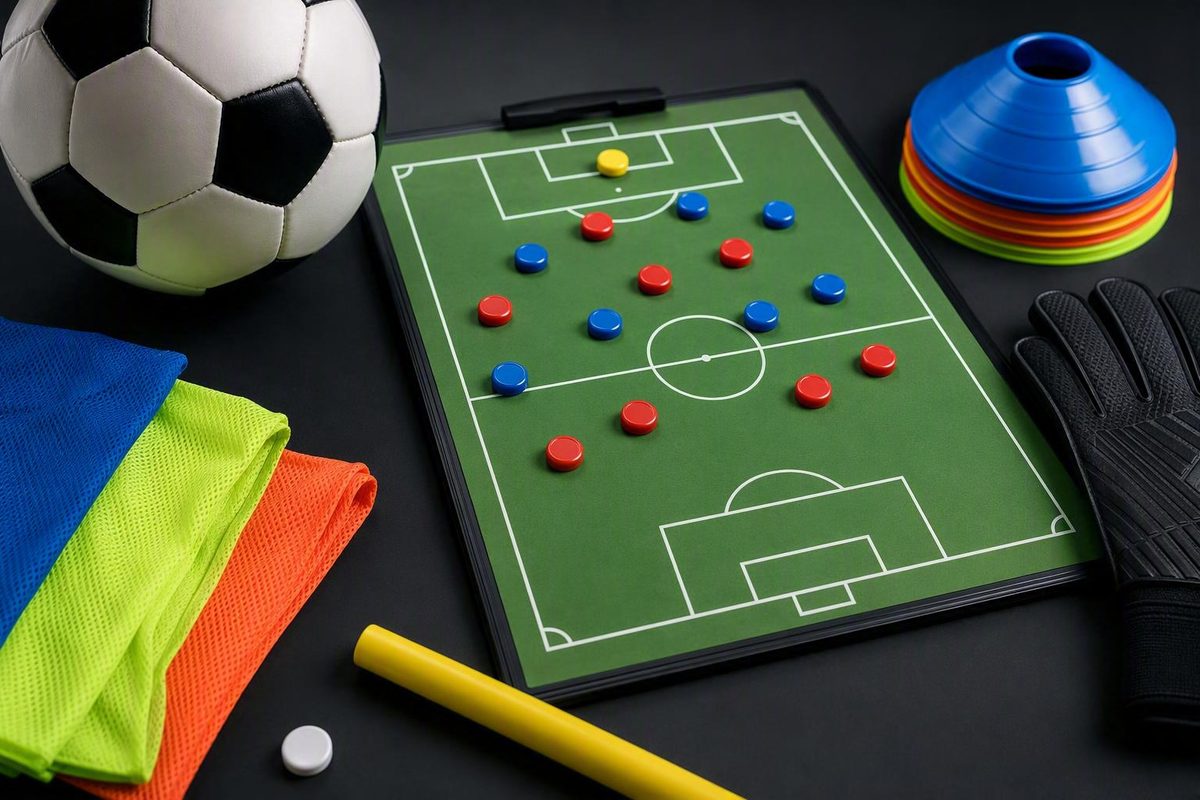
A research-led 20-minute set-piece soccer session covering corners, wide free kicks, throw-ins, defending, transitions and simple tracking.
A set piece is a restart after play stops: a corner, free kick, penalty or throw-in. For training purposes, the useful distinction is not simply “set piece versus open play.” It is a repeatable starting position followed by an unpredictable contest.
That changes the coaching decision. Do not spend the whole block rehearsing unopposed choreography. Give players a simple routine, define each role, then add defenders, second balls and transitions.
What the evidence supports—and what it does not
Set pieces deserve regular training, but scoring percentages should not be treated as universal. In one full season of the Northern Ireland Premiership, 70 goals came from 1,988 analysed corners: 3.5% of corners produced a goal, yet club-level effectiveness varied substantially (Beare and Stone, 2024). That is useful context, not a benchmark for every age or playing level.
The broad research base is also uneven. A 2025 scoping review included 95 studies of adult male professional players; 44% concerned penalties and 20% corners, while only 7% examined free kicks and 2% throw-ins (Sarmento et al., 2025). Coaches should therefore be more confident about the value of rehearsing roles and match context than about any supposedly perfect routine.
For corners specifically, a 21-study systematic review linked higher shot-on-target probabilities with dynamic three- or four-player attacking organizations and indirect deliveries toward the far post. It also noted inconsistent pitch-zone definitions and little analysis of the transition after possession is lost (Plakias, Armatas and Giakas, 2025). The practical lesson is to train movement and delivery together, while always accounting for what happens after the first contact.
The 20-minute set-piece session
Choose one attacking corner, one wide free kick and one defensive corner structure for the session. More routines usually mean fewer meaningful repetitions.
Minutes 0–4: delivery and first-contact warm-up
Split the squad into servers and finishers.
- Servers alternate from the right and left, aiming at a marked target zone.
- Finishers rehearse curved, checked and delayed runs without defenders.
- Add one player outside the penalty area for clearances.
- Use driven passes and clipped deliveries appropriate to the players’ age and ability; do not demand adult-sized aerial service from players who cannot execute it safely.
Score the delivery, not the goal: one point when the ball reaches the intended zone at a playable height and pace. A good run cannot rescue an unreachable cross, and a good cross is wasted if everybody attacks the same space.
Minutes 4–10: attacking corner, opposed
Set up 6 attackers against a goalkeeper and 6 defenders. Give the attackers five jobs:
- Server: delivers to the called zone.
- Primary runner: attacks the intended first contact.
- Space-clearing runner: moves a defender away from that route.
- Second-contact player: reads flicks and loose clearances.
- Rest-defence players: protect against the counterattack.
Begin from the same picture but permit two endings: a direct delivery and a short option. Run three repetitions from each side, then let defenders adjust.
Judge the routine by this chain:
accurate delivery → attacking first contact → shot or controlled second ball → counterattack prevented
Do not call a repetition successful merely because the movement looked synchronized. Conversely, a missed shot can follow an effective routine if the team created a clean first contact in the intended area.
Blocking must remain legal. A player may hold an existing position, but moving into an opponent’s path to obstruct them when the ball is not within playing distance is impeding; holding or impeding with contact brings a direct free kick (IFAB Law 12). Coach separation through timing, changes of direction and legitimate positioning—not grabbing or a moving screen.
Minutes 10–15: wide free kick plus transition
Use the same players and goal, moving the restart to a wide free-kick position. Give the attack two calls:
- First line: a fast delivery between defenders and goalkeeper.
- Second line: a deeper ball for a header or pass back across goal.
After every attempt, the coach immediately serves a second ball either to the goalkeeper to start a counterattack or to an attacking player outside the box for a recycled attack. FIFA’s published France U17 session uses this same principle: attack-versus-defence restarts are followed by a coach-fed ball that creates either a counterattack or a second cross (FIFA Training Centre).
This prevents a common training error: every player watching the first header while the match continues around them.
Minutes 15–19: defend three live corners
Choose one system rather than switching randomly between player-to-player, zonal and hybrid marking. FIFA’s analysis of the 2025 Club World Cup identifies those as the three main structures and reports that 30 of 32 teams stayed with one of the player-marking or zonal systems throughout the tournament (FIFA Training Centre). That elite tournament does not prove one universal best system, but it reinforces the value of role clarity and consistency.
Every defender needs an answer to four questions:
- What space or opponent is mine?
- Who attacks the first ball?
- Who protects the edge of the box?
- Where is our first outlet after the clearance?
Play three consecutive corners without resetting for a lecture. Coach between rounds, not while the ball is live.
Minute 19–20: recall under light pressure
Without a tactics board, ask players to set up the attacking corner and defensive corner from memory. Change one player’s position or remove a usual starter. If the group cannot reorganize, the routine depends on memorizing locations rather than understanding jobs.
Track four outcomes, not just goals
Over several sessions and matches, record:
- deliveries reaching the intended zone;
- attacking or defensive first contacts;
- shots created within the set-piece phase;
- controlled exits or counterattacks conceded.
Use raw counts first. For example: “7 of 12 deliveries reached the target; 4 produced first contact; 2 produced shots.” This is more actionable than celebrating one goal from ten poor deliveries.
Review the numbers by side, server and routine. Change one variable at a time—delivery zone, starting shape or runner—not the entire play. The research suggests that delivery, player numbers and defensive organization all matter, but it does not supply a universal diagram that overrides your players’ kicking range, aerial ability or opposition.
For younger squads, keep the same logic while reducing bodies and aerial contacts: use 4v4 or 5v5, lower driven service, and rehearsed cut-backs. Where heading is restricted, follow the applicable association policy and build the routine around feet rather than adding unnecessary heading exposure. See age-specific heading limits and their evidence before planning youth repetitions.
A useful set-piece block is therefore short and repeatable: one clear plan, opposition, a transition and objective feedback. The routine gives players a shared starting point; the opposed repetitions teach them to solve what happens next.