
Build Your Training Week Around the Match
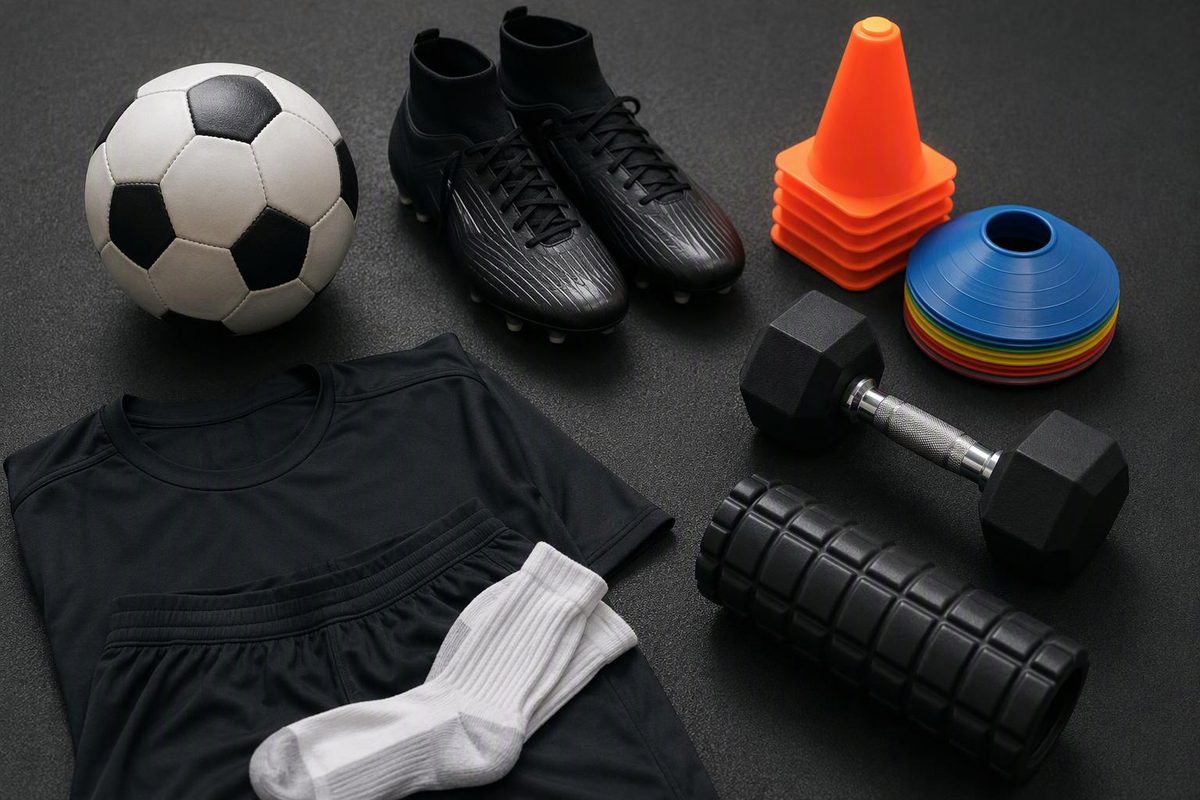
A practical soccer training week for adult recreational players, with strength sets, sprint distances and rules for when to skip extra conditioning.
Build your soccer workout plan around your match and existing team sessions: one main strength session, a short sprint block, and extra conditioning only when team training leaves a gap. Keep easy ball practice in the week, but avoid stacking extra hard work onto already demanding practices.
This template is for healthy adult recreational outfield players already training regularly, with a Saturday match and Tuesday and Thursday team practices. Move the days to suit your fixture. It is a coaching template informed by research, not a weekly programme tested as a complete package. Returning from injury or a long layoff requires an individually assessed progression.
Select your recovery status and what team practice already includes; use the result to choose your extra work.
Choose Your Extra Training
Main-Day Decision
Candidate: short sprints + strength; no extra conditioning.
- Sprints
- After warming up: 2 × 10 m, then 2 × 20 m; rest 90–120 seconds between efforts.
- Strength
- Use the main strength session below; shorten or move it if practice is exceptionally demanding.
- Conditioning
- Skip extra running. Team sessions already cover this work.
This is a candidate plan, not clearance to train hard. For a two-match week, remove extra conditioning and reassess strength with your coach.
Source: the article’s coaching template and cited research. Starter doses are practical prescriptions, not a tested combined programme.
A Weekly Schedule Built Around Saturday’s Match
| Day | Training Decision | Practical Dose |
|---|---|---|
| Sunday | Rest or comfortable movement | Optional 15–25-minute walk or easy cycle; no fitness targets |
| Monday | Light ball work, if comfortable | 15–25 minutes of passing, receiving and dribbling; avoid repeated hard cuts |
| Tuesday | Main physical training day | Warm-up → short sprints → team practice; strength afterward or separately. Intervals replace a conditioning block rather than adding another hard block |
| Wednesday | Rest or light technical work | Optional 15–20 minutes; keep it easy |
| Thursday | Team practice; no extra fitness workout | Agree on lighter technical and tactical work where possible, rather than exhausting extra running |
| Friday | Rest or brief match preparation | Optional 10–15 minutes of easy touches; no exhausting workout |
| Saturday | Match | Progressive match warm-up; no extra conditioning for players completing substantial minutes |
Tuesday is a candidate for the main workout, not automatic clearance to train hard. A review focused on professional and semi-professional men describes recovery of different physical measures taking roughly 48–96 hours after training or competition. That is not a universal countdown: match minutes, soreness and individual response should influence your decision. Recovery review
If Tuesday practice is exceptionally demanding, shorten the strength session or arrange a different slot with your coach. The schedule is not an instruction to complete sprints, a hard practice, intervals and a full gym workout on the same day.
Warm Up Before a Short Acceleration Block
For squad training, use the complete FIFA 11+, starting at level 1 when learning it and progressing once the exercises can be performed correctly. Its approximately 20-minute structure combines running, strength, balance and jumping, then faster running and cutting.
The manual recommends regular use at least twice weekly. Before matches, it recommends the running sections, parts 1 and 3, rather than the full programme. Have a coach supervise technique. FIFA 11+ manual
After warming up, use this low-volume acceleration block:
- 2 × 10 metres, then 2 × 20 metres.
- Run fast with controlled technique; build toward maximal efforts only if you are accustomed to sprinting.
- Rest 90–120 seconds between repetitions, extending the rest until you feel ready for another quality effort.
- Leave clear space beyond the finish to slow down gradually.
- Stop if you develop pain or your running mechanics deteriorate.
These distances and rests are starter prescriptions, not a proven optimum. The purpose is a few high-quality accelerations before fatigue—not another conditioning circuit. If team practice already contains a comparable sprint block, do not duplicate it.
The Main Strength Session Takes About 40 Minutes
After a gym-specific warm-up and lighter practice sets, complete:
| Exercise | Starting Dose | Alternative |
|---|---|---|
| Goblet squat | 2 × 6–8 | Bodyweight or loaded backpack squat |
| Dumbbell Romanian deadlift | 2 × 6–8 | Glute bridge, 2 × 10–12 |
| Reverse lunge | 2 × 6 each leg | Supported split squat |
| Push-up | 2 × 6–12 | Hands elevated on a stable bench |
| Dumbbell or band row | 2 × 8–12 | Supported single-arm dumbbell row |
| Calf raise | 2 × 10–15 | Supported bodyweight calf raise |
| Side plank | 2 × 20–30 seconds each side | Bent-knee side plank |
Rest about two minutes between lower-body strength sets and 60–90 seconds for the other exercises. Choose loads that leave approximately two good repetitions in reserve. Do not turn the session into a race or lift to failure.
If a movement is unfamiliar, learn it with a qualified coach before increasing the load. Use stable supports and secure any resistance-band anchor.
A review of highly trained soccer players aged 17 and older reported that two weekly strength sessions could develop strength and power in preseason, while one could help maintain gains in season. The maintenance evidence included high-intensity lifting—not simply any weekly gym visit. It supports the frequency used here, but does not establish that this lighter starter menu will maintain every player’s existing strength. Strength-training review
For a training week without a match, a second strength session can occupy the later-week slot. See the two-day soccer strength plan for a fuller progression. Do not add unfamiliar, soreness-producing exercises just before competition.
Add Conditioning Only When Team Training Leaves a Gap
If team sessions already provide demanding games or interval work, skip extra running. If they are mostly low-intensity tactical practice, agree on a replacement conditioning block for the main physical day:
| Component | Starter Prescription |
|---|---|
| Work intervals | 3 × 4 minutes of hard, controlled running |
| Recovery | 3 minutes of easy jogging between efforts |
| Effort | About 7–8 out of 10; hard breathing at a sustainable pace |
| Progression | 4 × 4 minutes once the starter dose does not compromise the next session |
Use a flat loop or long straight sections rather than repeated tight turns. Warm up first and finish with a few minutes of easy movement. If Tuesday cannot accommodate the block, do not automatically squeeze it into Thursday, two days before the match. Skip it or rearrange the week with your coach.
The four-by-four structure comes from a small trial of 19 elite junior male players. The nine-player training group performed four-minute intervals at 90–95% of maximal heart rate, with three-minute jog recoveries, twice weekly for eight weeks. Their average maximal oxygen uptake rose from 58.1 to 64.3 mL/kg/min. Strength, speed and measured passing quality did not improve. Original trial
The reduced dose and effort cue here are practical adaptations, not an exact reproduction of that trial or an equivalent heart-rate prescription. Do not expect its results from one weekly session. For alternative formats, use the soccer interval-training guide.
Progress One Variable Without Compromising Team Training
For the first two weeks, keep the doses steady. Then change one variable at a time: a small strength-load increase, one additional sprint, or the fourth interval—not all three together.
Record session duration, overall effort out of 10, next-day soreness and whether normal team training still feels manageable. Persistent fatigue means reduce or remove the optional work first. Pain, limping or altered movement means stop the aggravating exercise and seek assessment from a qualified clinician. This plan does not replace a coach or physiotherapist who can assess you directly.
Use easy ball sessions for a specific task, such as receiving across your body and passing to a target, rather than collecting touches without feedback. Include opponent pressure in team practice; solo work does not replace decisions against defenders. The first-touch practice progression offers a focused starting point.
In a two-match week, remove the extra conditioning and reassess strength volume with your coach. Match readiness takes priority over completing the template.