
Drills for Shooting in Football: From Clean Contact to Match Pressure
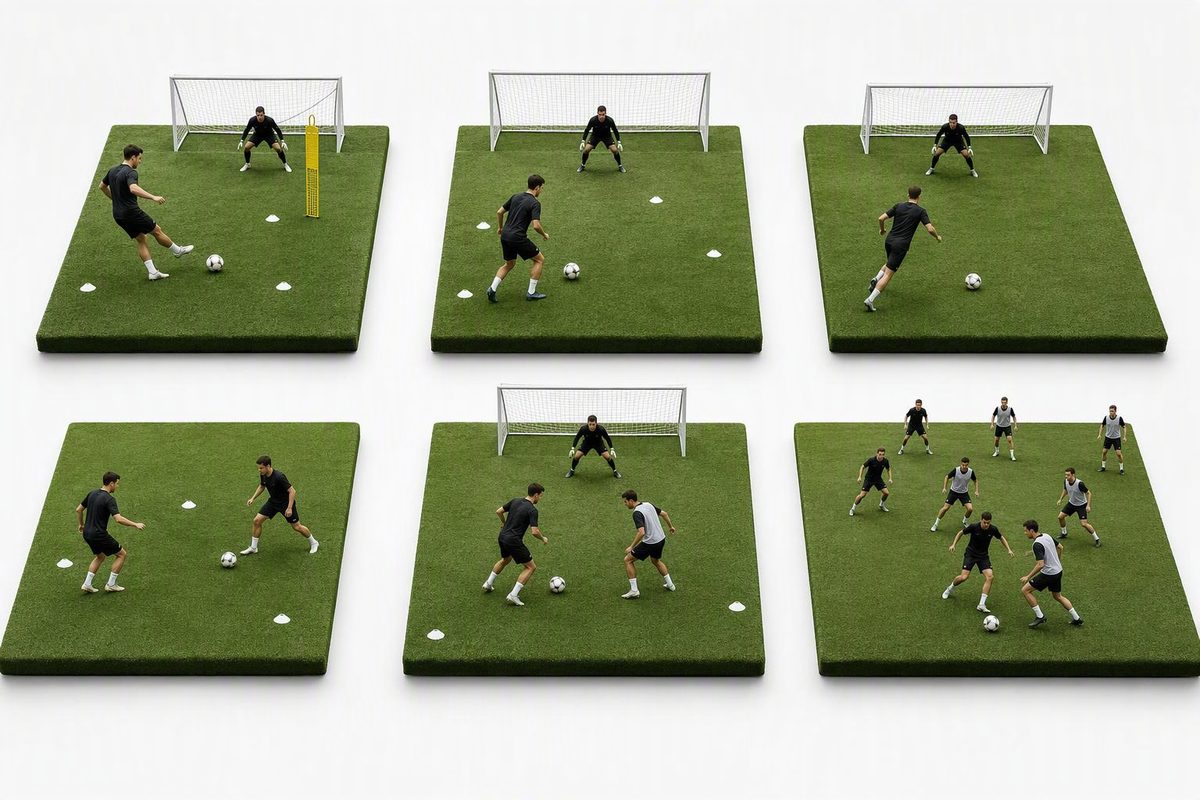
Six football shooting drills progressing from accurate contact to first-time finishes, receiving, 1v1 pressure and a conditioned game.
A useful shooting session should not consist of 30 identical strikes from a stationary ball. Start with a simple accuracy task, then add a moving pass, a first touch, a defender, a goalkeeper and a decision.
That balance fits the available skill-learning evidence. A systematic review covering 35 soccer studies found support for practice that encourages players to explore solutions in representative situations. Repetition-based practice also improved technical outcomes, although its effect on match performance was largely unexplored. The evidence was of moderate overall quality and varied substantially between studies, so the practical decision is to combine clean repetitions with game-like finishing rather than declare one method universally superior (systematic review).
A 30-minute shooting session
| Drill | Time | Main demand |
|---|---|---|
| 1. Two-gate placement | 4 minutes | Accuracy and clean contact |
| 2. Receive, set and finish | 5 minutes | First touch into the shot |
| 3. First-time finishing | 5 minutes | Timing and body shape |
| 4. Turn and shoot | 5 minutes | Receiving under pressure |
| 5. Live 1v1 to goal | 5 minutes | Creating a shooting lane |
| 6. Conditioned 3v3 | 6 minutes | Selecting and executing the shot |
Adjust distances to the players’ age, ability and available goal size. Complete a progressive warm-up before starting; this soccer warm-up routine builds from movement preparation to accelerations and changes of direction.
1. Two-gate placement
Set-up: Mark a target gate near each bottom corner of the goal. A width of about 2m suits a full-size goal, but smaller goals need narrower targets. Players shoot from 10–16m after rolling the ball a short distance in front of themselves. Use two starting lines if space and staffing allow.
Task: Score one point for sending the ball through either gate. Give each player six shots with the dominant foot and four with the non-dominant foot. Retrieve balls only when the shooting area is clear.
Coach: Let players use a natural run-up. Direct attention to the target and quality of contact rather than demanding maximum force. A biomechanics review reported that accurate kicks generally involved slower kicking movements and ball speeds than maximum-power kicks; maximum speed alone does not produce a successful shot (Kellis and Katis, 2007).
Avoid prescribing one “correct” approach angle to everyone. In a preliminary study, seven male recreational players took penalties using self-selected, 30°, 45° and 60° approaches. Changing the angle did not significantly improve accuracy or ball velocity, although it altered parts of the kicking movement (Scurr and Hall, 2009). That small penalty study does not establish an ideal run-up for open play, but it offers no reason to replace a comfortable approach with a universal angle.
Adjust: Alternate corners on the coach’s call. Make the task easier by moving closer or widening the gates.
2. Receive, set and finish
Set-up: A server stands 8–12m from the shooter and passes diagonally into a central shooting area. Add a goalkeeper when one is available.
Task: The shooter moves toward the pass, takes the first touch toward goal and finishes with the second or third touch. Rotate the shooter, server and goalkeeper regularly.
Coach: Judge the first touch by whether it improves the next action, not whether every repetition looks identical. A firm pass may require a softer touch; a slower pass may need to be pushed farther into the shooting line. Encourage the player to scan before receiving and finish into the space the goalkeeper leaves.
Adjust: Serve from alternating sides or vary the pass speed. Add a recovering defender who starts two steps behind the shooter.
3. First-time finishing
Set-up: Put one server on each side of the penalty area. The shooter starts centrally, checks away from goal and then attacks a pass delivered along the ground.
Task: Finish first time, alternating deliveries from the left and right. At first, the pass should arrive just ahead of the player rather than directly under their feet.
Coach: Prioritize arrival timing, balance and clean contact. The player does not need to strike every ball with the laces: the inside of the foot may suit a placed finish. Keep the service realistic but achievable; consistently poor passing turns a finishing drill into a retrieval drill.
Adjust: Mix cut-backs, square passes and slightly pulled-back deliveries without announcing the exact service. Allow two touches when the pass makes a first-time shot unsuitable—recognizing that situation is part of finishing.
4. Turn and shoot
Set-up: A forward starts with their back to goal, 14–20m out. A server passes into their feet. Begin with a passive defender about an arm’s length behind.
Task: The attacker receives, turns to either side and shoots within three touches. The defender initially supplies realistic presence without tackling, then becomes fully active.
Coach: Ask the attacker to check a shoulder before the ball arrives, protect the receiving line and use the first touch to escape pressure. Do not require the same turn repeatedly: the defender’s position should shape the solution.
Adjust: Let the defender begin tight to one shoulder, then choose either side. Award the defender a point for forcing the attacker away from goal, even without winning the ball.
5. Live 1v1 to goal
Set-up: Use a channel about 20m long leading to goal and wide enough for the attacker to go either side. A server passes to an attacker as a defender enters from the side or from a recovery position.
Task: The attacker tries to create enough separation to shoot. The defender and goalkeeper play normally. End the repetition after a shot, save, tackle or the ball leaving the area.
Coach: Reward a useful change of speed, feint or first touch across the defender—not extra dribbles for their own sake. The FIFA Training Centre uses an opposed finishing exercise to connect receiving on the move, beating a defender and shooting under pressure. Its design deliberately combines the pass, attacking movement and defender pressure rather than using a static start (FIFA Training Centre).
Adjust: Start the defender farther away to give the attacker more time, then reduce that advantage. Rotate roles so every player attacks and defends.
6. Conditioned 3v3
Set-up: Play 3v3 plus goalkeepers in an area of roughly 30m by 20m. Use full-size, youth-size or mini-goals appropriate to the group and space.
Task: Play normal football with one condition: a goal counts double when the shot follows a forward pass, a turn or a regain. Restart quickly from the goalkeeper.
Coach: Watch whether players recognize a genuine shooting opportunity. Do not praise a forced, low-probability attempt simply because this is a shooting session. Teammates without the ball should provide width, runs and passing angles that help create a better finish.
Change the bonus condition if it begins to distort play. For example, reward finishes after a cut-back when the session’s tactical aim is creating from wide areas.
What to measure
Use outcomes that can be recorded without repeatedly stopping the session:
- Shots on target: on-target attempts divided by total attempts.
- Goals per 10 shots: useful within the same drill, but influenced by goalkeeper level and shot difficulty.
- Shots after an effective first touch: count whether the touch creates a clear striking action.
- Non-dominant-foot attempts: record appropriate opportunities taken, not only goals.
- Time to shoot in opposed drills: estimate with a count or review video rather than interrupting each repetition.
Compare players with their own previous results under similar conditions. An unopposed target score is a measure of that task, not proof that finishing has transferred to matches. The later drills add the information and pressure that the isolated task removes.
For more variations covering power, placement and overloads, use this broader collection of soccer shooting drills. Stop or modify an activity if fatigue causes a clear loss of movement quality. Individual pain, injury and return-to-play decisions belong with an appropriately qualified coach or physiotherapist.