
The Pitches Felt Hard. The Injury Data Doesn't Exist Yet.
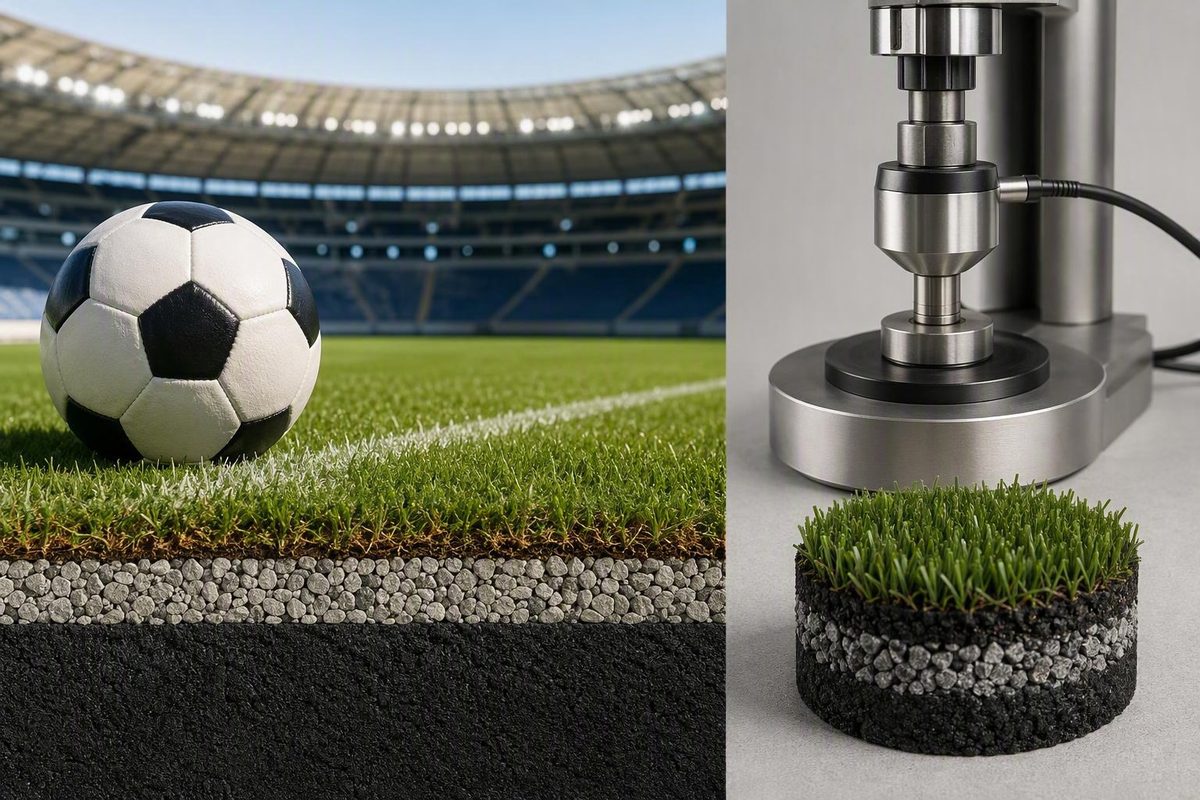
MetLife's grass-over-asphalt pitch drew complaints from Rabiot and Deschamps, but no exposure-adjusted injury data exists. What Gmax hardness research shows.
No available evidence shows that the hybrid pitches at the 2026 World Cup increased injuries. Players at MetLife Stadium said the grass-over-asphalt surface felt hard and rigid, a biomechanist explained why that could raise loading on high-speed cuts, and a June 2026 field study measured harder surfaces producing higher lower-limb impact. None of that is an injury count. Settling the question needs medically confirmed injuries per player-minute at each venue, matched to same-day hardness readings, and neither FIFA nor anyone else has published that.
Four Levels of Evidence, and Where the Tournament Stops
Separate the claim into what each kind of evidence can carry.
- Player perception: the surface felt hard, slippery, unusually grippy or bouncy.
- Pitch measurement: hardness, shock absorption, deformation and rotational resistance, with numbers.
- Biomechanical response: measured changes in impact or movement while players use the pitch.
- Injury incidence: medically confirmed injuries per player-minute or athlete-exposure.
The tournament produced level one. Researchers offered plausible level-three mechanisms, but no tournament-specific measurements from players on those surfaces. Venue-level pitch readings and exposure-adjusted injury counts were not published.
FIFA said the pitches remained suitable for playability and player safety despite criticism of individual venues. That is an organisational assessment, not an independently checkable result, because the underlying measurements were not released (Reuters-sourced reporting on FIFA’s assessment and player feedback).
So the honest conclusion sits between the headlines. No injury increase has been demonstrated. That does not prove every venue behaved the same, or that surface-related risk was zero.
Pick two surfaces; the comparison line and highlighted rows update below.
Surface Hardness and Impact Comparator
Synthetic turf, higher-usage field measured 69.7 Gmax against 46.8 for natural turfgrass, lower-usage field: 22.9 points harder (+49%). Average lower-limb impact: 20.7g vs 17.8g (+2.9g). Impact values are surface-type averages, not per-field readings.
| Surface | Gmax | Impact | Hardness |
|---|---|---|---|
| Natural, lower use | 46.8 | 17.8g | |
| Natural, higher use | 49.8 | 17.8g | |
| Hybrid over asphalt | — | — | not measured |
| Synthetic, lower use | 61.3 | 20.7g | |
| Synthetic, higher use | 69.7 | 20.7g |
Source: June 2026 field study of natural turfgrass vs synthetic turf during matched drills (PMC13333742). Gmax per field; impact is the surface-type average. Hybrid grass over asphalt was not tested and FIFA has published no venue readings, so its row is blank.
What the Gmax Study Measured, and What It Left Out
The best available numbers come from a study comparing natural turfgrass with synthetic turf during matched drills. Gmax is a field-hardness measure: a weight is dropped onto the surface and the peak deceleration recorded, so a higher value means a harder surface response. Natural turfgrass fields read 46.8 to 49.8 Gmax; synthetic turf fields read 61.3 to 69.7. Average lower-limb impact intensity during the drills was 17.8g on natural turfgrass and 20.7g on synthetic turf (the field-hardness and mechanical-loading study).
Those figures show that measured hardness differences travel with measured loading differences during the same activity. They are not safety thresholds, and they are not World Cup readings. The study did not test reinforced natural grass over asphalt, and it did not record injuries. The hybrid row in the tool above is blank for that reason: there is no published number to put there.
What a Hybrid Pitch Is
The World Cup was not played on artificial turf. A hybrid pitch is living natural grass reinforced with synthetic fibres or a synthetic backing. FIFA treats it as a third category alongside 100% natural grass and 100% synthetic turf, and describes stitched-fibre, reinforced-rootzone and carpet-type systems (FIFA’s turf and pitch design guidance).
From the top down, a hybrid pitch has living grass at the surface, synthetic reinforcement holding the grass and root system, a designed rootzone for growth and water, drainage and irrigation, and finally the stadium’s structural base. That base is the layer the label hides. Two fields both called “hybrid” can differ in rootzone depth, drainage, foundation and installation date, and each of those changes hardness, moisture, traction and deformation.
A permanent hybrid pitch grown into a deep soil profile is not the same system as temporary sod laid weeks earlier over infrastructure built for artificial turf. Artificial-turf research cannot be dropped onto either, because player-surface interaction depends on the whole construction, not on whether plastic fibres are present.
Why MetLife’s Base Matters More Than Its Fibres
MetLife Stadium drew the sharpest criticism. France midfielder Adrien Rabiot said it played more like an artificial surface, hard and rigid. Coach Didier Deschamps reported an unusual bounce and described the subsurface as cement-like. Secondary reporting described the temporary pitch as hybrid bermudagrass installed over an asphalt-supported base (reporting on the MetLife complaints and construction).
These are firsthand perceptions, not instrument readings. They give no Gmax value, no shock-absorption figure and no injury outcome. They also do not show that the synthetic reinforcement caused the feel; the asphalt base, a shallow rootzone, moisture or the installation timeline could each explain it.
Biomechanics researcher Mike Hahn proposed the mechanism: small increases in compressive stiffness lead players to stiffen their legs in response, which raises mechanical strain. He also warned that a surface failing under a high-speed cut could do so suddenly (reporting on Hahn’s proposed mechanism).
Hahn’s warning is conditional. It describes what would happen if the surface gave way under a cut. It is not evidence that a failure occurred, that a player was hurt by one, or that failures were more common at MetLife than elsewhere. The construction details also come from press reports rather than published specifications or an independent inspection. MetLife is a focused case for investigation, not a demonstrated hazard.
How Hardness, Traction and Consistency Change Loading
A pitch does not need to be artificial to change how a player moves.
Hardness and shock absorption describe how much the surface gives under load and how it handles impact. A surface with less give returns more of the impact to the player, shifting what muscles, tendons and joints absorb during running, landing and braking.
Rotational traction is how strongly the boot resists twisting against the ground. Too little and the foot slips. Too much and the foot stays planted while the body rotates above it, which loads the knee during a cut. Studs are part of this interaction: a change of boot can raise or lower traction, so footwear is not a simple safety fix.
Consistency matters as much as the average. A uniformly firm pitch is a different problem from one with soft patches, loose seams, variable moisture or divots, because a player plants expecting the response from one stride earlier. These are plausible mechanisms with measurement behind them, not proof of injury (a sports-science synthesis of hardness, traction and footwear effects).
All of these properties move. Moisture, weather, mowing, repair, match count and even the zone of the pitch change them within a week.
What Artificial-Turf Injury Studies Can and Cannot Transfer
Artificial-turf research does not show that hybrid grass raises ACL risk. The systems differ, and the artificial-versus-natural literature itself is mixed across sex, age, level and setting.
| Source | Main finding | Why it does not settle the World Cup question |
|---|---|---|
| Conference-poster meta-analysis, artificial vs natural | Across seven soccer studies, game ACL incidence rate ratio for female players was 1.18 (95% CI 1.05–1.31); not significant for males, games overall, training or the pooled population. | No hybrid grass, no World Cup venues; poster format limits methodological detail. |
| High-school surveillance study, artificial vs natural | ACL injuries were a larger share of injuries on artificial turf in several football and soccer comparisons; not every comparison was significant. | No surface-specific exposure data, so it reports proportions, not rates; adolescents, not professional adults. |
| Biomechanical research | Different stiffness or traction alters grip, impact and lower-limb loading. | A loading difference is not a confirmed injury outcome. |
| Player reports from 2026 venues | Some surfaces felt hard or bounced differently. | Perception is not exposure-adjusted injury evidence. |
The female-player estimate deserves attention, but it comes from a poster abstract built on seven studies, with subgroup conclusions drawn from fewer. It is a reason to keep studying artificial turf, not a risk figure that transfers to reinforced natural grass over asphalt.
The high-school study’s limitation is different. Without surface-specific athlete-exposure data, it could only compare the proportion of injuries that were ACL cases on each surface. A proportion among recorded injuries is not injuries per minute played.
Read significance carefully in both directions. A nonsignificant result does not prove two surfaces carry equal risk; the estimate may just be imprecise. A significant association does not prove the surface caused the injuries when footwear, maintenance, weather and match demands differ alongside it.
Why Vancouver’s Feedback Blocks a Tournament-Wide Verdict
Australia midfielder Aiden O’Neill said the ball moved well in Vancouver and the surface was not too hard. That does not prove Vancouver was safer, any more than Rabiot’s complaint proves MetLife was unsafe. Together they show perceptions varied by venue (Reuters-sourced reporting on the contrasting feedback).
Warm-season venues used bermudagrass; colder venues used Kentucky bluegrass and perennial ryegrass mixtures. Covered stadiums had to keep living grass alive with limited sunlight, and some laid it over infrastructure normally carrying artificial turf.
FIFA’s pitch programme aimed for comparable playing characteristics across all 16 stadiums, assessing ball bounce and pace and whether players slipped, fell or completed movements on their feet. Its public account does not include venue-by-venue results collected under matched conditions (FIFA’s account of its World Cup pitch programme).
Without those readings nobody can say how closely the venues matched or how they drifted over five weeks. The right unit of analysis is 16 separate pitch systems, each with its own grass, reinforcement, rootzone, base, climate, roof and maintenance history, not “World Cup hybrid grass” as one product.
The Data FIFA Would Need to Publish
A defensible answer starts with the denominator. Raw injury totals are useless because venues hosted different numbers of matches and players logged different minutes. The measure is medically confirmed injuries per player-minute or athlete-exposure at each stadium.
Injuries then need classifying. Contact injuries separate from noncontact lower-limb injuries. Medical and video review records whether the incident involved a cut, a slip, apparent excessive grip, a hard landing, visible surface failure or a collision unrelated to the ground.
Each incident pairs with same-day pitch data: hardness and shock absorption, vertical deformation, rotational resistance, surface and rootzone moisture, weather, visible seams or divoting, and readings taken before and after the match. The analysis also has to control for footwear, prior familiarity with the surface, recent workload and how many earlier matches that pitch had absorbed.
| Signal | What it establishes | Next data needed |
|---|---|---|
| Player complaints | A surface felt or behaved unusually | Instrument testing, structured feedback |
| Pitch measurements | Hardness or traction at one moment | Thresholds, repeat tests, incident matching |
| Biomechanical loading | A plausible or measured change in impact | Exposure and medical surveillance |
| Injury surveillance | Confirmed injury counts and types | Venue comparison tied to pitch readings |
FIFA could shorten this considerably by publishing its acceptance thresholds, each venue’s test results, maintenance interventions and before-and-after-match readings. That would let independent researchers compare the suitability verdict against the conditions players actually met.
What to Ask Before Converting an Academy Field to Hybrid
The MetLife episode is a useful checklist for any club weighing a hybrid conversion, because the complaints pointed at the base, not the grass.
Ask the contractor what sits under the rootzone and how deep the rootzone is. Sod over a rigid engineered base and grass grown into a deep soil profile are different products with the same name. Ask for the target Gmax or shock-absorption value and how it will be tested after installation, then again after a season of use; the natural turfgrass fields in the study above ran 46.8 to 49.8, which gives you a reference range for a well-maintained grass field. Ask how rotational resistance will be checked, because a reinforced surface that grips more than players expect changes cutting loads even if hardness is fine.
Then treat surface feedback from players as a signal to measure, not a diagnosis. Inspect the field, let players test braking and cutting during preparation, and review boot choice with staff qualified to assess the player and the conditions. Do not turn “this feels hard” into an injury-risk percentage.
Soccer Science disclaimer: Training and match play carry injury risk. This article does not replace assessment by a qualified coach or physiotherapist who can evaluate a player directly.
Is Hybrid Grass the Same as Artificial Turf?
No. Hybrid grass is living natural grass reinforced with synthetic fibres or backing; artificial turf is fully manufactured. Their construction and player-surface interaction differ, so artificial-turf findings do not automatically apply.
Did the MetLife Pitch Cause Any Documented World Cup Injuries?
No source cited here links a World Cup injury to the MetLife pitch. Players described it as hard and unusual, and Hahn described a plausible mechanism, but no medically confirmed, surface-attributed injury was reported.
Does a Harder Pitch Automatically Mean More Injuries?
No. Less give changes impact loading, which makes hardness worth measuring, but outcomes also depend on traction, consistency, footwear, movement, workload and the player. Hardness alone cannot establish injury incidence.
The concerns about hard temporary pitches, and MetLife’s reported asphalt base in particular, are plausible and worth investigating. What would move the question forward is not another argument about whether the grass looked artificial; it is venue-level pitch measurements paired with exposure-adjusted, medically verified injury data.